ICT Market Maker Model: How Institutions Engineer Price Delivery
How the ICT Market Maker Buy and Sell Models work — the five-stage framework institutions use to accumulate, manipulate, and deliver price.

Most ICT concepts explain individual pieces of the puzzle - fair value gaps, order blocks, breaks of structure. The Market Maker Model puts all those pieces together into a complete narrative of how price moves from one liquidity pool to another.
It answers the question every trader asks: Why did price do that? Not after the fact, but in real time - by understanding the sequence institutions follow to engineer and deliver price.
What Is the Market Maker Model?
The Market Maker Model (MMM) describes the full lifecycle of an institutional price delivery from start to finish. It explains how market makers (large institutions, banks, algorithms) move price through five distinct stages to:
- Accumulate positions at favorable prices
- Generate the liquidity needed to fill their orders
- Deliver price to their target level
- Distribute positions at profitable prices
There are two variations:
- Market Maker Buy Model (MMBM) - The bullish version. Institutions want to buy, so they engineer price lower first to accumulate at a discount before delivering price higher.
- Market Maker Sell Model (MMSM) - The bearish version. Institutions want to sell, so they engineer price higher first to distribute at a premium before delivering price lower.
The models are mirror images. Once you understand one, you understand both.
What Are the Five Market Maker Model Stages?
Stage 1: Original Consolidation
What happens: Price ranges in a tight consolidation. Volume is low, volatility is compressed, and the market appears to be going nowhere. This is the accumulation phase - institutions are quietly building their initial positions within the range.
What it looks like:
- Tight price range with defined highs and lows
- Small-bodied candles, often with overlapping wicks
- Low volume relative to recent history
- Retail traders get bored or chopped up trading the range
What to do: Mark the consolidation range. The high and low of this range become the first liquidity targets. Don't trade inside this range - wait for the model to develop.
Stage 2: Smart Money Reversal (Manipulation)
What happens: Price breaks out of the consolidation in the opposite direction of the intended move. This is the manipulation - the engineered move that generates the liquidity institutions need.
In the MMBM (bullish model):
- Price breaks below the consolidation range
- This triggers sell stops from traders who were long within the range
- It also lures breakout sellers who see a "bearish breakout"
- Institutions absorb all this sell-side liquidity to fill their buy orders at discount prices
In the MMSM (bearish model):
- Price breaks above the consolidation range
- This triggers buy stops from shorts and attracts breakout buyers
- Institutions absorb the buy-side liquidity to fill their sell orders at premium prices
What it looks like:
- A sharp move beyond the consolidation high/low
- Liquidity sweep of obvious stops
- Often occurs during a kill zone (London open is common)
- The move may look convincing - that's the point
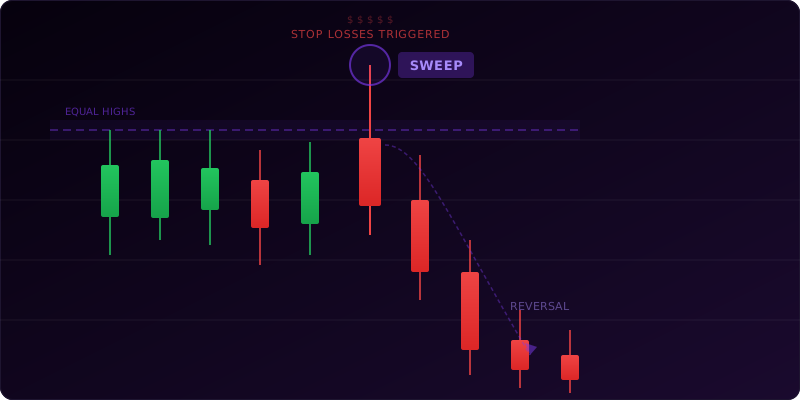
What to do: Recognize this as the manipulation, not a genuine breakout. Do not trade it. Watch for signs that the sweep is complete - rejection wicks, volume shift, or a quick reversal back into the range.
Stage 3: Smart Money Accumulation/Distribution
What happens: After the manipulation sweep, price reverses and begins the re-accumulation (MMBM) or distribution (MMSM) phase. Institutions have filled their orders during the liquidity sweep and are now positioning for the main move.
What it looks like:
- Price reverses from the manipulation extreme
- A change of character occurs - the first structural break against the manipulation direction
- Fair value gaps form on the reversal, indicating displacement
- An order block forms at the reversal point - this is the institutional entry zone
What to do: This is where you start looking for entries. The CHoCH confirms the manipulation is over. The FVGs and order blocks provide specific entry zones.
Stage 4: Re-Distribution/Re-Accumulation (The Trend)
What happens: Price moves aggressively in the intended direction. This is the delivery phase - the main trend where institutions are actively driving price toward their target.
What it looks like:
- Strong displacement candles creating multiple FVGs
- Clear market structure - higher highs and higher lows (MMBM) or lower lows and lower highs (MMSM)
- Breaks of structure confirming the trend at each structural level
- Pullbacks are shallow and find support/resistance at FVGs and order blocks from earlier stages
What to do: Trade with the trend. Enter on pullbacks to FVGs and order blocks. Add to your position at structural retests. Trail your stop loss behind each new structural swing point.
During this phase, price may pause and form mini-consolidations before continuing. These are continuation patterns within the larger model - not new Stage 1 consolidations. The difference is context: they occur within an established trend, not at the beginning of one.
Stage 5: Reversal/Completion
What happens: Price reaches the target - the opposing liquidity pool. The model completes as institutions take profit and the move exhausts itself.
In the MMBM:
- Price reaches the buy-side liquidity target (previous highs, equal highs, a major resistance level)
- The target was predetermined by the nearest significant pool of buy-side liquidity
- Institutions begin distributing their long positions into the buy orders at the high
In the MMSM:
- Price reaches the sell-side liquidity target (previous lows, equal lows, major support level)
- Institutions begin covering their short positions into the sell orders at the low
What it looks like:
- Price reaches a significant structural level
- Momentum decreases (smaller candles, more wicks)
- A potential CHoCH against the trend forms
- A new consolidation may begin - potentially the Stage 1 of the next Market Maker Model
What to do: Take profit or tighten stops significantly. The model is completing. A new model may begin in either direction.
What Is the Market Maker Buy Model Summary?
| Stage | Name | Price Action | Institutional Activity |
|---|---|---|---|
| 1 | Original Consolidation | Tight range, low volatility | Quietly accumulating initial positions |
| 2 | Smart Money Reversal | Breaks below range (sweep) | Absorbing sell-side liquidity to fill buys |
| 3 | Accumulation | CHoCH, FVGs form on reversal | Positioning for the upside delivery |
| 4 | Re-Accumulation | Strong uptrend with pullbacks | Delivering price toward buy-side liquidity |
| 5 | Completion | Reaches target, momentum fades | Distributing longs into buy-side liquidity |
What Is the Market Maker Sell Model Summary?
| Stage | Name | Price Action | Institutional Activity |
|---|---|---|---|
| 1 | Original Consolidation | Tight range, low volatility | Quietly distributing initial positions |
| 2 | Smart Money Reversal | Breaks above range (sweep) | Absorbing buy-side liquidity to fill sells |
| 3 | Distribution | CHoCH, FVGs form on reversal | Positioning for the downside delivery |
| 4 | Re-Distribution | Strong downtrend with pullbacks | Delivering price toward sell-side liquidity |
| 5 | Completion | Reaches target, momentum fades | Covering shorts into sell-side liquidity |
How Do You Trade the Market Maker Model?
Entry Zone: Stage 3
The best entry point is during Stage 3 - after the manipulation is complete and the reversal begins:
- Wait for the Stage 2 manipulation sweep to complete
- Identify the CHoCH that confirms the reversal
- Mark the FVG and/or order block formed during the reversal
- Enter when price retests the FVG or order block
- Stop loss below the Stage 2 manipulation low (MMBM) or above the manipulation high (MMSM)
- Target the opposing liquidity pool (the Stage 5 completion level)
This gives you the full Stage 4 trend as your profit potential, with a tight stop at the manipulation extreme.
Adding Positions: Stage 4
During the trending phase, you can add to your position at structural pullbacks:
- FVGs created during the Stage 4 displacement
- Order blocks at each new structural level
- Each new break of structure confirms the model is still active
Use the position size calculator to keep each addition within your risk parameters.
Exit: Stage 5
Take profit when price approaches the identified liquidity target. Signs the model is completing:
- Price reaches the target level (previous highs/lows, equal highs/lows)
- Momentum slows visibly (candle bodies shrink, wicks increase)
- A lower timeframe CHoCH against your trade direction appears
- The next kill zone shows no continuation
GrandAlgo
See these concepts automated on your charts
18 TradingView indicators — smart money, price action, supply/demand, and more.
How Do You Identify the Liquidity Target?
The target of the Market Maker Model is typically the nearest significant liquidity pool in the direction of the intended move.
For a MMBM (bullish), the target is buy-side liquidity:
- Previous swing highs
- Equal highs (obvious double tops)
- Previous session highs (London high, Asian high)
- Previous day/week high
For a MMSM (bearish), the target is sell-side liquidity:
- Previous swing lows
- Equal lows (obvious double bottoms)
- Previous session lows
- Previous day/week low
The liquidity pool is determined before the move begins by analyzing the chart for obvious levels where stops are likely resting. This is what gives the model its predictive power - you have a probable destination before the journey starts.
How Does MMM Work on Different Timeframes?
The Market Maker Model is fractal - it appears on every timeframe:
Weekly/Daily: The macro model. Stage 1 might last days, the manipulation targets weekly highs/lows, and Stage 4 delivers over multiple days. Best for swing traders.
4H/1H: The session model. The model often completes within a single trading day. Stage 1 during Asian session, Stage 2 during London, Stages 3-4 during New York. This is the most commonly traded MMM timeframe.
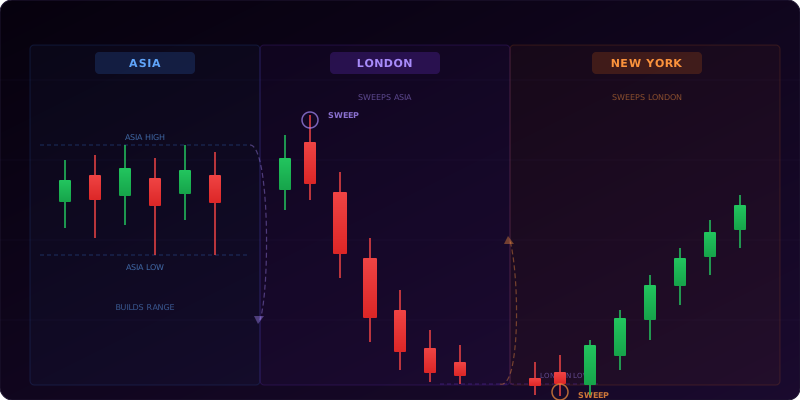
15m/5m: Micro models within larger models. Useful for timing entries within a Stage 3 or adding to positions during Stage 4 pullbacks. Higher noise, requires the context of a larger timeframe model.
The most effective approach: identify the model on the 4H or 1H, then use 15m or 5m for entry timing within Stage 3.
How Does MMM Compare With Power of 3?
The Market Maker Model and Power of 3 (AMD) describe similar institutional behavior but at different levels of detail:
| Aspect | Power of 3 | Market Maker Model |
|---|---|---|
| Phases | 3 (AMD) | 5 stages |
| Detail level | Framework/concept | Specific trade model |
| Target identification | General direction | Specific liquidity pool |
| Entry precision | Direction only | Exact stage and level |
| Best use | Understanding daily narrative | Planning specific trades |
Think of PO3 as the philosophy and MMM as the trading plan. PO3 tells you to expect accumulation → manipulation → distribution. MMM tells you exactly what each stage looks like, where to enter, and what the target is.
What Market Maker Model Mistakes Should You Avoid?
1. Labeling Every Consolidation as Stage 1
Not every range is the beginning of a Market Maker Model. The consolidation must occur at a level where institutional positioning makes sense - near a major structural level or at the edge of a premium/discount zone. A range in the middle of nowhere with no structural significance isn't Stage 1.
2. Entering During Stage 2
The manipulation is designed to look convincing. Traders who enter during Stage 2 - shorting the breakdown in a MMBM or buying the breakout in a MMSM - are providing the liquidity institutions need. Wait for Stage 3 confirmation.
3. Not Having a Clear Target
The model only works if you can identify the liquidity target before entering. If there's no obvious pool of buy-side or sell-side liquidity for price to target, the model may not apply, or your target may be too close for a worthwhile trade.
4. Forcing the Model Onto Every Move
Not every price move follows the Market Maker Model. Sometimes markets trend without a clean Stage 2 manipulation. Sometimes the manipulation doesn't reverse. Apply the model when the stages unfold clearly, and sit out when they don't.
5. Ignoring Higher Timeframe Context
A 15-minute MMBM during a Daily downtrend is fighting the dominant flow. The MMM on lower timeframes must align with the higher timeframe structure.
What Should Be on the Market Maker Model Checklist?
| Factor | Check | Required? |
|---|---|---|
| Clear Stage 1 consolidation | Defined range at a structural level | Yes |
| Stage 2 manipulation sweep | Price breaks beyond the range | Yes |
| Liquidity taken on the sweep | Stops triggered, breakout traders trapped | Yes |
| Stage 3 CHoCH | Structure shifts against the manipulation | Yes |
| FVG/OB formed at reversal | Entry zone identified | Yes |
| Clear liquidity target | Obvious pool in the delivery direction | Yes |
| HTF alignment | Model direction matches dominant trend | Preferred |
| Kill zone timing | Stage 2-3 occur during active session | Preferred |
| R:R ≥ 3:1 | Stop at manipulation extreme, TP at target | Yes |
Frequently Asked Questions
The ICT Market Maker Model is a five-stage framework for reading institutional price delivery from consolidation, through manipulation, into the real move toward a liquidity target.
The best entry usually appears in Stage 3, after the manipulation sweep fails and price confirms reversal with CHOCH, displacement, a fair value gap, or an order block retest.
MMBM is the bullish buy model, where price sweeps lows before delivering higher. MMSM is the bearish sell model, where price sweeps highs before delivering lower.
The model is usually completing when price reaches the planned liquidity target, momentum slows, and a lower-timeframe shift appears against the delivery direction.
They describe similar behavior, but Power of 3 is a broader accumulation, manipulation, distribution framework. The Market Maker Model breaks that behavior into more specific tradeable stages.
What Is the Short Version of the Market Maker Model?
- The Market Maker Model describes the full lifecycle of institutional price delivery in five stages
- MMBM (bullish): consolidation → sweep lows → accumulate → trend up → reach buy-side liquidity
- MMSM (bearish): consolidation → sweep highs → distribute → trend down → reach sell-side liquidity
- The best entry is during Stage 3, after manipulation completes and the CHoCH confirms
- The target is typically the nearest significant liquidity pool in the delivery direction
- The model is fractal and appears on all timeframes - use higher timeframes for the model and lower timeframes for entry timing
- Stage 2 manipulation is designed to trap retail traders - never trade the initial range breakout
- Always identify the liquidity target before entering - no clear target means no trade
- The Market Maker Model is the complete narrative; individual concepts like FVGs, OBs, and BOS are the building blocks within it


