AMD Model Trading: ICT Power of 3 (Accumulation, Manipulation, Distribution) Explained
AMD model trading (ICT Power of 3) explained — how Accumulation, Manipulation, and Distribution build every daily candle, with entry rules and bias.
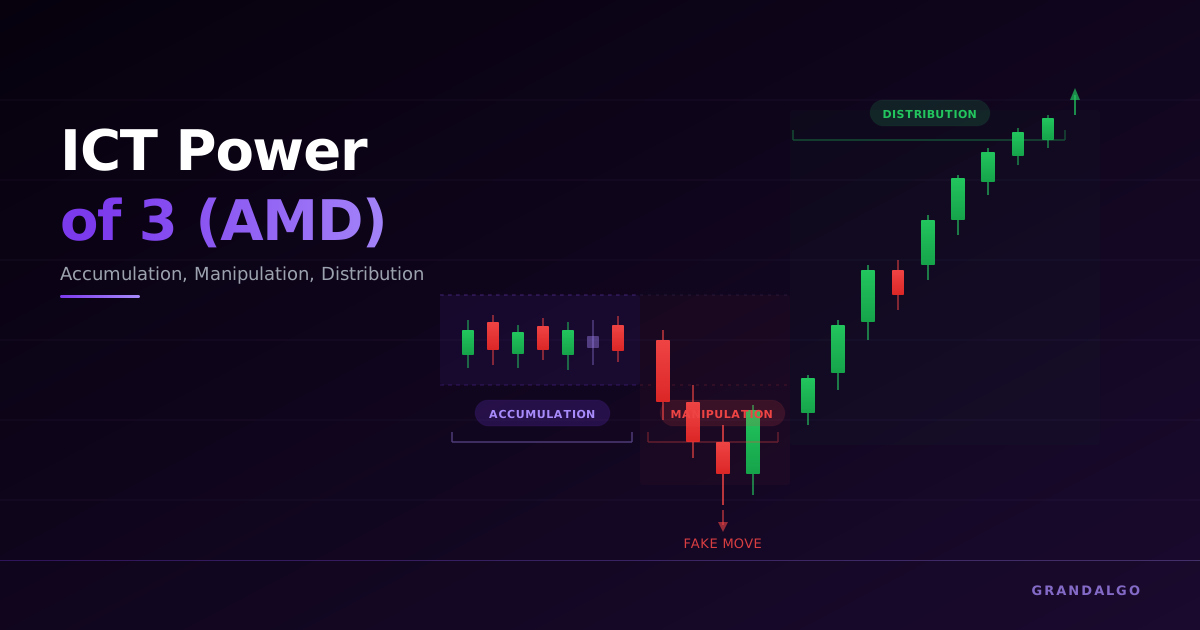
AMD model trading — short for Accumulation, Manipulation, Distribution — is the single most useful framework for understanding why price moves the way it does inside any trading session. Also known as the ICT Power of 3 (PO3), the AMD model describes the three-phase institutional sequence that builds every daily candle, weekly candle, and session range.
Once you understand the AMD model, you stop reacting to price and start anticipating it. You see the fake-out before it traps retail traders. You recognize the accumulation before the real move begins. You understand exactly which phase of the daily cycle you are trading in.
This guide explains each phase of the AMD model, how to identify them in real time, and the exact entry approach that works inside the ICT Power of 3 framework.
What Is the AMD Model (ICT Power of 3)?
The AMD model — also called the Power of 3 — describes how institutional price delivery unfolds in three distinct phases:
- Accumulation - Institutions quietly build positions during a low-volatility period
- Manipulation - Price is pushed against the intended direction to trigger stops and generate liquidity
- Distribution - The real move occurs as institutions distribute their positions in their intended direction
This sequence repeats on every timeframe - within a daily candle, a session, a weekly candle, and even on lower timeframes. The scale changes but the structure doesn't.
What Happens During Phase 1: Accumulation?
What Happens
The accumulation phase is a period of consolidation and range-building. Price moves sideways in a tight range with small candles and low volatility. Nothing looks interesting. Most retail traders ignore it or get chopped up trying to trade the range.
Behind the scenes, institutions are quietly building their positions. They can't execute their full order at once - the size would move the market against them. So they accumulate over time, buying or selling in small increments within the range.
Where It Occurs
- Daily candle: The Asian session (roughly 8 PM - 2 AM ET) typically forms the accumulation range
- Weekly candle: Monday often serves as the accumulation day
- Intraday: The first 30-60 minutes of a session can form micro-accumulation before the session's main move
What to Watch For
- Tight consolidation range forming
- Low volume relative to previous periods
- Price oscillating between defined highs and lows
- No clear directional momentum
- The range's high and low become liquidity targets for the next phase
The accumulation range is not the trade. It's the setup for the trade. Mark the range high and low - they become critical reference points.
What Happens During Phase 2: Manipulation?
What Happens
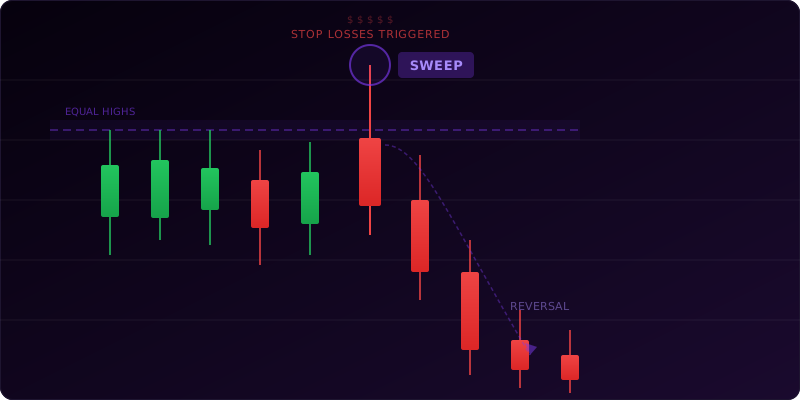
This is where most retail traders get trapped. Price breaks out of the accumulation range in the wrong direction - against where institutions actually want price to go. This false breakout serves two purposes:
- Triggers stop losses - Traders who positioned correctly during accumulation get stopped out
- Creates liquidity - The stop triggers and breakout entries provide the liquidity institutions need to fill their large orders at favorable prices
The manipulation phase is a liquidity sweep. It's engineered. Price pushes past the accumulation range to trigger the orders resting there, absorbs that liquidity, and then reverses.
Where It Occurs
- Daily candle: London Open often sweeps one side of the Asian range before reversing
- Weekly candle: Early in the week, price sweeps the previous week's high or low
- Intraday: The first move out of a consolidation is frequently the fake move
What to Watch For
- A sharp move beyond the accumulation range high or low
- The move sweeps liquidity - taking out obvious stop-loss levels
- Volume spikes on the sweep as stops trigger
- The move lacks follow-through - price stalls quickly after breaking the range
- Wicks begin forming, suggesting rejection of the new level
How to Avoid Getting Trapped
The manipulation phase is specifically designed to get retail traders on the wrong side. Common traps:
- Breakout traders enter on the range break, placing stops inside the range - exactly where price is headed
- Mean reversion traders fade the range, get stopped when price briefly expands beyond their levels
- Impatient traders enter during accumulation, get stopped during manipulation
The solution: wait for the manipulation to complete before entering. Don't trade the breakout. Trade what comes after.
What Happens During Phase 3: Distribution?
What Happens
After accumulation (building positions) and manipulation (generating liquidity), institutions now distribute - they drive price aggressively in their intended direction. This is the real move.
Distribution is characterized by:
- Strong displacement candles with large bodies and small wicks
- Fair value gaps created by the aggressive momentum
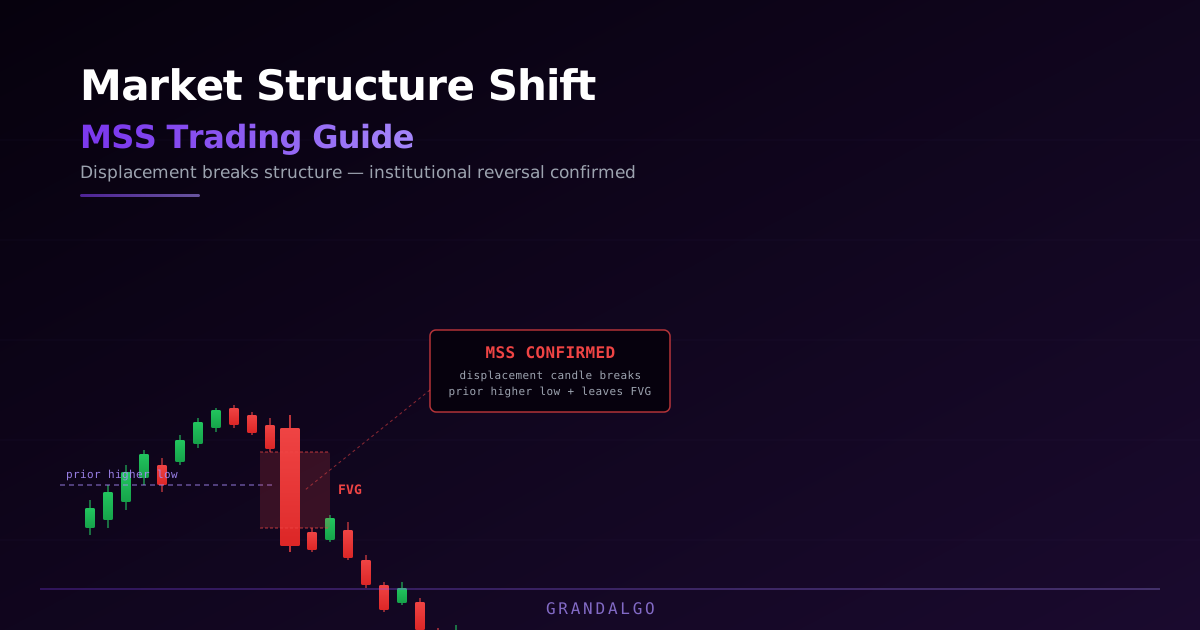
- Clear breaks of structure confirming the directional move
- Volume expansion as the move accelerates
- Sustained directional movement, not just a spike
Where It Occurs
- Daily candle: New York session typically delivers the distribution move
- Weekly candle: Wednesday through Thursday often delivers the week's main move
- Intraday: The second major push after the manipulation reversal
This Is Where You Trade
The distribution phase is where your entry should be. Not during accumulation (too early, no direction). Not during manipulation (you'd be on the wrong side). During distribution, the direction is confirmed and momentum is with you.
The best entries during distribution:
- Retests of FVGs created by the initial displacement
- Order block retests at the origin of the move
- Lower timeframe pullbacks within the distribution trend
- Silver Bullet setups during the kill zone that delivers the distribution
How Does the AMD Model Map to the Daily Candle?
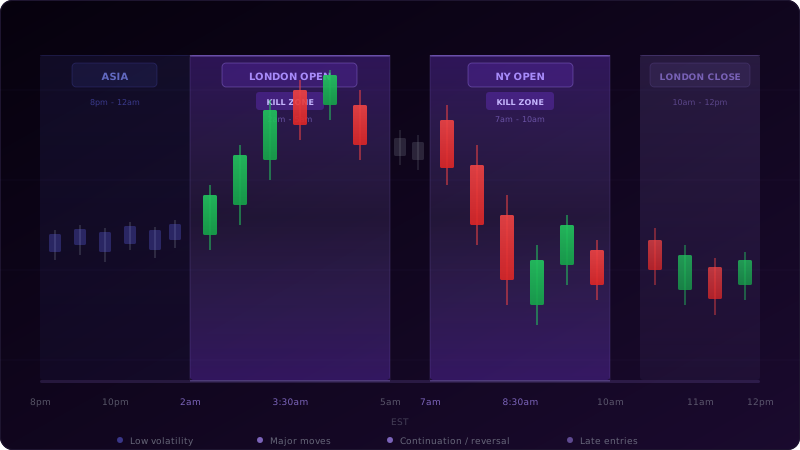
The most common application of the AMD model (PO3) maps directly to the three major trading sessions:
| Phase | Session | Time (ET) | What Happens |
|---|---|---|---|
| Accumulation | Asian | 8 PM - 2 AM | Range builds, positions accumulated |
| Manipulation | London Open | 2 AM - 5 AM | Range swept, liquidity taken |
| Distribution | New York | 7 AM - 2 PM | Real move delivered |
Bullish PO3 Day
- Asian session builds a range
- London sweeps the Asian low (manipulation down)
- Price reverses and the daily candle closes bullish
- The open is near the low of the day; the close is near the high
The daily candle has a long lower wick (manipulation) and a large bullish body (distribution).
Bearish PO3 Day
- Asian session builds a range
- London sweeps the Asian high (manipulation up)
- Price reverses and the daily candle closes bearish
- The open is near the high of the day; the close is near the low
The daily candle has a long upper wick (manipulation) and a large bearish body (distribution).
GrandAlgo
See these concepts automated on your charts
18 TradingView indicators — smart money, price action, supply/demand, and more.
How Does PO3 Work on the Weekly Candle?
The same structure plays out across the week:
| Phase | Day | What Happens |
|---|---|---|
| Accumulation | Monday | Range-building, low-conviction trading |
| Manipulation | Tuesday (early) | Week's high or low is set (the fake move) |
| Distribution | Wednesday - Thursday | Week's main directional move |
| Consolidation | Friday | Profit-taking, reduced volume |
This is why many ICT traders focus their entries on Tuesday afternoon through Wednesday - the manipulation is complete and distribution is beginning.
How to Trade PO3
Step 1: Identify the Accumulation Range
Before your target session begins, mark the range that has formed:
- For daily PO3: Mark the Asian session high and low
- For weekly PO3: Mark Monday's high and low
- For intraday PO3: Mark the pre-session consolidation range
Step 2: Determine Directional Bias
You need to know which side of the range will be swept (manipulation) and which direction the real move (distribution) will go. Determine bias from:
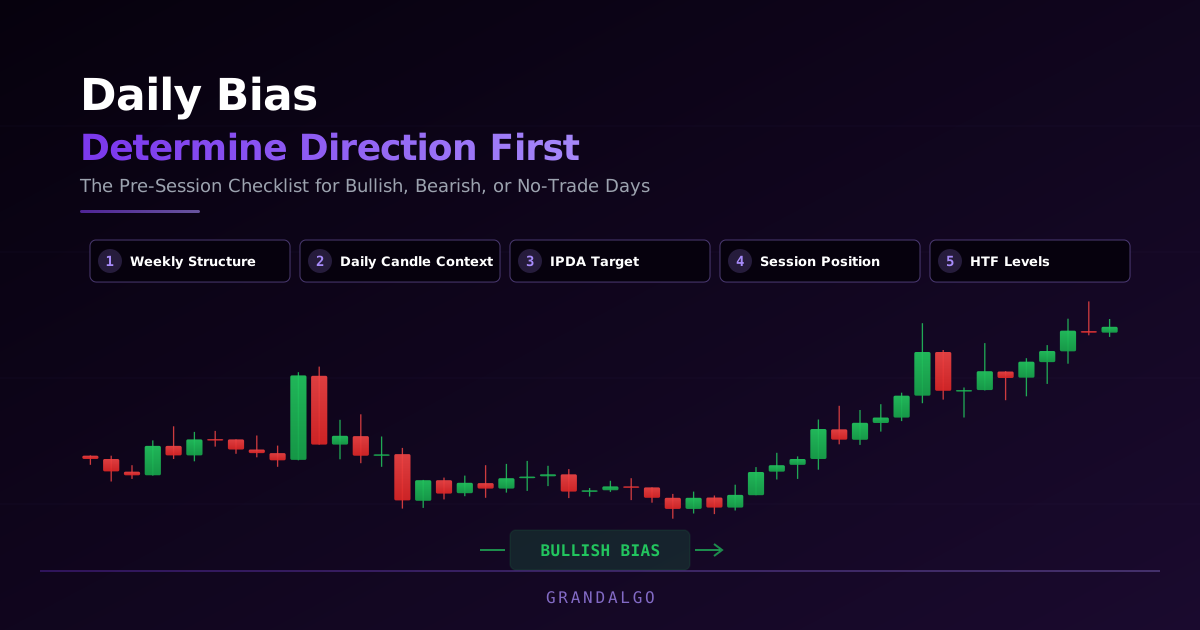
- Higher timeframe market structure - Is the daily/4H trend bullish or bearish?
- Premium/discount positioning - Is price in a discount (expect bullish distribution) or premium (expect bearish)?
- Previous session narrative - What did London establish? What is NY likely to continue?
- Key levels above and below - Where is the nearest draw on liquidity?
Step 3: Wait for Manipulation
Watch for price to sweep one side of the accumulation range. The sweep should:
- Push beyond the range high/low
- Trigger visible stop losses
- Show signs of rejection (wicks, volume shift)
- Occur during the expected manipulation window (London for daily PO3, Tuesday for weekly)
Step 4: Enter During Distribution
Once manipulation is complete and price reverses:
- Look for an FVG on the reversal as the entry point
- Confirm with a lower timeframe change of character
- Enter with a stop below the manipulation low (bullish) or above the manipulation high (bearish)
- Target the opposite side of the accumulation range as the first take-profit, with extensions toward the next liquidity level
Example: Bullish Daily PO3
- Mark the Asian session range: High at 1.0850, Low at 1.0820
- Daily bias is bullish (4H structure making higher highs)
- London opens and sweeps below 1.0820 to 1.0810 (manipulation)
- Price rejects and a bullish FVG forms on the 5-minute chart
- Enter long on the FVG retest, stop below 1.0810
- TP1 at 1.0850 (opposite range extreme), TP2 at previous day's high
When Does PO3 Fail?
The framework is a tendency, not a guarantee. It fails when:
No manipulation occurs - Sometimes London simply continues in the distribution direction without sweeping the range. No sweep means no PO3 setup. Don't force it.
Manipulation in both directions - High-impact news or conflicting institutional flows can sweep both sides of the range. When the range is swept in both directions, the setup is invalidated.
Distribution doesn't follow - The manipulation occurs but price doesn't reverse convincingly. It chops or slowly drifts back. If distribution doesn't begin within a reasonable time, the thesis is weakening.
Higher timeframe event overrides - A weekly PO3 cycle can override the daily PO3 pattern. If Tuesday's daily distribution is against the weekly distribution direction, the weekly structure usually wins.
What AMD Model Trading Mistakes Should You Avoid?
-
Trading during accumulation - The range exists for institutions to build positions, not for you to scalp. Trading the chop leads to frustration and small losses that compound.
-
Trading the manipulation as a breakout - The most expensive mistake. The manipulation is designed to trap breakout traders. Wait for the reversal.
-
Entering distribution too late - If the distribution move is already extended and approaching the next major level, the risk-reward is no longer favorable. Better to wait for a pullback or skip the setup.
-
Applying PO3 without higher timeframe context - PO3 describes how price is delivered, but it doesn't tell you the direction. Without top-down analysis, you're guessing which side is manipulation and which is distribution.
-
Expecting exact session timing - PO3 phases don't start and stop at exact times. London might begin manipulating at 1 AM or 4 AM. The framework is a guide for the sequence of events, not a clock.
Frequently Asked Questions
Yes. AMD model and ICT Power of 3, also written as PO3, refer to the same three-phase framework: Accumulation, Manipulation, Distribution. AMD emphasizes the phases themselves, while Power of 3 emphasizes the repeating three-part delivery sequence.
The AMD model is fractal, so the same three phases can appear on weekly, daily, 4-hour, 1-hour, and lower-timeframe candles. Most traders apply it to the daily candle because the Asian, London, and New York session structure makes the sequence easier to observe.
They are related but not identical. Wyckoff schematics describe institutional accumulation and distribution in more granular events, while AMD simplifies the idea into three phases. Traders familiar with Wyckoff will recognize the same underlying logic with fewer moving parts.
The best instruments have clear session structure and institutional participation. Forex majors, index futures, and liquid crypto pairs can all work. Crypto needs adaptation because it trades continuously, so many traders map the AMD cycle to UTC days or major session rotations.
AMD is a tendency, not a rule. The sequence is visible often enough to be useful, but not every session forms clean accumulation, manipulation, and distribution. News events, strong trend days, and low-liquidity conditions can override the pattern, so higher-timeframe context still matters.
What Matters
- The AMD model (Accumulation, Manipulation, Distribution) and ICT Power of 3 describe the same three-phase framework
- Accumulation builds the range, manipulation generates liquidity, distribution delivers the real move
- The pattern repeats on every timeframe - daily candles, weekly candles, and intraday sessions
- On a daily candle, Asian = accumulation, London = manipulation, New York = distribution
- On a weekly candle, Monday = accumulation, Tuesday = manipulation, Wednesday-Thursday = distribution
- The manipulation phase is designed to trap retail traders - don't trade the initial range breakout
- Enter during the distribution phase, after manipulation is complete and direction is confirmed
- Higher timeframe bias is required to know which direction the distribution will go
- PO3 is a tendency, not a rule - when the pattern doesn't materialize, step aside