Liquidity Grab & Sweep Trading: How Institutions Hunt Stop Losses
How liquidity grabs and liquidity sweeps work, why institutions target your stop losses, and a structured approach to trading them with proper entries.

Every retail trader has experienced it. You place a stop-loss below a swing low. Price drops, hits your stop, and then immediately reverses in your original direction. You were right about the trade — but you got stopped out anyway.
That is a liquidity grab — also called a liquidity sweep depending on how far price extends beyond the level. Both terms describe the same institutional mechanic: smart money driving price to obvious stop-loss clusters to fill their own orders, then reversing.
Understanding how and why this happens - and learning to trade on the right side of it - is one of the most powerful edges in Smart Money trading.
What Is a Liquidity Grab?
A liquidity grab is an engineered push beyond an obvious high or low — a swing point, the previous day's high, equal lows — that triggers the stop-loss and pending orders resting there, then reverses back inside the range. The "grab" framing emphasizes intent: the move exists to collect those orders, not to start a new trend. Large players need counter-party volume to fill size, and the densest source of that volume is a cluster of stops sitting just past a level everyone can see.
The signature is a wick or brief push beyond the level followed by quick rejection, usually within one to three candles. Price takes the liquidity, the orders change hands, and the market moves in the opposite direction — leaving stopped-out traders watching the move they were positioned for happen without them.
Liquidity Grab vs Liquidity Sweep vs Stop Hunt
Three terms, one mechanic. The differences are usage, not substance:
- Liquidity grab — the SMC term that stresses intent. Usually describes a quick, aggressive stop run beyond a high or low that reverses almost immediately.
- Liquidity sweep — often used for a slightly cleaner or deeper push through the level before rejection. Many traders use grab and sweep interchangeably, and nothing about the trade changes based on which word you pick.
- Stop hunt — the older retail-forum term for the same event, framed from the victim's side: your stop got hunted.
All three describe price running clustered stop orders beyond an obvious level before reversing. The oldest named trade built on this mechanic is ICT Turtle Soup — a false breakout of a prior high or low, faded on the reversal. Whatever you call the event, the playbook in the rest of this post applies unchanged.
What Is Liquidity?
In trading, liquidity refers to resting orders in the market. These are primarily stop-loss orders and pending orders sitting at predictable price levels.
Where does liquidity cluster?
- Above swing highs - Stop-losses from short sellers, buy-stop entries from breakout traders
- Below swing lows - Stop-losses from long traders, sell-stop entries from breakdown traders
- At round numbers - Psychological levels where traders cluster orders
- At session highs/lows - Previous day, previous week, and session extremes
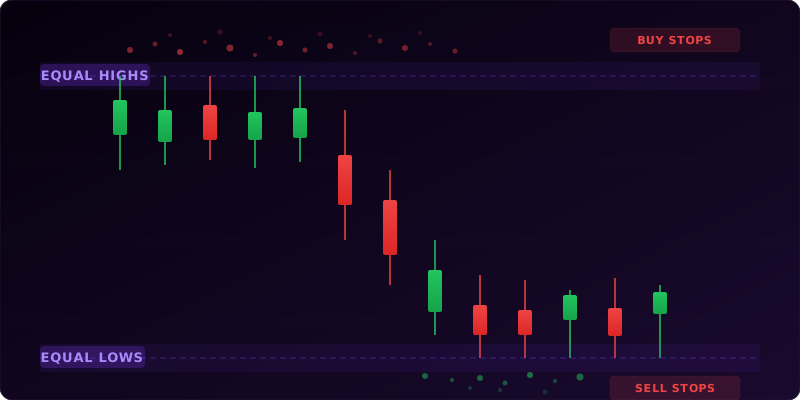
Institutional traders can infer where these clusters sit using order flow data from their venues and by reading the same price structure that makes stop placement predictable.
What Is a Liquidity Sweep?
A liquidity sweep occurs when price briefly pushes beyond a key level to trigger the resting orders, then reverses. The institutional logic:
- Large traders need to fill massive positions (buying thousands of contracts)
- They can't do this at one price without moving the market against themselves
- By pushing price into a liquidity pool, they trigger a cascade of stop-loss orders
- These triggered stops become the counter-party to the institution's position
- Once filled, price reverses in the institution's intended direction
Bullish sweep: Price dips below a swing low, triggers stops, then reverses upward. The institution used the sell orders (triggered stops) to fill their buy position.
Bearish sweep: Price spikes above a swing high, triggers stops, then reverses downward. The institution used the buy orders (triggered stops) to fill their sell position.
How to Identify a Liquidity Sweep
The Key Levels to Watch
Not every level holds meaningful liquidity. Focus on:
Previous Day High/Low (PDH/PDL): These are the most-watched levels in institutional trading. Massive amounts of stops accumulate above/below these levels overnight.
Previous Week High/Low (PWH/PWL): Even more significant. Weekly levels attract larger position sizing and more accumulated orders.
Session Highs/Lows: Asia, London, and New York session extremes. Each session creates its own liquidity pools that the next session often targets.
Obvious Swing Points: Clear swing highs and lows that are visible on higher timeframes. The more obvious the level, the more stops sit there.
The Sweep Pattern
A valid liquidity sweep has three components:
- The run - Price moves toward the liquidity level
- The sweep - Price pushes beyond the level (wicks through, triggering stops)
- The reversal - Price quickly moves back inside the range and continues in the opposite direction
The speed of the reversal matters. A genuine sweep reverses within 1-3 candles. If price pushes beyond the level and stays there for extended time, it's more likely a genuine breakout than a sweep.
How Do You Trade Liquidity Sweeps?
Step 1: Mark Your Levels
Before each trading session, mark:
- Previous day high and low
- Previous week high and low
- Current session highs and lows (Asia for London session, etc.)
- Any obvious swing highs/lows on your trading timeframe
These are your liquidity targets - the levels where sweeps are most likely to occur.
Step 2: Wait for the Sweep
Don't anticipate. Let price actually sweep the level. You need to see:
- Price pushes beyond the level (the wick or close exceeds it)
- Immediate rejection - price moves back inside within 1-3 candles
Step 3: Look for Confirmation
A sweep alone isn't an entry. You need confirmation that the reversal is genuine:
Fair value gap: If an FVG forms on the reversal candle, it confirms the directional imbalance. An inverse FVG at a sweep level is one of the highest-probability setups in Smart Money trading.
Market structure shift: If the sweep causes a Change of Character on a lower timeframe, it confirms the direction has shifted. An order block often forms at the sweep origin, providing a precise entry zone.
Candlestick pattern: A strong engulfing or pin bar at the sweep level adds confirmation.
Step 4: Enter the Trade
Entry: After confirmation - typically on the close of the reversal candle or at the FVG retest.
Stop-loss: Beyond the sweep wick. If price pushes further than the sweep, the level has been genuinely broken, not just swept.
Take-profit targets:
- TP1: The opposite liquidity level (swept PDL → target PDH)
- TP2: The next structural level or order block
- TP3: The equilibrium (50%) of the range between the two liquidity levels
Step 5: Manage the Trade
- Move to break-even after 1R
- Take 50% at TP1
- Trail the remainder toward TP2/TP3
GrandAlgo
See these concepts automated on your charts
18 TradingView indicators — smart money, price action, supply/demand, and more.
How Do You Combine Liquidity Sweeps With Other Concepts?
Sweep + Inverse FVG
When price sweeps a key level and an inverse fair value gap forms at the sweep point, you have maximum confluence. The sweep confirms institutional positioning, and the inverse FVG confirms the price imbalance has been negated.
This is arguably the highest-probability setup in Smart Money trading.
Sweep + CRT (Candle Range Theory)
When a higher-timeframe candle sweeps beyond the prior candle's range and reverses, it's a CRT setup. Combining CRT with key level sweeps (PDH/PDL, session levels) adds another layer of confirmation.
Sweep + Market Structure Break
If a sweep at a key level coincides with a Break of Structure or Change of Character on the lower timeframe, the reversal is structurally confirmed. This is the strongest possible validation.
How Do Liquidity Heatmaps Show Where Liquidity Clusters?
Beyond individual levels, liquidity heatmaps visualize where the densest concentrations of trading activity exist across all price levels.
A good heatmap indicator:
- Analyzes volume or candle interaction at each price level
- Filters out insignificant levels
- Color-codes by position (support below, resistance above)
- Shows intensity tiers for the strongest clusters
- Supports multi-timeframe analysis
Heatmaps give you a broader view of the liquidity landscape - not just individual levels, but the full map of where the most significant concentrations of historical trading activity sit. The Liquidity Heatmap indicator visualizes where these concentrations form on your chart, while Alpha Sweep automatically detects sweep signals at key levels in real time.
What Liquidity Sweep Mistakes Should You Avoid?
-
Entering before the sweep completes - Don't front-run the sweep. Wait for price to push beyond, reject, and show confirmation before entering.
-
Confusing breakouts with sweeps - If price pushes beyond a level and holds there, it's a breakout. The key difference: sweeps reverse quickly (1-3 candles), breakouts don't. Learn to distinguish between stop hunts and genuine breakouts.
-
Using weak levels - Minor intraday swings don't hold significant liquidity. Focus on session levels, PDH/PDL, PWH/PWL, and obvious higher-timeframe swings.
-
No confirmation - A sweep alone isn't an entry signal. You need a reversal pattern, FVG, or structure shift to confirm the reversal is real.
-
Stop-loss too tight - If your stop is at the sweep level, a slightly deeper sweep will take you out. Place it beyond the sweep wick with a small buffer.
-
Ignoring the bigger picture - A sweep of a PDL in a strong weekly uptrend is high-probability (institutional buying). A sweep of a PDL in a weekly downtrend might just be continuation. Context matters.
What Are the Limits of the Liquidity Grab Model?
The concept is real, but it is easy to oversell. Three limitations deserve to be stated plainly.
Hindsight bias is the big one. Every failed breakout looks like a liquidity grab after the fact. Scroll back through any chart and you will find dozens of wicks through levels that "grabbed liquidity" before reversing — and just as many pushes through the same kinds of levels that kept going. The label only has value if you can apply it in real time, and in real time, while price is trading beyond the level, a grab and a genuine breakout look identical. Anyone who claims to tell them apart at the wick tip is describing hindsight, not a repeatable process.
Confirmation costs you. The evidence that separates a grab from a breakout — a close back inside the range, rejection within one to three candles, a structure shift or displacement on the lower timeframe — only prints after the extreme. Waiting for it means a worse entry than the theoretical fill at the very top or bottom of the wick, and sometimes confirmation appears and price breaks out anyway. That lag is not a flaw in your execution. It is the built-in price of trading a pattern that can only be verified in arrears, and the stop beyond the sweep wick exists precisely because confirmation is sometimes wrong.
Intent is a narrative, not a data point. No retail chart shows who pushed price through the level or why. What is observable — and what makes the pattern tradeable — is the mechanical part: stops cluster at obvious levels, triggered stops release a burst of orders, and a market that immediately rejects the level has shown that the breakout found no follow-through. Trade the observable behavior. Skip the story about who engineered it.
Frequently Asked Questions
Traders often use the terms interchangeably. A liquidity grab usually describes a quick stop run beyond a high or low, while a liquidity sweep can imply a cleaner push through a level before rejection. In both cases, the key feature is stop orders being triggered before price reverses.
Functionally, yes. Stop hunt is the older retail term, while liquidity grab and liquidity sweep are the Smart Money Concepts terms for the same event: price running through clustered stop-losses beyond an obvious level before reversing. The vocabulary differs by community, but the mechanic and the trade built on it are identical.
You cannot confirm one at the extreme. While price is beyond the level, a grab and a genuine breakout look identical. Real-time identification means waiting for evidence — a close back inside the range, rejection within one to three candles, and a structure shift or displacement on a lower timeframe — and that evidence always arrives after the best theoretical entry. Accepting the confirmation lag is part of the trade.
The best sweep levels are obvious to many traders: previous day high and low, previous week high and low, Asian session highs and lows, major swing points, and round numbers. Minor intraday levels can work, but they usually hold less meaningful liquidity.
A valid sweep should push beyond the level, reject back inside quickly, and show confirmation through a structure shift, fair value gap, inverse fair value gap, engulfing candle, or strong displacement. If price stays outside the level, it is more likely a breakout than a sweep.
The stop-loss should sit beyond the sweep wick with enough buffer for normal volatility. Placing the stop directly on the swept level is too tight because the market can retest or slightly extend the sweep before the real reversal begins.
Liquidity sweeps can appear in forex, crypto, indices, commodities, and stocks because stop placement behavior is universal. They work best in liquid markets with clean session structure and enough participation for obvious highs, lows, and stop clusters to matter.
Key Takeaways
- Liquidity sweeps are institutional positioning events - not random market noise
- PDH/PDL, PWH/PWL, and session levels hold the most significant liquidity
- Wait for the sweep to complete before looking for entries - don't front-run
- Require confirmation - FVG, structure shift, or reversal pattern at the sweep level
- Inverse FVG + sweep is one of the highest-probability setups in Smart Money trading
- Place stops beyond the sweep wick, not at the level itself
- Use liquidity heatmaps for a broader view of where order clusters sit
Institutional traders hunt liquidity. Once you understand this, you stop being the hunted and start positioning yourself alongside the hunters. The sweep is the moment of truth - learn to read it, and you're trading with the institutions instead of against them.


