ICT Kill Zones Explained: When Institutions Trade
A breakdown of ICT kill zones - the specific time windows when institutional traders are most active and the highest-probability setups occur.

Not all hours are created equal. Institutional traders don't sit at their desks 24 hours a day - they operate during specific windows when their firms are active, their markets are open, and liquidity is sufficient to fill large orders.
ICT methodology identifies these windows as kill zones - the time periods where the highest-probability setups occur. Understanding them changes how you approach the trading day.
Why Does Time Matter?
Markets are open nearly 24 hours during the week, but activity is not evenly distributed. Volume, volatility, and institutional participation spike during specific windows and drop during others.
Trading during low-activity periods means:
- Wider spreads
- Choppy, directionless movement
- Stop-loss hunting without follow-through
- Lower-probability setups
Trading during kill zones means:
- Tighter spreads
- Directional moves with momentum
- Institutional participation creating genuine setups
- Higher-probability trade opportunities
What Are the Four ICT Kill Zones?
Asian Kill Zone (8:00 PM - 12:00 AM ET)
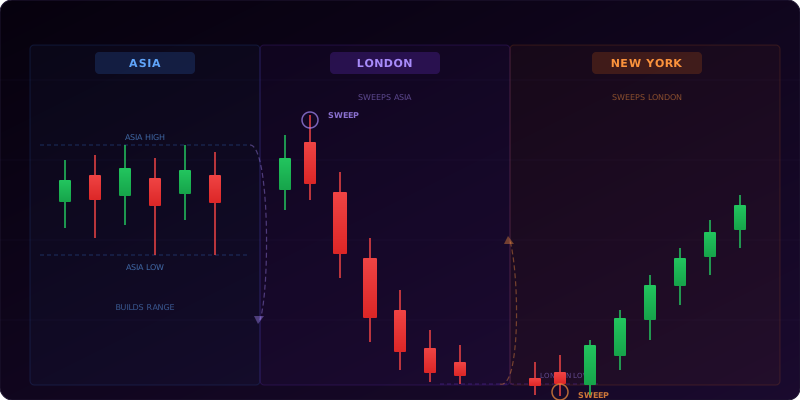
What happens: The Asian session builds the day's initial range. Price typically consolidates, establishing the high and low that London and New York will target.
How to use it:
- Mark the Asian session high and low - these become liquidity targets
- The range gives you context for what London is likely to sweep
- Don't expect major trend moves during this window
- Use this time for analysis and preparation, not aggressive trading
Best setups: Range identification, not entries. The Asian session's value comes from the levels it creates, not from trading within it.
London Kill Zone (2:00 AM - 5:00 AM ET)
What happens: European banks and institutions come online. This is often the first major liquidity event of the day. London frequently sweeps one side of the Asian range to build positions.
How to use it:
- Watch for a sweep of the Asian high or low
- The direction of the sweep often sets up the NY session move
- Fair value gaps created during London displacement are high-probability
- Order blocks formed at London structure breaks carry institutional weight
Best setups: Liquidity sweeps of Asian levels, structural breaks with FVG confluence, trend initiation trades.
New York Kill Zone (7:00 AM - 10:00 AM ET)
What happens: The highest volume window of the day. US institutions enter alongside European traders still active. This overlap creates the most significant moves and highest-probability setups.
How to use it:
- NY often continues the direction London established
- But it can also reverse London if the daily narrative calls for it
- The best setups have confluence: HTF structure + London-created FVG + key level + NY killzone timing
- This is where most ICT models (Silver Bullet, 2022 model) are designed to execute
Best setups: Continuation of London's move, reversals at key daily levels, FVG retests created during London displacement.
London Close Kill Zone (10:00 AM - 12:00 PM ET)
What happens: European traders wind down positions. This creates potential reversals as profit-taking occurs. The remaining NY session becomes lower volume.
How to use it:
- Watch for reversals of the London/NY move
- Profit-taking can create counter-trend moves
- Less reliable than London Open and NY Open kill zones
- Better for closing existing trades than opening new ones
Best setups: Counter-trend reversals for experienced traders, position management for existing trades.
What Behavior Patterns Appear in Kill Zones?
The Classic Daily Sequence
A common ICT day looks like this:
- Asian session builds a range (consolidation)
- London sweeps one side of the Asian range (first displacement)
- New York continues the move or reverses after sweeping London's extreme
- London close sees profit-taking and potential counter-move
This doesn't happen every day, but it's the most common institutional pattern. Understanding it gives you a framework for anticipating the day's movement. The opening range breakout strategy is built directly around this concept — marking the first 15-minute range after the New York open and trading the breakout with session context.
Liquidity Flow Through the Day
Think of each session as targeting the liquidity created by the previous session:
- London targets Asian session liquidity (Asian highs/lows)
- New York targets London session liquidity (London highs/lows)
- The next day's Asian session resets the cycle
This creates a cascading session liquidity flow where each session hunts the stops created by the prior session.
GrandAlgo
See these concepts automated on your charts
18 TradingView indicators — smart money, price action, supply/demand, and more.
How Do You Trade ICT Kill Zones?
Step 1: Preparation (Before the Kill Zone)
- Mark the previous session's high and low
- Identify higher timeframe bias (daily/4H structure)
- Note any FVGs or order blocks price is approaching
- Know which levels are likely liquidity targets
Step 2: Wait for the Sweep (Kill Zone Opens)
- Watch for price to push into a liquidity pool
- The sweep should be visible - a wick or brief push beyond the level
- Don't enter the moment the kill zone opens. Wait for the setup to form.
Step 3: Confirm and Enter (Within the Kill Zone)
- Look for a fair value gap on the reversal
- Confirm with a lower timeframe structure shift
- Enter with defined stop-loss and take-profit
- The setup must form within the kill zone - not after
Step 4: Manage the Trade
- First target: the opposite session level
- Second target: the next structural level
- Tighten stops as the kill zone window closes
- Don't expect moves to continue strongly outside kill zones
What Common Kill Zone Mistakes Should You Avoid?
-
Trading outside kill zones - Price moves happen outside kill zones too, but they're less reliable. Stick to the high-probability windows.
-
Forcing trades within the window - A kill zone doesn't guarantee a setup. If the conditions aren't there, don't trade just because the clock says you should.
-
Only trading one kill zone - Different traders suit different windows. If you can't trade London (2-5 AM ET), focus on New York. Don't try to force all four.
-
Ignoring the Asian range - The Asian session doesn't give you trades, but it gives you context. Skipping the analysis means you miss the levels London and NY will target.
-
Not adjusting for your timezone - Kill zones are defined in ET (Eastern Time) — New York local time, which adjusts for daylight saving. Convert them to your local time and be realistic about which ones you can actually trade consistently.
How Do Kill Zones Work With Indicators?
Session-based indicators like Session Fib Fan can automate the tedious parts:
- Auto-plotting session highs/lows - Asian, London, NY levels drawn automatically
- Previous day H/L tracking - Key reference points always visible
- Kill zone highlighting - Visual overlay showing active windows on your chart
This automation lets you focus on analysis rather than manually marking levels at the start of each session.
Frequently Asked Questions
ICT kill zones are time windows when institutional participation and volatility tend to increase. Traders use them to focus on periods where liquidity sweeps, displacement, and high-quality entries are more likely.
London open and New York open are usually the strongest windows because they combine liquidity, volatility, and institutional activity. The best window for you depends on the market you trade and your timezone.
No. A kill zone is a window of opportunity, not an automatic setup. Trade only when price reaches a meaningful level, sweeps liquidity, and confirms direction within the window.
ICT kill zones are commonly referenced in New York time. The main windows include Asian evening, London open, New York open, and London close, with daylight saving adjustments handled by New York local time.
The Asian session often creates the range and liquidity levels that London and New York later target. Even if you do not trade Asia, its high and low can frame the next session's plan.
What Are the Key Takeaways for ICT Kill Zones?
- Kill zones are specific time windows when institutional activity peaks
- London Open and New York Open are the highest-probability windows
- The Asian session provides context and levels - not trading opportunities
- Each session targets the liquidity created by the previous session
- Always prepare before the kill zone opens - mark levels, identify bias
- Don't force trades - kill zones provide opportunity, not obligation
- Convert times to your local timezone and focus on windows you can trade consistently


