ICT Premium and Discount Zones: How to Use Them
Learn how ICT premium and discount zones work, why smart money buys in discount and sells in premium, and how to apply this to your entries.

New to ICT? Start with our ICT Trading Basics guide to learn structure, liquidity, and how premium/discount fits into bias.
One of the simplest yet most powerful ICT concepts is premium and discount pricing. The idea: in any given price range, the upper half is "premium" (expensive) and the lower half is "discount" (cheap). Smart money buys cheap and sells expensive.
It sounds obvious, but most retail traders do the exact opposite - they buy near highs and sell near lows.
What Are Premium and Discount Zones?
Take any defined price range - a swing high to swing low, a daily range, a weekly range. Split it in half at the 50% level (equilibrium).
Premium zone: Everything above the 50% line. Price is expensive relative to the range.
Discount zone: Everything below the 50% line. Price is cheap relative to the range.
Equilibrium (50%): The fair value midpoint. Neither premium nor discount.
The Institutional Logic
Institutions manage risk by buying at favorable prices:
- To go long, they want to buy in the discount zone - below equilibrium
- To go short, they want to sell in the premium zone - above equilibrium
This creates a natural framework: if you're looking for longs, only enter in the discount zone. If you're looking for shorts, only enter in the premium zone.
How Do You Identify the Range?
The range you measure from determines your premium/discount zones. Common ranges:

Swing Range
The most recent swing high to swing low on your trading timeframe. This is the most commonly used range and updates as new swings form.
Daily Range
Yesterday's high to low. Useful for intraday traders who want to know whether current price is at a premium or discount relative to the previous day.
Weekly Range
Last week's high to low. Useful for swing traders looking at the bigger picture.
Impulse Range
The range of a specific impulse move - from the start of the impulse to the end. The 50% level of an impulse move often acts as strong support or resistance.
How Do You Apply Premium and Discount to Trading?
Rule 1: Buy in Discount, Sell in Premium
In a bullish structure (you want to go long):
- Wait for price to pull back into the discount zone (below 50%)
- Look for entry signals (FVG, order block, structure shift) within the discount zone
- Don't buy in the premium zone - that's chasing
In a bearish structure (you want to go short):
- Wait for price to rally into the premium zone (above 50%)
- Look for entry signals within the premium zone
- Don't sell in the discount zone - that's selling after the move
Rule 2: Use Equilibrium as a Decision Level
The 50% level itself is a significant level:
- In an uptrend, price pulling back to equilibrium often bounces - it's the last line of defense before the discount zone
- In a downtrend, price rallying to equilibrium often gets rejected
- Price closing beyond equilibrium in the opposite direction is a warning sign
Rule 3: Combine With OTE
ICT's Optimal Trade Entry (OTE) zone sits between the 62% and 79% retracement of the impulse move. This falls within the discount zone for longs and premium zone for shorts - combining the Fibonacci sweet spot with the premium/discount framework.
The OTE zone within the correct pricing zone (discount for longs, premium for shorts) is one of the most powerful confluence combinations in ICT.
GrandAlgo
See these concepts automated on your charts
18 TradingView indicators — smart money, price action, supply/demand, and more.
How Do Premium and Discount Work With Other Concepts?
+ Order Blocks
An order block in the discount zone (for longs) is significantly higher probability than one in the premium zone. The zone tells you the price is favorable; the order block tells you institutions positioned there.
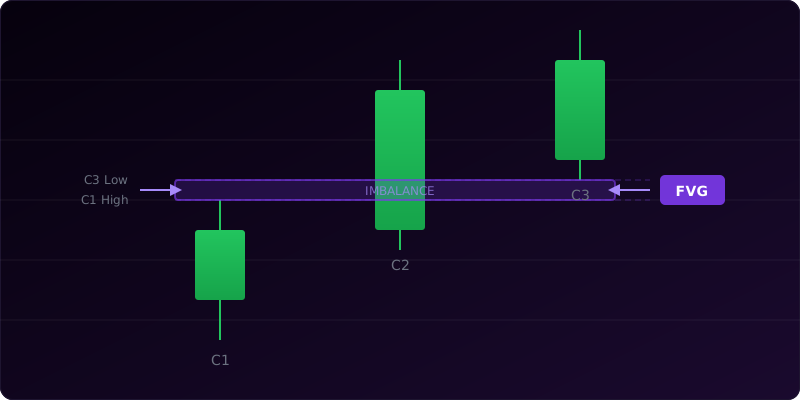
+ Fair Value Gaps
An FVG in the discount zone gives you both a price advantage (buying cheap) and an institutional imbalance (the gap). When both align, the probability of a reaction increases substantially.
+ Liquidity Sweeps
A liquidity sweep that pushes price deeper into the discount zone before reversing is the classic institutional play: they sweep stops to get even better prices, then reverse.
What Does a Practical Premium and Discount Example Look Like?
Scenario: Daily structure is bullish. Price made a new swing high at $100 and pulled back to a swing low at $80.
- Range: $80 to $100
- Equilibrium: $90
- Discount zone: $80 to $90
- Premium zone: $90 to $100
- OTE zone: $84.20 to $87.60 (62-79% retracement)
Action: You want to buy. Wait for price to pull back below $90 (into discount). Ideally, look for an FVG or order block entry between $84.20 and $87.60 (OTE within discount). Stop below $80. Target at or above $100. An indicator like Smarter Money Suite can automatically identify these zones and mark the relevant FVGs and order blocks within them.
What NOT to do: Buy at $97 because "it's going up." That's buying in deep premium - the risk/reward is terrible.
What Premium and Discount Mistakes Should You Avoid?
-
Buying in premium - The most common retail mistake. Price is near highs, it "feels" strong, but you're buying at institutional selling prices.
-
Choosing the wrong range - Using a 5-minute range when you should be measuring from the 4-hour swing. Match the range to your trading timeframe.
-
Ignoring structure - Premium/discount only works within a structural context. In a downtrend, even the discount zone can break lower.
-
Treating equilibrium as a hard line - It's a zone, not a precise price. Price might not react at exactly 50% - look for reactions in the area.
-
Not combining with other confluence - Premium/discount alone isn't an entry signal. It's a filter that tells you whether the price is favorable. You still need an entry trigger.
Frequently Asked Questions
Premium is the upper half of a defined range, above the 50% equilibrium level. It is where traders usually prefer short setups because price is expensive relative to the range.
Discount is the lower half of a defined range, below the 50% equilibrium level. It is where traders usually prefer long setups because price is cheap relative to the range.
Choose a valid swing range, daily range, weekly range, or impulse leg, mark the high and low, then split the range at 50%. Everything above is premium and everything below is discount.
You can, but it is lower quality in ICT logic. The cleaner approach is buying in discount and selling in premium, especially when order blocks, FVGs, or liquidity sweeps align.
OTE usually sits inside the correct premium or discount half of a swing. A bullish OTE should form in discount, while a bearish OTE should form in premium.
What Are the Key Takeaways for Premium and Discount Zones?
- Premium is the upper half of a range; discount is the lower half
- Smart money buys in discount and sells in premium
- Equilibrium (50%) is a significant reaction level
- Combine premium/discount with OTE, FVGs, and order blocks for highest probability
- Match your range measurement to your trading timeframe
- Premium/discount is a filter, not an entry signal - you still need a trigger at the right zone


