CHOCH Trading: How to Trade a Change of Character (Complete Guide)
CHOCH trading explained — how to identify a Change of Character, when to act on it, and the exact entry rules for trading CHOCH reversals in ICT/SMC.

A Change of Character (ChoCh) is the first market structure signal that a trend might be reversing. After a series of higher highs and higher lows, price suddenly makes a lower low. After lower lows and lower highs, price suddenly makes a higher high.
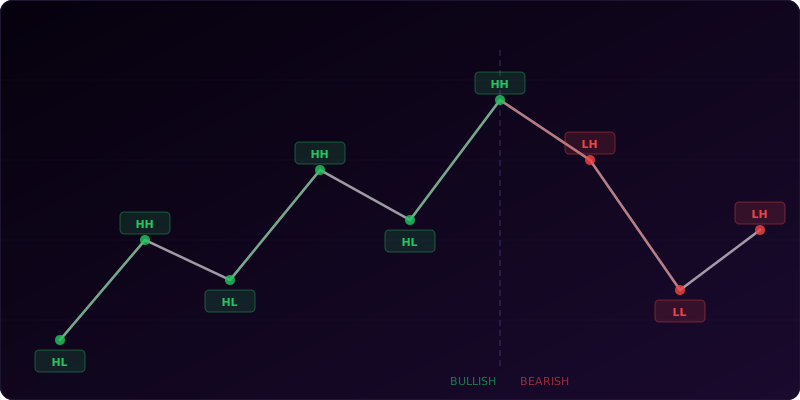
This single event changes the game - but most traders either jump in too early or miss it entirely. Here's how to trade it properly.
What Does ChoCh Look Like?
Bearish ChoCh (Uptrend → Potential Downtrend)
- Price has been making higher highs and higher lows (bullish structure)
- Price fails to make a new higher high (or makes one but with weak momentum)
- Price drops and breaks below the most recent higher low
- This break is the ChoCh - the first lower low in a bullish structure
Bullish ChoCh (Downtrend → Potential Uptrend)
- Price has been making lower highs and lower lows (bearish structure)
- Price fails to make a new lower low (or makes one but reverses quickly)
- Price rallies and breaks above the most recent lower high
- This break is the ChoCh - the first higher high in a bearish structure
Why Is ChoCh a Warning, Not a Guarantee?
This is the most important thing to understand: ChoCh signals potential reversal, not confirmed reversal.
Sometimes a ChoCh is just a deep pullback within a strong trend. Price breaks one swing point, then the original trend resumes.
How to increase confidence:
- Wait for a Break of Structure (BoS) in the new direction - if after a bearish ChoCh, price also makes a lower high and then a new lower low, the reversal is more confirmed
- Check if the ChoCh occurred at a significant level - a daily supply zone, a liquidity sweep, a higher timeframe zone
- Look for confluence - FVG, order block, volume spike at the ChoCh point

How Do You Trade ChoCh?
Approach 1: Aggressive (Trade the ChoCh Directly)
Enter immediately after the ChoCh, on the pullback.
- ChoCh occurs (e.g., bullish ChoCh - price breaks above a lower high)
- Mark the order block at the origin of the ChoCh move
- Wait for a pullback to the order block or FVG
- Enter on the pullback with a stop below the ChoCh swing low
- Target the next structural level
Pros: Early entry, best prices, highest R:R Cons: Higher failure rate - the ChoCh might be a false signal
Approach 2: Conservative (Wait for Confirmation)
Wait for the first BoS in the new direction before entering.
- ChoCh occurs - note it as a warning
- Wait for BoS - price makes a second move in the new direction that breaks another swing point
- Now enter on the pullback after the confirmed BoS
- Stop below the most recent swing low in the new structure
- Target based on the new structure
Pros: Higher win rate, confirmed direction Cons: Later entry, less favorable prices, lower R:R
Which Approach to Use?
Use aggressive when:
- The ChoCh occurs at a significant higher TF zone
- There's strong confluence (FVG + sweep + volume)
- The higher TF structure supports the reversal
- You're comfortable with a lower win rate but higher R:R
Use conservative when:
- The ChoCh is ambiguous (weak break, strong prior trend)
- There's no significant level at the ChoCh
- You prefer higher win rate
- You're newer to structure trading
GrandAlgo
See these concepts automated on your charts
18 TradingView indicators — smart money, price action, supply/demand, and more.
Where Is ChoCh Most Powerful?
At Liquidity Sweeps
A ChoCh immediately after a liquidity sweep is the strongest configuration:
- Price sweeps a key level (takes out stops)
- ChoCh occurs (structure breaks in the new direction)
- The sweep + ChoCh combination confirms structural reversal
At Higher Timeframe Zones
A lower timeframe ChoCh at a higher timeframe supply/demand zone is high probability:
- The higher TF zone provides the area of interest
- The lower TF ChoCh provides the timing and confirmation
At Session Levels
A ChoCh after sweeping a session level (PDH/PDL, Asian H/L):
- Session sweep provides the liquidity event
- ChoCh confirms the direction has shifted
What ChoCh Trading Mistakes Should You Avoid?
-
Treating every ChoCh as a reversal - Not every ChoCh leads to a full trend change. Some are deep pullbacks. Use confirmation and context.
-
Ignoring higher timeframe structure - A lower TF ChoCh inside a strong higher TF trend is usually a pullback. Don't fight the bigger picture.
-
Entering before the ChoCh completes - The swing point must be broken and the candle must close for the ChoCh to be confirmed. Don't anticipate.
-
Too tight stop-loss - ChoCh entries can be volatile. Give the trade enough room - place stops beyond the swing point, not right at it.
-
Not waiting for the pullback - Entering at the moment of the ChoCh means chasing. Wait for the pullback to the OB or FVG for a better entry.
Frequently Asked Questions
CHOCH means Change of Character. It is the first structural break against the current trend, such as an uptrend making a lower low or a downtrend making a higher high. It warns that order flow may be shifting, but it does not confirm a full reversal by itself.
A CHOCH alone is usually not enough. The higher-quality setup waits for context: a liquidity sweep, higher-timeframe supply or demand zone, fair value gap, order block, or a follow-up Break of Structure in the new direction before risking capital.
The conservative approach is to mark the CHOCH, wait for price to confirm with a Break of Structure in the new direction, then enter on the pullback. This gives up some early entry price but filters out many deep pullbacks that are mistaken for reversals.
For aggressive CHOCH entries, the stop usually belongs beyond the swing that created the CHOCH or beyond the order block used for entry. Avoid placing the stop directly at the broken level because post-CHOCH price action often retests and sweeps before moving.
CHOCH is most reliable when it forms after a liquidity sweep, at a higher-timeframe supply or demand zone, or around major session levels. In those locations, the structural change is supported by a reason for institutions to reverse price rather than a random intraday fluctuation.
Key Takeaways
- ChoCh is the first structural break against the prevailing trend
- It signals potential reversal, not guaranteed reversal - confirmation increases reliability
- Aggressive approach: Trade the ChoCh pullback directly (higher R:R, lower win rate)
- Conservative approach: Wait for a BoS in the new direction (higher win rate, lower R:R)
- ChoCh is most powerful at liquidity sweeps, HTF zones, and session levels
- Always check higher timeframe structure - a lower TF ChoCh in a strong HTF trend is likely just a pullback. Reversal Market Structure can automate ChoCh detection across multiple timeframes
- Wait for the pullback after ChoCh - don't chase the break itself


