Liquidity Pools: Where Stop Losses Cluster
Learn to identify where stop-loss orders likely accumulate in the market - and why these clusters become targets for institutional traders.

Every stop-loss you place becomes part of a liquidity pool. Every take-profit, every pending order. They all cluster at specific price levels, creating pools of resting orders that institutional traders actively target. If you're new to the concept, start with what liquidity means in trading before diving into pool mechanics.
Knowing where these pools form lets you avoid being the liquidity and start trading alongside those who take it.
How Do Liquidity Pools Form?
The Psychology
Traders are predictable. They place stops at logical levels:
- Below a swing low if they're long (textbook risk management)
- Above a swing high if they're short
- Below support or above resistance
- At round numbers ($100, $50,000)
- At session levels (previous day high/low)
When thousands of traders do the same thing, those "logical" levels become dense clusters of orders - liquidity pools.
The Accumulation
Pools grow over time:
- The longer price respects a level, the more traders position around it
- The more obvious a swing high or low, the more stops accumulate above or below it
- Equal highs/lows (price touching the same level multiple times) create the densest pools
The Visibility
Institutional traders have advantages retail traders don't:
- Order flow data from their trading venues, showing where activity is concentrated
- Volume profiles revealing activity at each price level
- Market depth showing resting limit orders
But even without this data, you can infer where pools exist based on chart structure.
How Do You Identify Pools on Your Chart?
Buy-Side Liquidity (Above Price)
Swing highs: Every obvious swing high has stops above it from short sellers and buy-stops from breakout traders.
Equal highs: Two or more highs at the same level significantly increase the pool. The market is practically advertising "stops are here."
Previous session highs: Previous day high, previous week high, and session highs all accumulate significant orders. These are watched by virtually every institutional trader.
Trendline touches: If price has touched a descending trendline three times, stops from shorts accumulate above it. When the trendline breaks, those stops trigger.
Sell-Side Liquidity (Below Price)
Swing lows: The mirror image of swing highs. Long traders' stops sit below.
Equal lows: Multiple lows at the same level create dense sell-side pools.
Previous session lows: Previous day low, previous week low - major order concentrations.
Support level touches: Multiple tests of support means more longs with stops below it.
How Do Institutions Use These Pools?
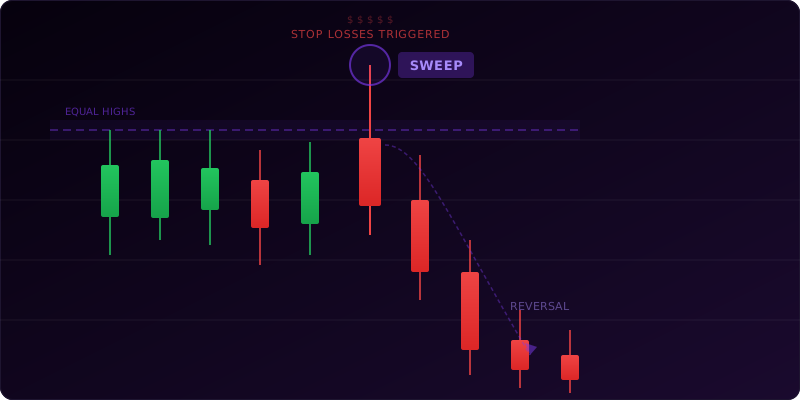
The Sweep
The most common play - and one you can learn to trade alongside institutions:
- Institution wants to sell (build a short position)
- They need buyers to sell to
- Buy-side liquidity above a swing high provides those buyers
- Price pushes above the swing high → triggers buy-stops
- Those triggered buy orders provide the counter-party
- Institution fills their sell position
- Price reverses lower
The Stop Hunt
A more aggressive version of the stop hunt:
- Price has been ranging with clear swing points
- Institutions push price below a swing low (triggering sell-stops)
- The triggered sells provide buy counter-parties
- Institutions fill their buy position at lower prices
- Price reverses higher - the longs who got stopped out watch in frustration
The Cascade
Sometimes one pool leads to another:
- Price sweeps above a swing high (triggers pool 1)
- The momentum from triggered orders pushes price to the next swing high
- That pool gets triggered too (pool 2)
- This cascading effect creates a large wick above the range
- Price then reverses sharply
GrandAlgo
See these concepts automated on your charts
18 TradingView indicators — smart money, price action, supply/demand, and more.
How Do You Protect Yourself From Sweeps?
Don't Be the Liquidity
If your stop is at the same level as everyone else's, you're part of the pool that will be targeted.
Better stop placement:
- Place stops a few ticks beyond the obvious level, not at it
- Use structural levels that are less obvious to the crowd
- Consider using the ATR (Average True Range) to place stops at a distance that accounts for normal sweep wicks
Recognize the Sweep in Real-Time
When price pushes beyond a key level, ask:
- Is this a genuine breakout, or a sweep?
- Is the candle body closing beyond the level, or is it wicking back?
- Is there a reversal pattern forming?
- Is this happening at a time when institutions are active (kill zones)?
A quick wick beyond a level that immediately reverses is often a sweep.
How Do Liquidity Pools Work Across Timeframes?
Higher Timeframe Pools
- Weekly and daily swing points
- Monthly highs and lows
- Major structural levels
- Impact: Large reactions when swept, significant position filling
Lower Timeframe Pools
- Hourly and 15-minute swing points
- Intraday session levels
- Minor structural levels
- Impact: Smaller reactions, shorter-term positioning
Higher timeframe pools attract more institutional interest and produce bigger moves when swept.
How Do You Use Indicators to Visualize Liquidity?
Manually marking every swing point and session level is tedious. Indicators can help:
Session level plotters: Automatically mark PDH/PDL, PWH/PWL, and session boundaries. These levels are updated each session without manual work.
Liquidity heatmaps: Visualize where the densest concentrations of historical trading activity exist across all price levels. Color-coded by intensity, these show the full liquidity landscape at a glance.
Swing detection: Automatic identification of swing highs and lows - the basis of most liquidity pools.
Frequently Asked Questions
A liquidity pool is a cluster of resting orders, usually around obvious highs, lows, support, resistance, round numbers, or session levels.
Large orders need opposing orders to fill. Liquidity pools provide enough stops, take-profits, and pending orders for institutions to enter or exit without excessive slippage.
They commonly form above swing highs, below swing lows, around equal highs or lows, near previous session levels, and at round psychological prices.
A sweep is not automatically bullish or bearish. Direction depends on the reaction after the sweep, higher-timeframe context, and whether price accepts beyond the level or rejects back inside the range.
Avoid placing stops at the most obvious level, wait for sweeps before entering, and use structure confirmation instead of chasing breakouts into known liquidity pools.
What Are the Key Takeaways for Liquidity Pools?
- Liquidity pools are clusters of resting orders at predictable price levels
- They form at swing points, session levels, equal highs/lows, and round numbers
- Pools grow over time - the longer a level holds, the more orders accumulate
- Institutions target these pools because they need counter-parties for large positions
- Sweeps (price pushing through a pool and reversing) are institutional positioning events
- Protect yourself by placing stops beyond the obvious level
- Higher timeframe pools produce larger reactions than lower timeframe pools
- Use indicators to automate pool identification across multiple timeframes


