Stop Hunts vs Genuine Breakouts: How to Tell the Difference
Price breaks above resistance - is it a real breakout or a stop hunt? Learn the key differences and how to avoid getting trapped on the wrong side.

Price breaks above a swing high. Breakout traders pile in. Then price reverses sharply and drops, stopping everyone out.
Was that a failed breakout or a stop hunt? The distinction matters - one is a trade to avoid, the other is a trade to take.
What Is a Stop Hunt?
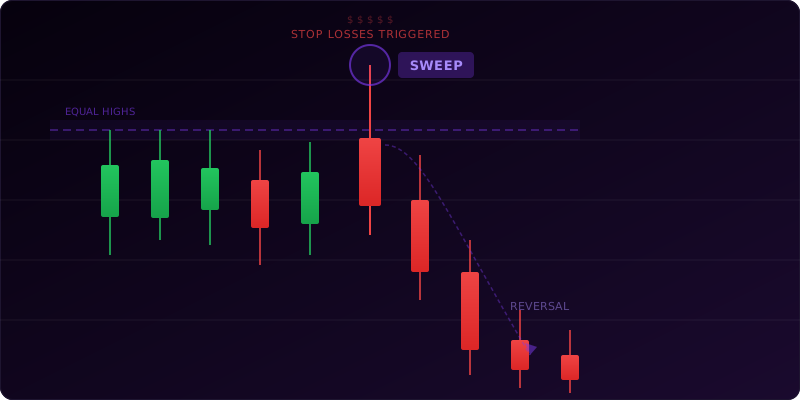
A stop hunt (or liquidity sweep) is a deliberate push through a key level to trigger resting orders, followed by a reversal. The purpose isn't to break out - it's to access the liquidity (stop-losses and breakout orders) sitting at that level.
Characteristics:
- Quick push beyond the level (1-3 candles)
- Long wick(s) showing rejection
- Price reverses back inside the range
- Often occurs at session opens or during kill zones
What Is a Genuine Breakout?
A genuine breakout is sustained price movement through and beyond a key level, establishing a new trading range.
Characteristics:
- Strong candle(s) closing beyond the level (not just wicking)
- Follow-through - subsequent candles continue in the breakout direction
- Volume supports the move
- The level that broke often becomes new support/resistance
How Do You Tell Them Apart?
Signal 1: Candle Close Position
Stop hunt: The candle that breaks the level has a long wick but closes back inside the range. The body is on the opposite side of the level from the wick.
Breakout: The candle closes strongly beyond the level. The body is mostly past the level, not just the wick.
This is the most immediately useful signal. Wicks beyond a level that close back inside = sweep. Bodies closing beyond = potential breakout.
Signal 2: Speed of Reversal
Stop hunt: Price reverses within 1-3 candles of the push through the level. The move is sharp and immediate.
Breakout: Price pushes through and continues for multiple candles. Any pullback is shallow and doesn't return to the breakout level.
If price breaks a level and immediately reverses (within the same session), it's very likely a sweep. Understanding how to distinguish these moves from false structure breaks is critical to avoiding traps.

Signal 3: Context and Structure
Stop hunt: The push through the level is against the prevailing market structure. A sweep above a high in a bearish structure is a stop hunt. Institutions are using the buy-side liquidity to fill sell orders.
Breakout: The push through the level is with the prevailing structure. Breaking above a high in a bullish structure is likely continuation. The trend is intact and extending.
Signal 4: Volume Behavior
Stop hunt: Volume spikes on the push (orders being triggered) but drops immediately as price reverses. The volume spike likely reflects triggered orders rather than sustained directional commitment.
Breakout: Volume is sustained. The initial push has strong volume, and the follow-through candles maintain or increase volume.
Signal 5: Time of Day
Stop hunt: Commonly occurs at session opens - London sweeping Asian levels, New York sweeping London levels. Kill zones are prime time for sweeps.
Breakout: Can occur at any time but is most significant during high-volume periods with clear structural context.
GrandAlgo
See these concepts automated on your charts
18 TradingView indicators — smart money, price action, supply/demand, and more.
What Is the Decision Framework?
When price breaks a key level, ask these five questions:
- Did the candle close beyond the level, or just wick?
- Is the break with or against the prevailing structure?
- Did the move reverse within 1-3 candles?
- Is the volume sustained or spiking and fading?
- Is this happening at a session open (common sweep time)?
| Answer | Points to... |
|---|---|
| Wick beyond, close inside | Stop hunt |
| Against prevailing structure | Stop hunt |
| Reversal within 1-3 candles | Stop hunt |
| Volume spikes then drops | Stop hunt |
| At session open | Likely stop hunt |
| Body closes beyond | Breakout |
| With prevailing structure | Breakout |
| Follow-through for 5+ candles | Breakout |
| Sustained volume | Breakout |
How Do You Trade Each Scenario?
Trading Stop Hunts
Stop hunts are reversal entries:
- Wait for the sweep to complete (price pushes beyond, then reverses)
- Confirm reversal (structure shift on lower TF, FVG formation, reversal candle)
- Enter in the reversal direction
- Stop beyond the sweep wick
- Target the opposite liquidity level
Avoiding Stop Hunt Losses
If you tend to get caught by stop hunts, a tool like the Candle Trap Zone indicator can help identify these setups in real time:
- Don't chase breakouts - wait for a pullback and retest
- Place stops beyond the obvious level (not at it)
- Be suspicious of breaks at session opens
- Check if the break is against the higher TF structure
Trading Genuine Breakouts
If the evidence points to a real breakout:
- Wait for the pullback to the breakout level (old resistance becomes new support)
- Enter on the retest with confirmation
- Stop below the retest zone
- Target the next structural level or liquidity pool
Don't enter at the moment of the break - even genuine breakouts often pull back to retest the level. The pullback entry gives you better risk-reward.
Frequently Asked Questions
A stop hunt rejects after sweeping liquidity, while a genuine breakout accepts beyond the level and continues with follow-through.
Look for a wick beyond an obvious level, quick reversal, weak close, and no sustained acceptance outside the range.
A genuine breakout usually has a strong close beyond the level, volume, retest holding, and continuation structure.
Usually wait for confirmation. The first break often tests liquidity before revealing whether the market accepts or rejects the new price area.
Yes. After a sweep and rejection, traders can look for a structure shift or FVG retest in the opposite direction.
What Are the Key Takeaways for Stop Hunts vs Breakouts?
- Stop hunts wick beyond a level and reverse; breakouts close beyond and continue
- The candle close position is the most reliable signal
- Sweeps typically happen against the structure; breakouts align with it
- Session opens are prime time for stop hunts
- Trade stop hunts as reversal entries - enter after the sweep with confirmation
- Trade breakouts by waiting for the pullback and retest, not chasing the initial break
- When in doubt, wait - the market will tell you within 1-3 candles which one it is


