What Is Liquidity in Trading?
A clear explanation of liquidity - what it is, where it clusters, why institutions target it, and why understanding it changes how you see the market.

It is the most important concept most retail traders ignore. They learn indicators, patterns, and strategies - but they never ask the fundamental question: where are the orders in the market, and who is going to fill them?
Understanding this changes everything about how you read price action.
What Is Liquidity?
In the context of Smart Money trading, the term refers to resting orders in the market — stops, limits, and pending orders sitting at specific price levels waiting to be triggered. (In broader market microstructure, it also covers execution quality factors like depth, spread, and price impact, but in ICT/SMC analysis the focus is on where targetable orders cluster.)
The two main types:
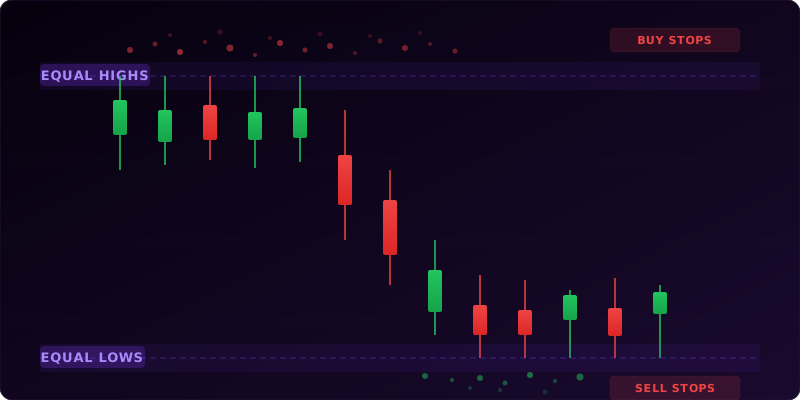
Buy-side liquidity: Buy orders sitting above the current price. This includes stop-losses from short sellers and buy-stop orders from breakout traders.
Sell-side liquidity: Sell orders sitting below the current price. This includes stop-losses from long traders and sell-stop orders from breakdown traders.
These orders are invisible on your chart, but they're predictable - because traders place them at predictable locations.
Where Liquidity Clusters
Above Swing Highs
Every trader who went short near a swing high placed a stop-loss above it. Every breakout trader has a buy-stop above it. The result: a pool of buy orders sitting just above every obvious swing high.
Below Swing Lows
The mirror image. Every long trader's stop-loss sits below swing lows. Breakdown sellers have sell-stops there. A pool of sell orders clusters below every obvious swing low.
At Round Numbers
Psychological levels - $50, $100, $50,000 - attract orders because humans think in round numbers. Stop-losses, take-profits, and pending orders all cluster at these levels.
At Session Levels
Previous day high/low, previous week high/low, session highs and lows. These are widely watched levels where orders accumulate.
At Equal Highs/Lows
When price makes two or more highs or lows at nearly the same level, the pool of resting orders above/below increases significantly because more traders anchor stops to that visible level. Equal highs scream "stop-losses clustered here."
Why Institutions Need Liquidity
Here's the key insight that changes everything:
Institutional traders manage massive positions - tens of thousands of contracts. They can't simply place a market order; it would move the price against them significantly.
They need counter-parties. To buy 50,000 contracts, someone needs to sell 50,000 contracts.
Where do they find these counter-parties? At liquidity pools.
When price pushes into a cluster of stop-losses:
- Short sellers' stops are triggered (they buy to close)
- Breakout traders' buy-stops are triggered (they buy to open)
- All these buy orders provide sell-side counter-parties for the institution that wants to sell
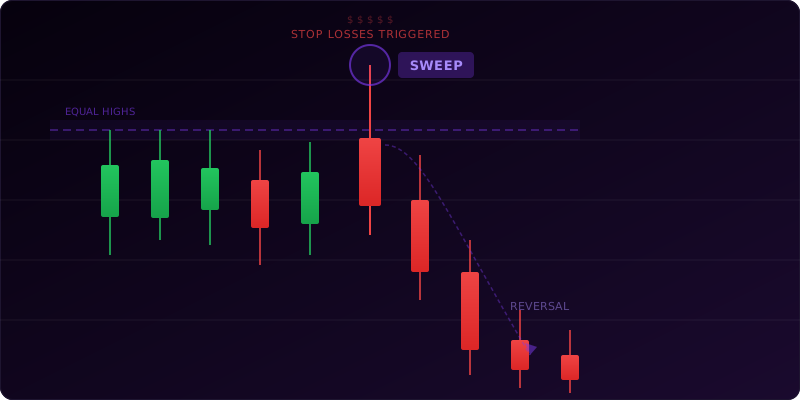
This is why price often sweeps a high and reverses - the institution used the buy-side flow to fill their sell order, then price moves in their actual direction.
GrandAlgo
See these concepts automated on your charts
18 TradingView indicators — smart money, price action, supply/demand, and more.
How Does the Liquidity Cycle Work?
Markets follow a predictable cycle:
- Build - Price consolidates, creating obvious highs and lows where orders accumulate
- Sweep - Price runs through the pool, triggering those resting orders
- Displace - After filling, price moves aggressively in the institution's intended direction
- Repeat - The displacement creates new structure with new clusters of stops
This cycle plays out across timeframes - from intraday charts to the monthly chart - though the speed and clarity varies. Understanding it means you can anticipate where price is likely to go next.
How Does Liquidity Affect Your Trading?
Stop-Loss Placement
If you place your stop at an obvious level where everyone else places theirs, you're adding to a pool of resting orders that institutions will target.
Better approach: Place stops beyond that cluster, not at it. A few extra ticks beyond the obvious level can be the difference between getting swept and staying in the trade.
Entry Timing
Instead of entering breakouts (which are often liquidity sweeps), wait for the sweep to complete and enter in the reversal direction.
The pattern: Price sweeps above a high → triggers the buy-stops sitting there → institutions have filled their sells → price reverses lower. Your entry is after the sweep, not during it.
Understanding "Why"
When price makes a confusing move - a sudden spike that reverses immediately - it is often a sweep. The "why" in the ICT framework is straightforward: institutions needed those orders to fill their position.
What Types of Liquidity Events Matter?
External Liquidity
External liquidity sits outside the current price range - above the range high or below the range low. Price must break out of the range to access it.
Internal Liquidity
Internal liquidity sits within the current range - fair value gaps, order blocks, and internal structure levels. Price fills these as it moves through the range.
The Relationship
A common ICT concept: price targets external pools (sweeps a high or low) then fills internal ones (returns to FVGs and order blocks within the range). External → internal → external is a repeating pattern. A liquidity heatmap can help visualize where these concentrations sit across all price levels — see our guide on how to read a liquidity heatmap for a full breakdown of interpreting the colors, clusters, and gaps.
Frequently Asked Questions
Liquidity is the availability of buy and sell orders that allow price to transact. In smart money trading, it often refers to stop clusters and resting orders.
Liquidity often clusters above swing highs, below swing lows, around equal highs or lows, at round numbers, and near session highs or lows.
Large traders need counterparties. Liquidity pools provide enough orders for institutions to enter, exit, or rebalance positions without excessive slippage.
A liquidity sweep happens when price moves beyond an obvious high or low to trigger resting orders, then reverses or displaces in the opposite direction.
Use liquidity to identify likely targets, avoid obvious stop placement, and wait for sweeps or reactions before taking entries.
Key Takeaways
- Liquidity is resting orders in the market - stop-losses, pending orders, and take-profits
- Those orders cluster at predictable locations: swing highs/lows, session levels, round numbers, equal highs/lows
- Institutions target these pools because they need counter-parties to fill large positions
- Sweeps - price running through a pool and reversing - are institutional positioning events
- Price follows a build, sweep, displace, repeat cycle
- Place stops beyond obvious clusters to avoid being swept
- Understanding where orders sit explains the "why" behind seemingly random price movements


