ICT Macros Explained: The Algo's 20-Minute Windows
ICT macro times in one New York-time table: London, AM, lunch, and PM windows, plus the ET/EST daylight-saving distinction and setup limitations.

Kill zones are broad session windows used in ICT analysis. Macros narrow the observation period to particular minutes. Both are ways of organizing a chart review, not direct measurements of institutional activity.
The price delivery algorithm framing is part of ICT's interpretation of markets, not evidence that one algorithm controls price. Treat the windows as a way to structure observations, then test whether they add anything to your setup.
What Are ICT Macros?
A macro is a fixed, recurring time window, typically around 20 minutes. In the ICT framework, traders use it to look for liquidity sweeps, displacement, and rebalancing. The clock identifies the window; price action determines whether a particular setup has formed.
During a macro, the observations traders look for include:
- Run a nearby high or low to take liquidity
- Expand with displacement, leaving a fair value gap behind
- Deliver toward a clear draw on liquidity (an old high, low, or unfilled gap)
The distinction that trips people up: a macro is not a kill zone. Kill zones are multi-hour sessions (London open, New York open). Macros are the short windows nested inside those sessions. You can have several macros within a single kill zone.
What Are the ICT Macro Times?
The reference below uses New York local time (ET). Some windows last longer than 20 minutes. Labels such as "London" describe the session; the times in this table are still New York times.
| Window | Starts (New York) | Ends (New York) |
|---|---|---|
| London 1 | 2:33 AM | 3:00 AM |
| London 2 | 4:03 AM | 4:30 AM |
| New York premarket | 8:50 AM | 9:10 AM |
| New York AM 1 | 9:50 AM | 10:10 AM |
| New York AM 2 | 10:50 AM | 11:10 AM |
| New York lunch | 11:50 AM | 12:10 PM |
| New York PM | 1:10 PM | 1:40 PM |
| New York final hour | 3:15 PM | 3:45 PM |
These conventions are also listed in the published ICT Equities Time Framework schedule. Community implementations differ; this is not an official exchange timetable. The 9:50-10:10 window overlaps the beginning of the 10:00-11:00 AM Silver Bullet window.
Is New York time the same as EST all year?
No. New York uses EST (UTC-5) in standard time and EDT (UTC-4) during daylight saving. Set a chart or converter to America/New_York, not a fixed UTC-5 offset. For example, 9:50 AM New York is 13:50 UTC in daylight time and 14:50 UTC in standard time. Convert the date you are reviewing; London and New York do not always change clocks on the same weekend.
Why Do Macros Exist?
Within ICT's interpretation, macros organize the search for two behaviors: moves beyond recent highs or lows, and returns to unfilled fair value gaps. Neither behavior establishes that a single algorithm controls the market.
The proposed sequence to record and evaluate is:
- Liquidity resting just outside the recent range gets taken first
- Price then reverses with displacement
- The move targets the next obvious pool of liquidity
The practical question is whether a defined time filter improves your own recorded results after costs. The timetable alone does not show that trading these windows beats trading other times.
What Happens Inside a Macro?
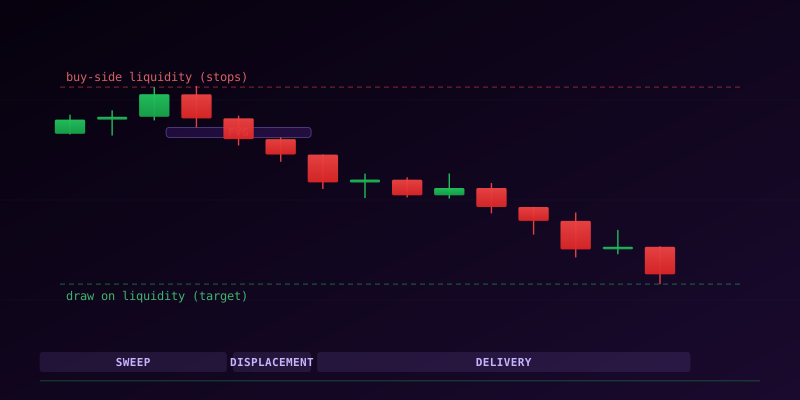
The three-part setup traders look for resembles the Judas swing. This is a schematic sequence, not a claim about how frequently it occurs within a macro.
-
The sweep (first few minutes) - Price pushes against the intended direction to run stops. If the macro is going to deliver a move down, it often spikes up first to take buy-side liquidity. This is the trap that catches breakout traders.
-
Displacement - Price reverses with a strong candle or sequence, potentially leaving a fair value gap. Record the completed candles rather than inferring who placed the orders.
-
Delivery - Price may continue toward the next reference level: the opposite side of the range, an old session high or low, or an unfilled gap. It can also reverse before reaching that target.
Not every macro delivers this cleanly. Some are quiet. The skill is recognizing when the sequence is forming versus forcing a trade because the clock says a macro is open.
GrandAlgo
See these concepts automated on your charts
18 TradingView indicators — smart money, price action, supply/demand, and more.
How Do You Trade an ICT Macro?
Step 1: Prepare before the window opens
- Mark the recent session high and low - these are the likely liquidity targets
- Know your higher-timeframe bias (are you looking for longs or shorts?)
- Note any unfilled fair value gaps price is approaching
Step 2: Wait for the sweep
- When the macro opens, let price run the obvious liquidity first
- Don't chase the initial push - that's usually the manipulation leg
- A clean sweep is a wick or brief push beyond a level, then rejection
Step 3: Enter on displacement + FVG
- Look for a sharp reversal that prints a fair value gap
- Enter on the retrace into that gap, not at the extreme
- Confirm with a lower-timeframe structure shift in your direction
Step 4: Manage toward the draw
- First target: the opposite side of the macro range or the swept level on the other side
- Define whether your exit depends on price, time, or both; the end of the window does not guarantee that momentum fades
- If the sequence doesn't form, stand aside. A macro is an opportunity, not an obligation.
How Do Macros Fit With Kill Zones and Quarterly Theory?
Macros are one layer in a nested time framework. It helps to see how they stack:
- Kill zones - the multi-hour sessions where institutions are active (London, New York)
- Macros - the ~20-minute windows inside those sessions where delivery concentrates
- Quarterly theory - the broader idea that time itself divides into accumulation, manipulation, and distribution quarters
The Silver Bullet model lives right at this intersection: a specific one-hour window (10:00-11:00 AM ET) that opens on the back of the 9:50 macro. Layering these gives you a reason to be at your screen at a specific minute - not just "sometime during New York."
What Common Macro Mistakes Should You Avoid?
-
Confusing macros with kill zones - Macros are the short windows inside the session, not the session itself. Trading the whole two-hour kill zone as if it were a macro defeats the point.
-
Entering on the sweep - The first push is usually the trap. Wait for displacement and a fair value gap before committing.
-
Forcing every window - Most macros don't produce a clean setup. Trading all eight in a day guarantees you take the messy ones.
-
Ignoring the timezone - Macro times are New York (ET). Convert them to your local time and be honest about which windows you can actually watch.
-
No liquidity target - A macro without a defined draw on liquidity is a guess. Always know what the move is reaching for before you enter.
How Do Macros Work With Indicators?
The tedious part of trading macros is marking session levels and watching the clock. Session-based tools like the Session Fib Fan can automate the reference points - plotting session highs and lows and previous-day levels - so when a macro opens you already know which liquidity pools are in play and where price is likely drawing toward. That leaves you free to watch the sweep-displacement-delivery sequence instead of redrawing levels every session.
Frequently Asked Questions
An ICT macro is a short intraday window used by ICT traders to look for a setup. Many last 20 minutes; some last longer. It is a timing convention, not proof of an institutional order or a guarantee that price will move. A separate price-based setup and risk rule are still needed.
In New York local time, the reference windows are 2:33-3:00 AM, 4:03-4:30 AM, 8:50-9:10 AM, 9:50-10:10 AM, 10:50-11:10 AM, 11:50 AM-12:10 PM, 1:10-1:40 PM, and 3:15-3:45 PM. Community lists differ. Use a daylight-saving-aware New York timezone rather than treating these as fixed UTC times.
A kill zone is a multi-hour session window like the London open or New York open. A macro is a roughly 20-minute window nested inside a kill zone where price delivery concentrates. One kill zone can contain several macros.
There is no universally best window. The 9:50-10:10 AM New York window overlaps the start of the 10:00-11:00 AM Silver Bullet hour. Choose a window you can observe consistently and compare its results after trading costs, including windows where no qualifying setup forms.
The concept applies to any market with concentrated session liquidity, including index futures and major forex pairs. Crypto trades 24/7 so session-based macros are less defined, though the New York windows still see increased activity.
What Are the Key Takeaways for ICT Macros?
- Macros are short, recurring ~20-minute windows inside a session when price delivery concentrates
- They sit inside kill zones - the session is the hour, the macro is the minute
- All macro times are referenced in New York time (ET)
- The 9:50-10:10 AM macro overlaps the start of the Silver Bullet hour
- A sweep, displacement, and a move toward a target are observations to test, not events guaranteed by the clock
- Don't enter on the sweep and don't force every window - most macros stay quiet
- Always know which liquidity pool the move is reaching for before you trade


