Best Order Block Indicator for TradingView: How to Find One That Works (2026)
Looking for the best order block indicator for TradingView in 2026? Learn what separates useful OB and BOS indicators from misleading swing-based tools.

Order blocks are one of the most discussed concepts in Smart Money trading. The idea is straightforward: identify the candle or zone where institutional traders placed large orders that caused a significant price move. When price returns to that zone, it often reacts - giving you a high-probability entry.
The problem? Most order block indicators are terrible. They mark every swing candle as a valid zone, ignore market context entirely, or fail to invalidate areas that have already been mitigated.
Here's how to separate the useful tools from the noise.
What Is an Order Block Indicator Actually Detecting?
Before evaluating any indicator, you need to understand the concept properly.
An order block (OB) is the last opposing candle before a significant impulsive move. In a bullish scenario, it's the last bearish candle before a strong rally. In a bearish setup, it's the last bullish candle before a sharp drop.
The institutional logic: large players can't fill their entire position at once. They accumulate at a level, price moves sharply from that level (confirming the positioning), and when price returns to the same zone, the remaining unfilled orders get triggered.
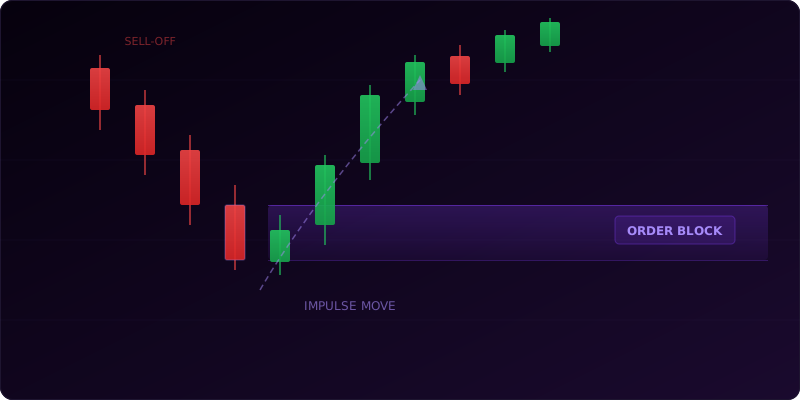
Key characteristics of a valid zone:
- Forms at a market structure break (Break of Structure or Change of Character)
- The impulse move away from the zone is significant - not just a few ticks
- The zone hasn't been fully mitigated - price hasn't already returned and closed through it
Where Do Most Order Block Indicators Fail?
Problem 1: Marking Every Swing Candle
This is the most common failure. The indicator identifies every swing high/low candle and draws a box around it. You end up with dozens of rectangles on your chart, most of which have zero institutional significance.
A swing candle is not an order block. A valid zone requires a structure break - evidence that the price movement from that candle was institutionally driven, not just normal market noise.
What to look for instead: An indicator that only marks zones at confirmed BoS or ChoCh points.
Problem 2: No Invalidation Logic
These zones have a shelf life. Once price returns and closes decisively through it, the block is invalidated — the orders at that level have been absorbed, and the area loses its significance.
Indicators that never remove mitigated zones leave stale levels on your chart that actively mislead you. The stale zones no longer reflect the current market state, leading you to trade levels that have lost their edge.
Better feature: Automatic zone removal when price closes beyond the block boundaries.
Problem 3: No Context Awareness
A bullish order block in a strong downtrend is likely to get swept. A block that formed 500 candles ago in a completely different market regime is probably irrelevant.
Many indicators have no concept of trend direction, recency, or structural context.
What separates good indicators: Integration with market structure analysis. Proximity filtering that keeps only nearby, relevant blocks visible.
Problem 4: No Target Projection
Even when an indicator correctly identifies a valid order block, most stop there. They show you where it is but give you no framework for what to expect when price arrives.
What actually helps: Target zones or projection logic that shows potential price targets beyond just the entry zone - where institutional participants likely have their exits.
How Do You Evaluate an Order Block Indicator?
Detection Quality
- Does it require a structure break before marking a block?
- Does it identify the correct candle - the last opposing candle before the impulse?
- Does it distinguish between different block types (BoS blocks vs. ChoCh blocks)?
Zone Management
- Does it remove zones when price closes through them (invalidation)?
- Does it filter out blocks that are too far from current price?
- Can you configure the sensitivity?
Visualization
- Are zones clearly drawn with distinct colors for bullish vs. bearish?
- Does it use gradient fills or clean boundaries?
- Is the chart still readable with the indicator active?
Alerts
- Can you set alerts for when price approaches or enters a block?
- Are alerts available for both bullish and bearish blocks?
Additional Features
- Does it integrate with FVG detection for confluence?
- Does it show market structure context alongside blocks?
- Are there target projection features?
Are Premium Order Block Indicators Better Than Free Ones?
Free Indicators
There are hundreds of free OB tools available. Some have thousands of likes. But here's the reality:
Pros: Zero cost. Good for learning the concept. Source code is often visible.
Cons: Most use simple swing-based detection (every swing = a block). Rarely include invalidation. No multi-timeframe support. Can slow down charts with unoptimized code. No guaranteed updates or support.
Premium Indicators
Premium tools generally offer better detection, proper zone management, and additional features. But not all are worth the money.
What makes a premium order block indicator worth paying for:
- Structure-based detection, not just swing-based
- Automatic mitigation and invalidation
- Target projection beyond the basic zone
- Multi-timeframe analysis
- Clean visualization that doesn't clutter
- Built-in alert system
- Regular updates and performance optimization
GrandAlgo
See these concepts automated on your charts
18 TradingView indicators — smart money, price action, supply/demand, and more.
How Do You Build a Trading System Around Order Blocks?
Step 1: Identify Market Structure
Before looking at any zone, determine the trend:
- Bullish structure → Only trade bullish (demand) blocks
- Bearish structure → Only trade bearish (supply) blocks
- Ranging → Exercise caution or stay out
This single filter significantly reduces losing trades.
Step 2: Wait for Price to Return
Don't enter the moment an order block forms. Wait for price to pull back to the zone after the impulse move. This pullback is the actual retest trade setup.
Step 3: Confirm at the Zone
When price reaches the zone, look for:
- A fair value gap forming within or near it
- A candlestick reversal pattern at the zone edge
- Volume increase as price enters
Step 4: Define Your Risk
- Stop-loss: Beyond the zone boundary. If price closes through, the block is invalidated.
- Take-profit: At the next structural level, or use projected targets if your indicator provides them.
- Minimum risk-reward: 1.5:1, ideally 2:1 or higher.
Step 5: Manage the Trade
- Move stop to break-even after 1R of profit
- Take partial profits at the first target
- Trail the remainder using structural stops
What Mistakes Make Order Block Indicators Unreliable?
-
Trading every block - Not all blocks are equal. Focus on blocks at structure breaks with clean impulse moves away from the zone.
-
Ignoring the trend - A bullish zone in a downtrend is a trap, not a setup. Always trade in the direction of confirmed structure.
-
No stop-loss - "The zone will hold" is not risk management. Define invalidation before you enter.
-
Stacking multiple OB indicators - One properly built tool beats three mediocre ones. Different detection logic creates conflicting signals.
-
Ignoring time - These zones lose relevance as market context shifts. Recent blocks at active structure breaks are far more reliable than old ones.
Why Must Order Blocks and Break of Structure Work Together?
Detection without structural context is meaningless. An order block only matters if it forms at a valid break of structure — otherwise it is just another swing candle with a box drawn around it.
The problem with most indicators is that they detect these zones in isolation. They scan for the last opposing candle before a move and mark it, regardless of whether that move represented a genuine structural shift. The result is dozens of zones on your chart, most of which have no institutional significance. Traders see a "bullish block" and enter long, not realizing it formed during a minor pullback in a downtrend with no structure break to validate it.
The best tools combine both concepts: they detect break of structure first, then mark the candle that caused it. This is a fundamentally different approach. Instead of finding candles and hoping they matter, the algorithm identifies structural events and traces back to the institutional positioning that drove them.
This is exactly how Smarter Money Suite works. It identifies BoS and ChoCh events first, then maps the corresponding zones at those structure breaks. You only see institutional zones at structurally significant levels — not at every swing point on the chart. The difference in signal quality is dramatic: fewer zones, each with a structural reason to exist, each with a higher probability of producing a reaction when price returns.
Reversal Market Structure complements this by focusing specifically on structure reversal detection. While Smarter Money Suite tracks ongoing structure (BoS continuation and ChoCh reversals), Reversal Market Structure zeroes in on the exact moments where trend direction shifts — the highest-value zones in any market.
If you are evaluating any tool in this category, ask one question: does it require a structure break before marking a block? If the answer is no, you are looking at a swing-based detector that will flood your chart with noise.
Frequently Asked Questions
The best order block indicator detects blocks only at confirmed structure breaks, automatically invalidates mitigated zones, supports multi-timeframe context, and keeps the chart readable. It should distinguish BOS continuation blocks from CHOCH reversal blocks.
Yes. BOS and CHOCH are what validate an order block as structurally meaningful. Indicators that mark order blocks without a structure event usually produce too many weak swing-based zones.
Some order block indicators repaint or remove failed historical zones without a clear invalidation rule. A reliable non-repainting tool should plot zones on confirmed candles and remove them only through explicit mitigation or invalidation logic.
Filter for blocks that form at structure breaks, align with the higher timeframe bias, remain unmitigated, and sit near liquidity or fair value gap confluence. Avoid old blocks and blocks that appear against the dominant trend.
Free order block indicators can help you learn the concept, but many use basic swing detection and lack mitigation, alerts, and multi-timeframe filters. Test the logic carefully before using any free tool for live decisions.
Key Takeaways
- A valid zone requires a structure break - not just any swing candle
- Good indicators remove invalidated areas automatically
- Always trade these blocks in the direction of market structure
- Look for FVG confluence at the zone for higher-probability entries
- Every trade needs a defined stop-loss beyond the boundary
- One properly built indicator is better than stacking multiple basic ones
The order block concept works. The challenge is finding a tool that implements it correctly - with proper detection, automatic invalidation, and structural context. Institutional Price Blocks is built around these principles, and pairs well with Smarter Money Suite for comprehensive Smart Money analysis. Take time to evaluate before trusting any tool with real capital.


