How to Trade Order Block Retests
A step-by-step guide to trading order block retests - from identifying valid blocks to timing your entry, placing stops, and managing the trade.

Identifying order blocks is only half the battle. The real skill is knowing how to trade the retest - when price returns to the block and you need to decide whether to enter, where to place your stop, and where to take profit.
Most order block losses come from poor retest execution, not poor block identification. This guide covers the full process.
Why Does the Retest Matter?
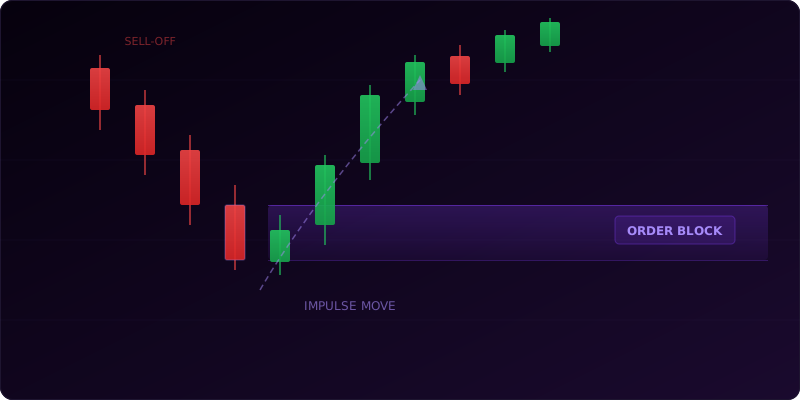
When an order block forms, price moves away from it aggressively. This confirms institutional positioning at that zone. But you didn't have a position at that point - you need price to come back to the zone so you can enter where the institutions did.
The retest is your opportunity to enter at the same price level where institutional money positioned, with the impulse move as proof that the level works.
Step 1: How Do You Confirm the Block Is Valid?
Before waiting for a retest, verify the order block qualifies:
Structure break present? The impulse from the OB must break a swing point (BoS or ChoCh). Without this, the block lacks institutional confirmation.
Strong departure? The move away should be impulsive - large candles, minimal pullback. A slow drift away suggests weak positioning.
Still fresh? The block hasn't been retested yet. First tests are highest probability.
Aligned with structure? In a bullish trend, you're only looking at bullish (demand) order blocks. In bearish, only bearish (supply) blocks.
Step 2: How Do You Define the Zone?
The order block zone is defined by the candle's range:
- Full zone: The entire high-to-low range of the order block candle
- Body zone: Just the open-to-close range (tighter, more aggressive)
- Extended zone: Some traders extend the zone slightly beyond the candle for a buffer
Which to use?
- Full zone gives you more room but wider stops
- Body zone gives precision but might miss entries where price only reaches the wick area
- Start with the full zone and refine based on your backtesting
Step 3: How Do You Wait for the Return?
This is where patience matters. After the impulse move, price will eventually pull back. Your job is to wait.
Signs the retest is coming:
- Price starts making lower highs (for bullish OB retest) or higher lows (for bearish OB)
- Momentum weakens - candles get smaller, wicks appear
- Price is approaching the zone - you can see it in the candle structure
Don't do this:
- Don't set a limit order at the zone and walk away. You need to see what happens when price arrives.
- Don't enter early because price is "close enough." Wait for it to actually reach the zone.
Step 4: How Do You Confirm at the Zone?
Price has reached the order block. Now you need a trigger before entering:
Trigger 1: Reversal Candlestick
A strong rejection candle at the zone - long wick, close in the direction you want to trade. Pin bars, engulfing candles, and hammer patterns at order blocks are classic triggers.
Trigger 2: Fair Value Gap
An FVG forming at or near the order block provides structural confluence. The block gives you the area; the FVG gives you the imbalance confirmation.
Trigger 3: Lower Timeframe Structure Shift
Drop to a lower timeframe and look for a Change of Character within the order block zone. If the 15m shows a ChoCh at a 1H order block, you have timeframe-confirmed reversal.
Trigger 4: Volume Spike
Increased volume as price enters the zone suggests significant market interest — orders being filled at the level.
Best case: multiple triggers align. An OB retest with an FVG, a lower TF ChoCh, AND a reversal candle is about as high-probability as it gets. An indicator like Institutional Price Blocks can help automate the detection of these setups.
GrandAlgo
See these concepts automated on your charts
18 TradingView indicators — smart money, price action, supply/demand, and more.
Step 5: How Do You Execute the Entry?
Entry price: On the close of the confirmation candle, or at the FVG retest if using gap-based entry.
Stop-loss placement:
- Standard: Below the order block low (bullish) or above the OB high (bearish)
- Tight: Below the body of the OB candle (more aggressive, smaller stop)
- With buffer: A few ticks beyond the OB boundary for noise
Position sizing: Calculate based on the stop distance and your risk per trade (1-2% of account).
Step 6: How Do You Define Targets?
Target 1 - Structural: The swing point that the original impulse created. If the order block launched price to a new high, that high is your first target.
Target 2 - Opposing zone: The next order block or supply/demand zone in the opposite direction.
Target 3 - Liquidity: The next obvious liquidity target - session high/low, previous day H/L, or obvious swing point where stops are likely clustered.
Step 7: How Do You Manage the Trade?
- At 1R profit: Move stop to break-even
- At Target 1: Close 50% of the position
- Remaining 50%: Trail using structural stops (below the most recent higher low for longs)
- If momentum is strong: Let the runner go to Target 2 or 3
What Should Be on Your Retest Quality Checklist?
Before entering any order block retest, score it:
- Structure break present (BoS or ChoCh) - Required
- Strong impulse departure - Required
- First retest (fresh zone) - Strongly preferred
- Aligned with higher TF structure - Required
- Confirmation trigger at the zone - Required
- Risk-reward at least 1.5:1 - Required
- FVG confluence - Bonus
- In premium/discount alignment - Bonus
- Within a kill zone - Bonus
If you're missing any "Required" item, skip the trade. The bonus items increase probability but aren't dealbreakers.
What If the Retest Fails?
Order blocks fail. It happens. When they do:
- Your stop-loss protects you - this is why it exists
- If price swept a previous high/low before breaking through, the failed OB may become a breaker block in the opposite direction. If no liquidity was swept (a failure swing), it becomes a mitigation block instead
- Don't revenge trade the same zone. If it failed, move on to the next setup.
- Log the trade and review what was different about this block vs. ones that worked
Frequently Asked Questions
An order block retest happens when price returns to a previously formed order block after an impulsive move away. Traders use the retest to enter near the institutional zone instead of chasing the original displacement.
Yes. First retests are usually higher probability because the zone is still fresh and unfilled orders may remain. Later retests are weaker because each visit can absorb more of the original supply or demand.
A limit order can work in tested systems, but newer traders should usually wait for confirmation at the zone. Rejection, lower-timeframe structure shift, or FVG confluence helps avoid entering a block that is about to fail.
The standard stop goes beyond the order block boundary with a small buffer. Aggressive traders may use the body of the block, but that increases the chance of being stopped by normal wick movement.
A retest is weak or invalid when there was no structure break, the departure was slow, the block has already been tested multiple times, or price closes decisively through the zone.
What Rules Should You Trade Order Block Retests By?
- The retest is where the actual trade happens - block identification is preparation
- Always require a confirmation trigger before entering at a retest
- First retests are highest probability - second and third tests are weaker
- Place stops beyond the block boundary with a small buffer
- Use multiple targets with partial profit-taking for optimal trade management
- Score each retest against a quality checklist before committing
- Failed retests aren't failures if your risk was managed - they're data


