ETH Apr 13 - 15M FVG Signals
- Market
- Crypto
- Timeframe
- 15M
- Date
- April 13, 2026
Ethereum 15-minute chart. Gap Sniper detected 51 FVGs with 3 actionable signals — 1 buy and 2 sell. Signals fire when price revisits identified fair value gaps.
Snipes high-probability fair value gap retests, generating Buy and Sell signals with automatic stop-loss and take-profit levels based on the gap structure.
GapSniper is a fair value gap (FVG) indicator that finds bullish and bearish gaps, then waits for a qualified retest before printing a Buy/Sell signal. Each signal includes automatic stop-loss and take-profit levels based on the gap structure, so you can execute without manual marking. Combine with higher-timeframe bias and stricter filters for cleaner setups.
Signals
Buy / Sell
Markets
All
Style
Overlay
Risk Mgmt
SL & TP
GapSniper automates the identification and trading of fair value gaps -price imbalances created by aggressive institutional order flow. The indicator detects gaps as they form, tracks them in real time, and waits for a qualified retest before generating a signal. Built-in directional filters ensure trades align with the prevailing trend, while configurable strictness settings let you dial in signal frequency to match your trading style. Every signal comes packaged with precise stop-loss and take-profit levels derived from the gap boundaries and your chosen risk-reward ratio, so you can execute consistently without manual calculations.
GapSniper detects bullish and bearish fair value gaps as they form and tracks them in real time. A bullish FVG is identified when the current bar low is above the high from two bars ago, creating an upward price imbalance; a bearish FVG is the inverse. Configurable strictness settings add directional filtering using a 21-period simple moving average and a premium/discount zone calculated from the 45-bar highest high and lowest low, ensuring gaps are only tracked when they align with the broader market context.
Once a gap is detected and visualized on the chart, the indicator monitors for a qualified retest. When price pulls back and touches the gap zone, a pending entry line is drawn at the recent highest high (for buys) or lowest low (for sells). If price reaches this entry level within a configurable number of candles, a Buy or Sell signal fires. The gap is invalidated if price closes through it before the entry triggers, preventing stale setups from lingering.
Every signal comes with automatically calculated stop-loss and take-profit levels. The stop-loss is derived from the gap boundaries with three configurable anchor points (near edge, midpoint, or far edge) plus an adjustable offset multiplier. The take-profit is calculated from the entry-to-stop distance multiplied by your chosen risk-reward ratio, giving you a complete trade plan with every signal.
Dated GapSniper charts from the public proof archive: what the indicator marked, and how price behaved around it. No win-rate claims.
Ethereum 15-minute chart. Gap Sniper detected 51 FVGs with 3 actionable signals — 1 buy and 2 sell. Signals fire when price revisits identified fair value gaps.

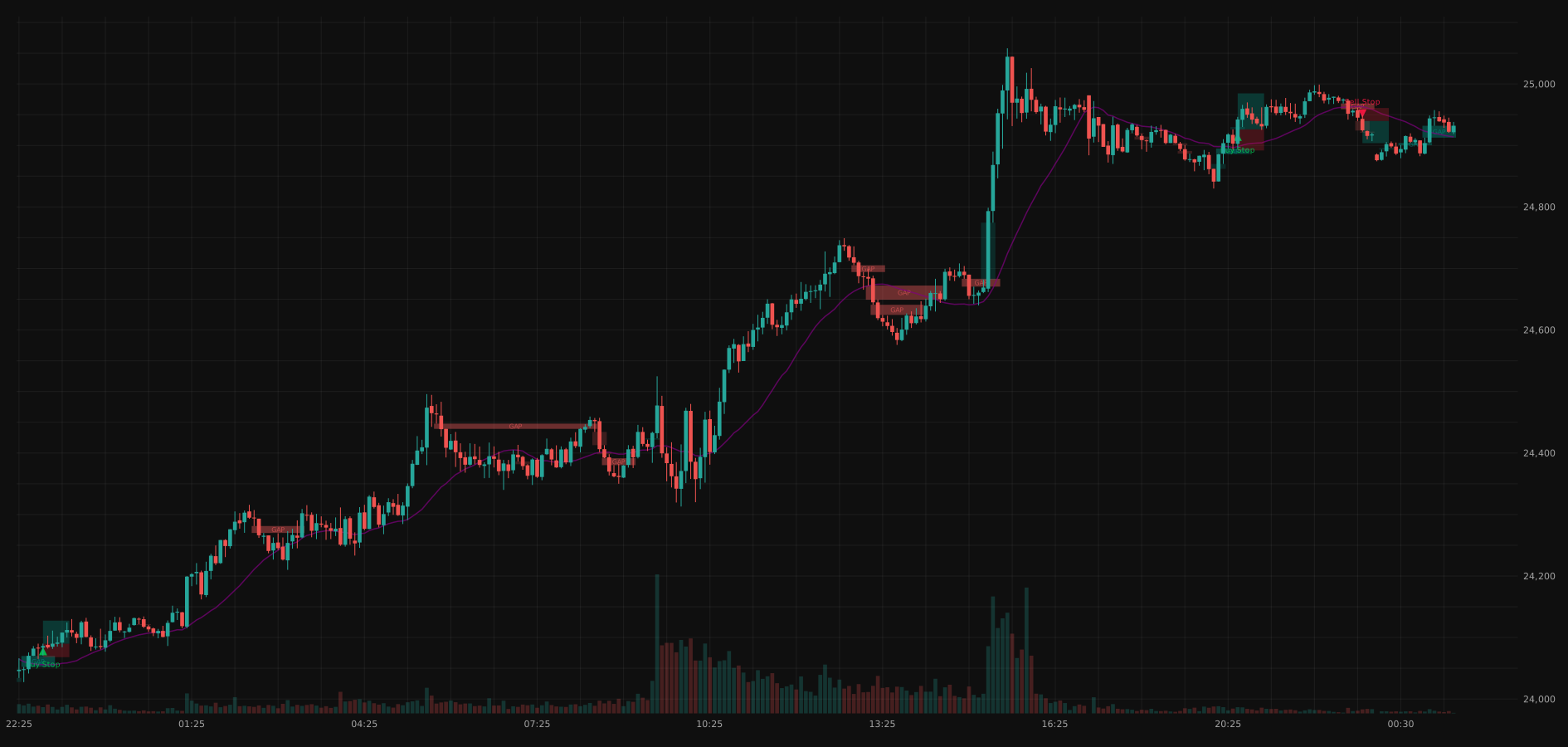
Nasdaq futures 5-minute chart highlighting fair value gaps (FVGs) and gap sniper signals. The indicator identifies unfilled price gaps and maps buy/sell opportunities when price revisits these zones.
Identifies bullish and bearish fair value gaps as they form, highlighting price imbalances where institutional order flow has left unfilled orders waiting to be revisited.
Waits for price to return and touch the gap zone, then generates a signal only when retest conditions are met within a configurable window.
Each signal comes with automatically calculated stop-loss and take-profit levels based on the gap boundaries and your chosen reward-to-risk ratio.
Incorporates trend context through moving average and premium/discount zone awareness, ensuring signals align with the broader market direction.
Practical ways to trade with GapSniper.
The core GapSniper setup: enter when price retests a fair value gap and then breaks out to the entry level, confirming that the gap is being respected as institutional support or resistance.
Use a higher risk-reward ratio with the GAP Near stop-loss setting to create tight-stop scalping entries on lower timeframes.
Use the GAP Far stop-loss setting on higher timeframes for swing trades that give the position room to breathe within the full gap range.
Key settings you can configure in TradingView. See the full setup guide for detailed walkthroughs.
| Parameter | Type | Default | Description |
|---|---|---|---|
| Enter Within X Candles | int | 7 | Number of candles after gap formation within which a retest must occur for a valid signal. |
| Strictness | int | 1 | Controls how strict the retest validation is. Higher values require more precise gap retests. |
| Use Highest/Lowest for Entry | bool | true | Uses the highest or lowest point of the entry candle for more conservative entry placement. |
| RR (Risk-Reward) | float | 1.7 | The reward-to-risk ratio used to calculate take-profit distance from the entry. |
| Stop At | string | GAP Near | Determines where the stop-loss is placed relative to the gap structure. |
| SL Offset | float | 0.1 | Additional offset added to the stop-loss placement for extra breathing room. |
Start with Strictness 1 to see the full range of signals. Increase it if too many signals fire or if you want to focus only on the cleanest gap retests.
The Enter Within X Candles parameter exists because gaps lose relevance over time. Stale gaps that haven't been retested within the window are less likely to produce quality reactions.
The built-in SL is calculated from the gap structure. Moving your stop further away defeats the purpose of the indicator's risk management system.
Strictness 1 filters gaps using a premium/discount zone: bullish gaps must form below the 45-bar midpoint and bearish gaps must form above it. Strictness 2 adds a second layer by also requiring alignment with the 21-period SMA. Higher strictness produces fewer but more directionally aligned signals.
The stop-loss is anchored to the gap boundaries. GAP Near uses the nearest gap edge, GAP Mid uses the gap midpoint, and GAP Far uses the furthest gap edge. An additional SL Offset multiplier extends the stop beyond the chosen anchor by a percentage of the entry-to-anchor distance, giving you breathing room against wicks.
After a gap retest triggers a pending entry line, price must reach the entry level within the specified number of candles. If it does not, the pending entry is discarded. This prevents stale entry lines from accumulating on the chart and ensures you are only entering fresh setups with active momentum.
Yes. GapSniper works on any market that produces fair value gaps -- forex, crypto, stocks, indices, and commodities. The ATR-based gap detection adapts to each instrument volatility automatically. Lower timeframes tend to produce more signals, while higher timeframes produce fewer but more significant gap formations.
Included with every subscription plan alongside all 18 premium indicators. Subscribe today for just $19/mo.
More tools in Buy & Sell Signals View all Buy & Sell Signals →