How to Trade FVG Retests Step by Step
A practical walkthrough of trading FVG retests — from identifying the gap to timing your entry, placing stops, and managing the trade to completion.

Fair value gap (FVG) retests are one of the most common entry methods in Smart Money trading. The concept is simple: a gap forms, price moves away, then returns to fill the gap - and you enter on that return.
But execution matters. Most FVG retest losses come from poor timing and weak filtering, not from the concept being flawed. Here's the step-by-step process.
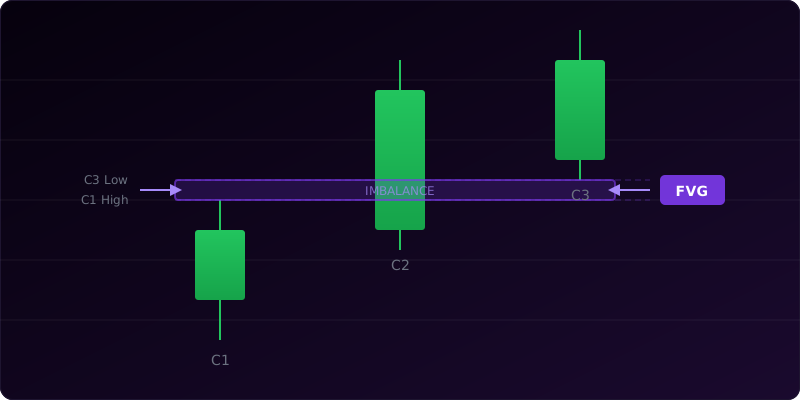
Step 1: How Do You Spot the FVG?
A valid FVG has three candles creating a gap:
- Candle 2 moves aggressively
- The gap between Candle 1's extreme and Candle 3's extreme is the FVG
Quick filter: Is the gap at least half the size of the average candle on your timeframe? If it's a tiny sliver, skip it. Small gaps are noise.
Step 2: How Do You Check the Context?
Before waiting for a retest, verify:
Market structure: Is the FVG aligned with the trend?
- Bullish FVG in bullish structure → Valid for longs
- Bearish FVG in bearish structure → Valid for shorts
- FVG against the structure → Skip or trade with extreme caution
Location: Where did the FVG form?
- At a structural break (BoS/ChoCh) → High significance
- At a key level (PDH/PDL, OB, session level) → High significance
- In the middle of a random move → Lower significance
Timeframe: What timeframe is the FVG on?
- 4H/Daily FVG → High significance, wider zones, stronger reactions
- 1H FVG → Moderate significance
- 5m/15m FVG → Lower significance on its own (needs HTF context)
If the context checks out, mark the gap and wait.
Step 3: How Should You Wait for the Retest?
Patience is everything. The retest might take hours, days, or never come at all.
What a retest looks like:
- Price pulls back toward the FVG zone
- Candles approaching the gap often get smaller (momentum fading)
- Price enters the gap zone
What NOT to do:
- Don't chase the initial impulse - that's a momentum trade, not an FVG retest
- Don't enter before price reaches the gap because "it's close enough"
- Don't set a limit order and walk away - you need to see the reaction
Step 4: How Do You Identify Your Entry Level?
Three entry approaches within the FVG zone:
Edge Entry (Conservative)
Enter when price touches the near edge of the FVG - the first boundary price encounters.
- Pro: Doesn't require price to go deep into the gap
- Con: Wider stop (to the far edge), lower R:R
Midpoint Entry (Moderate)
Enter at the 50% level (consequent encroachment) of the FVG.
- Pro: Better price, better R:R
- Con: Price might reverse before reaching the midpoint (missed entry)
Far Edge Entry (Aggressive)
Enter at the far edge of the FVG - the deepest point of the gap.
- Pro: Best possible price, tightest stop, highest R:R
- Con: Price often doesn't reach the far edge - many missed entries
Recommended for most traders: The midpoint entry balances precision with fill rate.
Step 5: How Do You Confirm Before Entry?
Price reaching the gap zone isn't automatically an entry. Wait for confirmation:
Reversal candle: A pin bar, engulfing, or strong rejection candle within the gap zone. The candle should show price respecting the gap.
Lower timeframe ChoCh: Drop to a lower timeframe and wait for a structural shift within the gap zone. A 5m ChoCh at a 1H FVG is strong confirmation. The CRT with Key Levels indicator can automate this FVG retest detection across timeframes.
Volume surge: Increased volume as price enters the gap suggests active order filling — strong participation at the level.
No confirmation = no entry. The gap provides the area. Confirmation provides the trigger.
GrandAlgo
See these concepts automated on your charts
18 TradingView indicators — smart money, price action, supply/demand, and more.
Step 6: Where Should You Place Your Stop-Loss?
Standard stop: Beyond the far edge of the FVG with a small buffer (2-5 ticks). If price closes beyond the gap, it's being filled completely and your thesis is wrong.
Aggressive stop: Just beyond the midpoint if you entered at the near edge. Tighter stop, higher risk of stop-out, but better R:R.
Structure-based stop: Beyond the nearest structural level past the FVG. This gives more room but may produce lower R:R.
Calculate R:R before entering: If the stop distance doesn't give you at least 1.5:1 reward-to-risk to your first target, skip the trade.
Step 7: How Do You Set Your Targets?
Target 1 - The impulse origin: The price level where the impulse that created the FVG started. This is the most reliable first target.
Target 2 - The impulse extreme: The highest point (bullish) or lowest point (bearish) of the impulse move. Price often returns to at least this level.
Target 3 - Next structural level: The next significant swing point, order block, or liquidity target beyond the impulse.
Step 8: How Do You Manage the Trade?
- At 1R profit: Move stop to break-even (entry price)
- At Target 1: Close 50% of position
- Trailing the rest: Move stop below each new higher low (longs) or above each new lower high (shorts)
- At Target 2 or 3: Close remaining position
If Price Stalls
If price reaches the FVG zone, you enter, and price goes flat (no meaningful movement for several candles):
- Tighten your stop to just beyond the gap boundary
- If still flat after your patience threshold (e.g., 10-15 candles), close at current price
- Dead trades aren't worth the mental energy or capital lock-up
What Is the Full FVG Retest Checklist?
Before entering any FVG retest:
- FVG is aligned with market structure direction
- FVG formed at a significant location (structural break, key level)
- Gap is meaningful size (not a tiny sliver)
- Gap is fresh (first or second test only)
- Price has reached the gap zone (not just approaching)
- Confirmation is present (reversal candle, LTF structure shift, volume)
- R:R is at least 1.5:1 to first target
- Stop-loss is placed beyond gap boundary
- Position size is 1-2% risk of account
All checked? Enter. Any "Required" item missing? Skip.
Frequently Asked Questions
An FVG retest is when price returns to a fair value gap after the initial displacement move. Traders watch the return for signs that the gap is respected before entering in the direction of the original impulse.
Common entry areas are the near edge, the midpoint or consequent encroachment, and the far edge of the gap. The midpoint often balances fill probability with better reward-to-risk.
No. Some gaps are never revisited, and others are filled completely without reacting. Waiting for a retest and confirmation helps avoid chasing the original impulse or trading weak gaps.
Useful confirmation includes a rejection candle, lower-timeframe change of character, displacement away from the gap, or volume expansion at the level. The gap marks the area, but confirmation provides the trigger.
A standard stop goes beyond the far edge of the gap with a small buffer. Some traders use structure-based stops when the gap is close to a nearby swing point or order block.
What Should You Remember About FVG Retests?
- FVG retests are the core entry method in gap trading - not the initial impulse
- Always verify context first (structure, location, timeframe) before waiting for a retest
- Three entry levels - edge, midpoint, far edge - each with trade-offs
- Never enter without confirmation - the gap is the area, not the trigger
- Calculate R:R before entry - if it doesn't meet your minimum, pass
- Scale out with partial profits and trail the remainder
- Use the checklist before every trade to maintain discipline


