Types of Fair Value Gaps Explained
Not all FVGs are the same. Learn the different types of fair value gaps - standard, inverting, engulfing, retracing, and more - and what each tells you.

Most traders learn fair value gaps as a single concept: three candles, a void, price returns to fill it. But there are actually several distinct FVG types, each carrying different implications for how price is likely to behave.
Understanding these types transforms FVG trading from a simple pattern to a nuanced analytical framework.
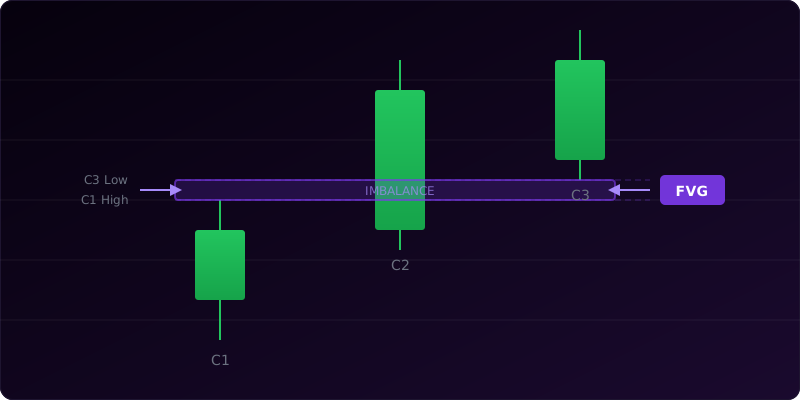
What Is a Standard FVG?
The classic three-candle pattern. An impulse candle creates a gap between the surrounding candles' ranges.
Characteristics:
- Clean, clear gap with an obvious impulse candle
- Most common type
- Moderate directional conviction
Trading implication: Baseline probability. Trade these when aligned with market structure and supported by additional confluence (order blocks, key levels).
What Is an Inverting FVG?
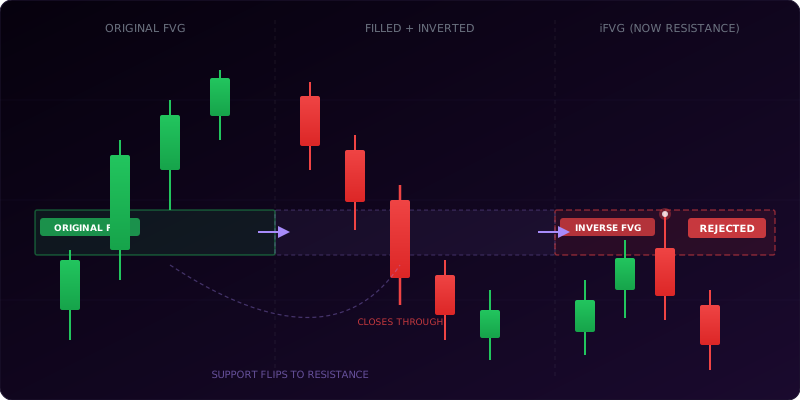
An Inverting FVG is one that has been completely filled and price continued through in the opposite direction. The gap that was originally bullish becomes a bearish zone, and vice versa.
How it forms:
- A bullish FVG forms (gap below an impulse up-move)
- Price returns to the gap (normal retest)
- Instead of bouncing, price fills the gap entirely and continues lower
- The zone flips - it's now a bearish FVG (inverse)
Trading implication: High-probability reversal signal. When a gap inverts, it means the original institutional intent was overwhelmed. The inverse gap often provides excellent entries in the new direction.
This is one of the most powerful FVG types. An inverse FVG at a liquidity sweep is arguably the highest-confluence setup in Smart Money trading.
What Is an Engulfing FVG?
An Engulfing FVG is where the impulse candle completely engulfs the prior candle's entire range. The gap exists not because of a moderate move, but because of an exceptionally aggressive one.
Characteristics:
- The impulse candle's range is larger than Candle 1's entire range
- Strong, decisive directional move
- Often accompanies news events or major session opens
Trading implication: Higher probability than standard FVGs. The engulfing nature shows strong institutional conviction. These gaps tend to produce stronger reactions on retest.
What Is a Retracing FVG?
A Retracing FVG forms during a pullback within an existing trend. As price retraces, the pullback itself creates a gap.
How it forms:
- Price is in a strong uptrend
- A pullback begins (price moves down)
- During the pullback, a bearish FVG forms
- The trend resumes
Trading implication: Trend continuation signal. The retracing gap marks where the pullback paused - and when price resumes the trend, this gap often gets filled as part of the continuation. These are ideal for adding to positions in the trend direction.
Caution: Don't confuse a retracing FVG with a reversal. The context (existing strong trend + shallow pullback) is what makes it a retracing gap. Understanding FVGs vs. liquidity voids also helps clarify these distinctions.
GrandAlgo
See these concepts automated on your charts
18 TradingView indicators — smart money, price action, supply/demand, and more.
What Is a Long-Tail FVG?
An FVG where one of the boundary candles (Candle 1 or Candle 3) has an unusually long wick extending into the gap area.
Characteristics:
- Long wick partially fills the gap
- The actual unfilled gap is smaller than it appears at first glance
- The wick indicates aggressive activity at the gap boundary
Trading implication: The wick already represents some order filling within the gap area. The remaining unfilled portion is the true zone of interest. These gaps sometimes produce quicker reactions because there's less gap left to fill.
How to trade: Focus on the unfilled portion of the gap (between the wick tip and the opposing candle), not the full candle range.
What Is a Balancing FVG?
An FVG that appears to be closing a previous gap in the opposite direction. Price creates a new imbalance in the process of rebalancing an old one.
How it forms:
- A bullish FVG exists (unfilled demand below)
- Price drops to fill this bullish gap
- During the drop, a bearish FVG forms above
- The new bearish gap is "balancing" the old bullish gap
Trading implication: Equilibrium-seeking behavior. Price is oscillating between imbalances rather than committing to a direction. Trade with caution - these often appear in ranging or transitional markets.
Best approach: Wait for market structure to confirm a direction before trading balancing FVGs.
What Is Consequent Encroachment?
Not a separate FVG type, but a critical concept: consequent encroachment is the 50% midpoint of any FVG.
Why the midpoint matters:
- Many traders use the 50% level as their entry within a gap
- Price reaching the midpoint has partially filled the gap
- If price pushes past the midpoint, the full fill becomes more likely
- The midpoint often acts as a decision level - reactions here are significant
How to use it:
- Conservative traders enter at the near edge of the gap
- Aggressive traders enter at the midpoint (consequent encroachment)
- If price closes beyond the midpoint, the gap's influence is significantly weakened
How Should You Use FVG Types in Your Trading?
Prioritize High-Probability Types
Not all FVGs deserve equal attention:
- Inverse FVGs - Highest priority (confirmed institutional shift)
- Engulfing FVGs - High priority (strong conviction)
- Standard FVGs - Moderate priority (needs confluence)
- Retracing FVGs - Context-dependent (good for trend continuation)
- Long-tail FVGs - Adjusted zones (focus on unfilled portion)
- Balancing FVGs - Low priority (uncertain direction)
Combine Type With Context
A standard FVG at a strong order block in the direction of the trend is better than an engulfing FVG in the middle of nowhere against the structure. Type is one factor - context is everything.
Track Multiple Types
The best FVG indicators classify multiple types automatically. The Smarter Money Suite classifies multiple FVG types, letting you quickly see which gaps carry the most weight without manually analyzing each three-candle sequence.
Frequently Asked Questions
The main FVG types are standard, inverse, engulfing, retracing, long-tail, balancing, and consequent encroachment gaps. Each type describes a different imbalance behavior.
Standard and retracing FVGs are common entry zones when they align with trend, liquidity, and market structure. Inverse FVGs are often better for reversal confirmation.
An inverse FVG forms when price violates a prior gap and then uses that same area as resistance or support in the opposite direction.
Consequent encroachment marks the midpoint of a fair value gap. Traders use it as a precision reaction level, partial fill target, or invalidation reference.
No. Trade only gaps that align with higher-timeframe bias, liquidity context, displacement, and a logical invalidation point. Many gaps are just noise.
Key Takeaways
- There are at least six distinct FVG types, each with different trading implications
- Inverse FVGs are the highest-probability type - they confirm institutional shifts
- Engulfing FVGs show strong conviction and tend to produce strong reactions
- Retracing FVGs are trend continuation signals - ideal for adding to positions
- The midpoint (consequent encroachment) of any FVG is a key decision level
- Always combine FVG type with market structure context - type alone isn't enough
- Indicators that classify multiple FVG types give you a significant analytical edge


