FVG vs Liquidity Void: How to Tell Them Apart (With Examples)
An FVG is a 3-candle imbalance. A liquidity void is a large empty zone with no trading activity. Both are imbalances, but you trade them differently.

Both fair value gaps and liquidity voids describe areas where price moved without normal order flow. They're often confused or used interchangeably. But they're different concepts with different characteristics and different trading implications.
What Is a Fair Value Gap as a Precise Pattern?
A fair value gap is a specific three-candle pattern where the impulse candle creates a gap between the surrounding candles' ranges.
Key characteristics:
- Defined by exactly three candles
- The gap has a precise boundary (Candle 1 extreme to Candle 3 extreme)
- Typically small to moderate in size
- Price tends to return and fill these gaps
- Used as precise entry zones on retests
- Can be classified into multiple types (standard, inverting, engulfing, etc.)
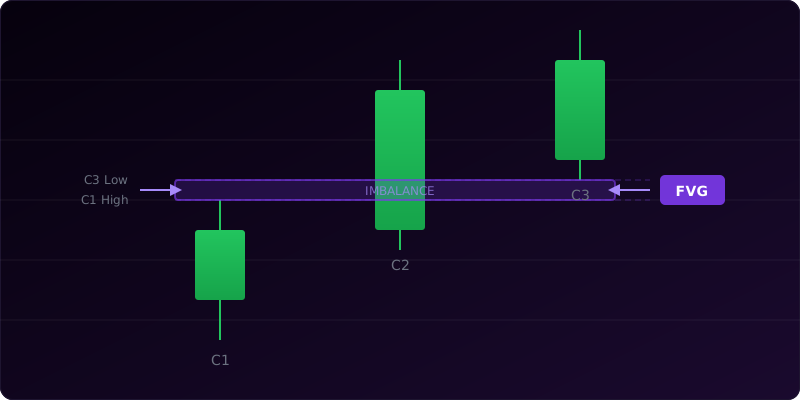
Think of it as: A targeted price void at a specific three-candle structure.
What Is a Liquidity Void as a Broad Imbalance?
A liquidity void is a large area where price moved extremely fast with minimal trading activity. There's no specific candle-count pattern - it's simply a region where very little two-sided order flow occurred.
Key characteristics:
- Not defined by a specific candle pattern
- Can span many candles worth of price movement
- Typically large - bigger than standard FVGs
- Created by extreme events (news, session opens, major structure breaks)
- Price may return to fill the void, but often in stages
- Less precise boundaries - the entire area is the void
Think of it as: A highway where price drove through at full speed without stopping.
How Do FVGs and Liquidity Voids Compare Side by Side?
| Aspect | Fair Value Gap | Liquidity Void |
|---|---|---|
| Pattern | Specific 3-candle structure | No specific pattern |
| Size | Small to moderate | Large, often spanning many candles |
| Boundaries | Precise (Candle 1 to Candle 3) | Approximate (start to end of fast move) |
| Frequency | Common (several per session) | Rare (major moves only) |
| Fill behavior | Price often returns and fills completely | May fill in stages or partially |
| Entry precision | High (trade the gap boundary) | Low (the void is too large for precise entry) |
| Timeframe | Works on all timeframes | Most visible on higher timeframes |
How Do FVGs and Liquidity Voids Relate?
Fair value gaps often exist within liquidity voids. When price makes a massive move (creating a void), individual three-candle gaps form along the way.
Example:
- Price drops 200 points in 15 minutes during a news event
- This entire 200-point move is a liquidity void - price flew through with minimal interaction
- Within that move, multiple individual FVGs formed at specific candle structures
- The FVGs give you precise levels within the broader void
GrandAlgo
See these concepts automated on your charts
18 TradingView indicators — smart money, price action, supply/demand, and more.
What Are the Trading Implications?
Trading FVGs
FVGs provide precise entry zones:
- Wait for price to return to the gap boundary
- Enter on confirmation at the gap
- Stop-loss beyond the gap boundary
- Clear, defined risk
Best for: Active entries with defined risk/reward.
Trading Liquidity Voids
Voids provide directional context rather than precise entries:
- A large void below price suggests eventual downside filling
- Price may take days or weeks to fill a large void
- Entering anywhere in the void is imprecise
- Instead, look for FVGs within the void as your actual entry points
Best for: Understanding broader market dynamics and potential targets.
Combining Both
The most effective approach uses both:
- Identify liquidity voids on higher timeframes - these show you where price is likely to travel (directional context)
- Find FVGs within or at the edges of voids - these give you precise entry zones
- Trade the FVGs with the void as your larger thesis
When Do Voids and FVGs Not Fill?
Strong Trends
In powerful trending markets, both FVGs and voids may remain unfilled for extended periods. The trend's momentum keeps price moving without retracing.
Void behavior in trends: Large voids created by trend impulses often fill only when the trend exhausts - which could be weeks or months later.
FVG behavior in trends: Individual FVGs within the trend may fill during pullbacks, but the broader void remains.
News Events
Major news events create voids that may never fully fill if the news represents a fundamental shift. A central bank decision or geopolitical event can create a permanent gap in the market.
How Do You Identify Each on Your Chart?
Spotting FVGs
Look for the three-candle pattern:
- Check if Candle 1's high and Candle 3's low don't overlap (bullish)
- Check if Candle 1's low and Candle 3's high don't overlap (bearish)
- Mark the gap between them
Automated FVG indicators like Smarter Money Suite handle this efficiently.
Spotting Liquidity Voids
Look for large, one-directional moves:
- Multiple consecutive candles in the same direction with large bodies
- Minimal wicks (price didn't pause or pull back)
- Often associated with high-volume candles
- The entire span of the move is the void
What Practical Framework Should You Use?
-
Zoom out - On the 4H or Daily chart, identify any liquidity voids (large unfilled areas). These are your potential target zones.
-
Zoom in - Within or at the edges of these voids, identify specific FVGs. These are your entry points.
-
Trade the FVGs - Use the FVG retest methodology (confirm, enter, stop, target) with the knowledge that the broader void supports the direction.
-
Target the void fill - Your extended targets can be the far edge of the liquidity void, while your immediate targets are the standard FVG targets.
Frequently Asked Questions
An FVG is a specific three-candle imbalance with a defined gap between candle one and candle three. A liquidity void is a broader area where price moved quickly with little trading activity. FVGs are precise; voids are wider context zones.
No. FVGs are often used as cleaner pullback entry zones. Liquidity voids are usually used to understand where price may rebalance, accelerate, or target. A void can contain several smaller FVGs inside it.
No. Strong trends can leave imbalances unfilled for a long time. A gap or void is more likely to fill when price loses momentum, reaches opposing liquidity, or structure shifts back toward the inefficient area.
FVGs are usually better for precise entries because they have cleaner boundaries. Liquidity voids are better for broader mapping, targets, and context. Many traders refine a liquidity void by locating the strongest FVG inside it.
Use the definition. If it is a three-candle gap, call it an FVG. If it is a larger fast-move area with thin trading and poor balance, call it a liquidity void. The label matters because trade management differs.
Key Takeaways
- FVGs are precise 3-candle patterns with defined boundaries - used for entries
- Liquidity voids are broad areas of fast, one-directional movement - used for context and targeting
- FVGs often exist within liquidity voids - giving you precision inside a larger thesis
- Trade FVGs for entries and use voids for directional context
- Both may remain unfilled in strong trends or after major news events
- The best approach combines both: identify voids for the bigger picture, trade FVGs for precision


