Session Liquidity: Asia, London, and New York Explained
Each trading session creates and targets liquidity differently. Learn how Asia, London, and New York interact and how to trade the session liquidity cycle.

The 24-hour trading day isn't one continuous flow - it's three distinct sessions, each with its own character, liquidity profile, and relationship to the others.
Understanding how Asia, London, and New York interact through liquidity is fundamental to timing your trades.
What Are the Three Trading Sessions?
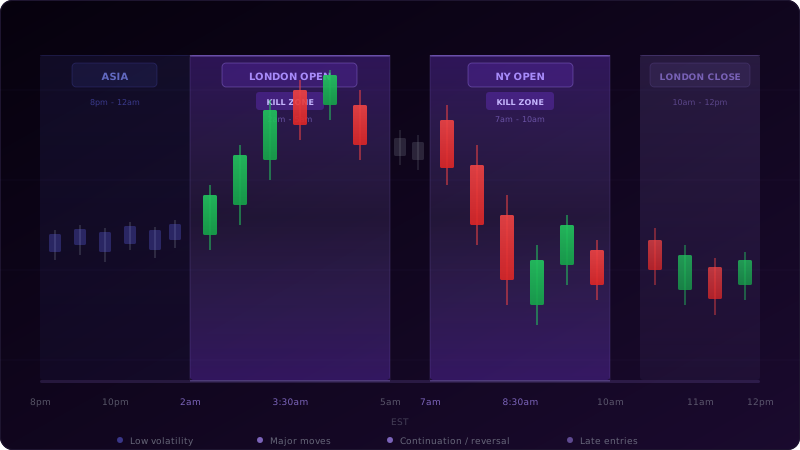
Asian Session (Approx. 7:00 PM - 4:00 AM ET)
Character: Low volatility, range-building, consolidation.
What happens:
- Price typically trades in a relatively tight range
- Volatility is lower than London or New York
- Liquidity accumulates above and below the range
Liquidity role: Asia creates the liquidity that London and New York will target. The Asian session high and low become the first targets of the London open.
London Session (Approx. 3:00 AM - 12:00 PM ET)
Character: High volatility, directional moves, first major liquidity events.
What happens:
- European banks and institutions come online
- Price often makes the day's first significant directional move
- The Asian range high or low gets swept within the first few hours
Liquidity role: London sweeps Asian liquidity and creates new levels. London typically takes one side of the Asian range (high or low), establishing the directional bias for the day.
New York Session (Approx. 8:00 AM - 5:00 PM ET)
Character: Highest volume, strongest moves, overlap with London creates maximum activity.
What happens:
- The London/NY overlap (8:00 AM - 12:00 PM ET) is the most active period
- NY either continues London's direction or reverses it
- The day's largest moves often occur during this overlap
Liquidity role: New York targets London's liquidity and completes the daily cycle. NY might sweep London's high/low before continuing or reversing.
How Does the Session Liquidity Cycle Work?
The daily cycle flows like this:
- Asia builds the range - Establishes the high and low, accumulates orders at both extremes
- London sweeps one side - Takes out the Asian high or Asian low, triggering stops and establishing direction
- New York refines - Continues London's direction or reverses after sweeping London's levels
- Asia resets - The next Asian session builds a new range based on NY's closing structure
This cycle is remarkably consistent. Not every day follows it perfectly, but understanding the pattern gives you a structural framework for the trading day. The opening range breakout strategy formalizes the New York phase — marking the first 15 minutes after the open and trading the breakout with session-aware filters.
How Do You Trade Session Liquidity?
Pre-Session Preparation
Before your trading session begins:
- Mark the Asian range - high and low
- Mark the previous day high and low - PDH and PDL
- Mark the previous week high and low - if relevant to your timeframe
- Identify which side was swept - Did London already take the Asian high? The low?
- Note the higher timeframe bias - Daily/4H market structure direction
London Session Trades
The Asian sweep trade:
- Wait for London to sweep one side of the Asian range
- Look for a reversal signal at the swept level (structure shift, FVG, reversal candle)
- Enter in the reversal direction
- Target the opposite Asian level or the next significant liquidity pool
When to be cautious: If the daily structure strongly favors one direction, London's sweep in that direction might be continuation, not a reversal. Only take the reversal trade if the context supports it.
New York Session Trades
The London sweep trade:
- Identify London's high and low
- Wait for NY to sweep one of these levels during the overlap
- Look for a reversal or continuation signal
- Enter with clear risk management
The continuation trade:
- London established a clear direction
- NY pulls back within the move (creating FVGs or retesting zones)
- Enter on the pullback in London's direction
- Target the next structural level or session level
Key Timing Windows
London Open (3:00-5:00 AM ET): First sweep of Asian liquidity. High-probability setups.
NY Open (8:00-10:00 AM ET): Highest volume period. London/NY overlap creates the biggest moves.
London Close (10:00 AM-12:00 PM ET): Potential reversals as European traders close positions.
GrandAlgo
See these concepts automated on your charts
18 TradingView indicators — smart money, price action, supply/demand, and more.
How Do Session Levels Work as Targets?
Session levels work as both entry zones and profit targets:
Entry: When price sweeps a session level and reverses, enter on the reversal with the sweep as your stop reference.
Target: When you're in a trade, the next session level is a natural target. Long from the Asian low? Target the Asian high. Short from the London high? Target the London low.
The PDH/PDL Framework
Previous day high (PDH) and previous day low (PDL) are among the most significant levels:
- PDH: Massive buy-side liquidity (shorts' stops, breakout buys)
- PDL: Massive sell-side liquidity (longs' stops, breakdown sells)
- The day often revolves around taking one or both of these levels
How Do Session Liquidity Indicators Help?
Manually marking session levels each day is tedious but essential. Indicators like the Session Fib Fan automate this:
- Auto-plot session boundaries - Asian, London, NY ranges drawn automatically
- PDH/PDL tracking - Previous day levels always visible
- Sweep detection - Alerts or visual markers when price sweeps a session level
- Kill zone highlighting - Visual overlay showing active high-probability windows
When Does the Session Pattern Break?
The cycle doesn't work every day:
- Major news events can override session patterns entirely
- Low-liquidity days (holidays, end of year) produce unreliable session behavior
- Strong trending days may not produce reversals at session levels - price just continues
How to handle: Check the economic calendar before each session. On major news days, reduce size or sit out. On low-liquidity days, don't trade session levels.
Frequently Asked Questions
Session liquidity is the pool of orders created around highs, lows, and ranges from major sessions such as Asia, London, and New York.
Asia often creates the initial range that London and New York later sweep or use as targets.
London often targets Asian session highs or lows to trigger liquidity before starting or setting up the next move.
New York may continue London's move, reverse after sweeping London extremes, or target previous day and session levels.
Yes. News events, holidays, low liquidity, and strong higher-timeframe trends can disrupt the usual Asia-London-New York rhythm.
What Are the Key Takeaways for Session Liquidity?
- Asia builds liquidity, London sweeps it, New York refines the move
- Mark Asian range, PDH/PDL, and session levels before each trading day
- London open typically sweeps one side of the Asian range - trade the reversal or continuation
- The London/NY overlap (8 AM-12 PM ET) produces the day's biggest moves
- Session levels work as both entry zones (after sweeps) and profit targets
- PDH and PDL are the most significant daily liquidity levels
- The pattern is consistent but not guaranteed - major news and holidays disrupt it
- Automate session level marking to save time and maintain consistency


