ICT Concepts: Best Indicators for Smart Money Trading
Which indicators actually implement ICT concepts correctly — from market structure to FVGs, order blocks, and liquidity sweeps. A practical breakdown.

New to ICT? Start with our ICT Trading Basics guide to understand the framework before choosing indicators.
ICT (Inner Circle Trader) concepts have reshaped how retail traders understand the markets. Liquidity sweeps, fair value gaps, order blocks, market structure shifts - these ideas went from niche to mainstream in a few years. And for good reason: they work.
The disconnect is obvious. ICT teaches concepts, not indicators. Most ICT traders manually mark up their charts, which is time-consuming, subjective, and inconsistent. The question is: can indicators reliably automate these concepts without losing accuracy?
Yes - if you choose the right tools.
What Are the Core ICT Concepts (and What Should Indicators Do With Them)?
1. Market Structure (BoS & ChoCh)
Markets move in waves. A Break of Structure (BoS) confirms the trend is continuing. A Change of Character (ChoCh) signals a potential reversal. This is the foundation of everything in ICT trading - understanding market structure is the first step.
What a good indicator does:
- Detects swing highs and lows automatically with configurable sensitivity
- Labels BoS and ChoCh events distinctly on the chart
- Offers multiple confirmation modes (close-based vs. wick-based)
- Works across all timeframes consistently
What a bad indicator does:
- Marks every minor swing as structure
- Doesn't distinguish between BoS and ChoCh
- Uses fixed parameters that don't adapt to different markets
Market structure is the first filter in any ICT system. If your indicator gets this wrong, everything downstream - your entries, your zones, your signals - is compromised.
2. Fair Value Gaps (FVGs)
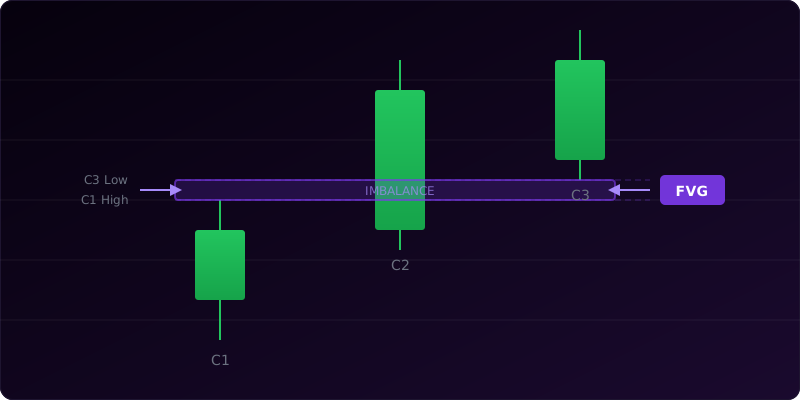
When a candle's range doesn't overlap with the candle two bars prior, a fair value gap exists. This represents an imbalance in order flow - price moved so fast that normal two-sided trading didn't occur. ICT theory says price tends to return and fill these gaps.
What separates great FVG indicators from basic ones:
- Classification depth - Not all FVGs are the same. Standard, inverting, engulfing, retracing, long-tail, and balancing gaps each have different implications. An indicator that classifies seven or more types gives you a genuine edge.
- Lower-timeframe refinement - Narrowing the gap boundaries using lower timeframe data for more precise entries.
- Multi-timeframe overlay - Displaying higher timeframe FVGs on your entry chart.
- Mitigation tracking - Showing when a gap has been partially or fully filled.
A basic FVG indicator that just draws rectangles around every 3-candle gap will clutter your chart with noise. You need classification and filtering.
3. Order Blocks
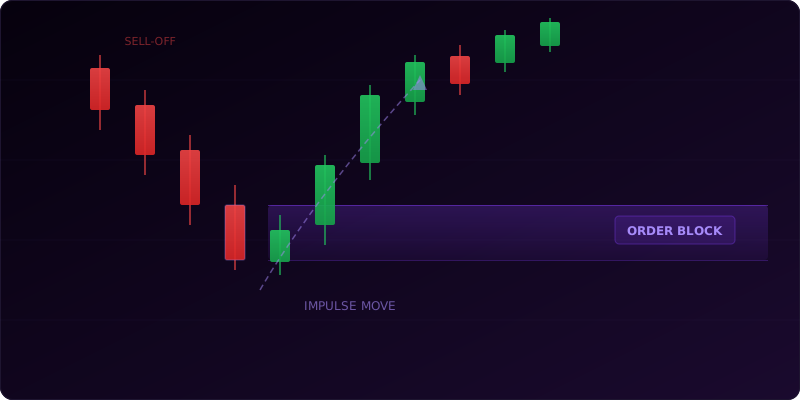
An order block is the last opposing candle before a significant impulse move - representing where institutional traders accumulated or distributed positions. When price returns to this zone, unfilled orders may trigger a reaction.
What matters in an order block indicator:
- Detection happens only at confirmed structure breaks (not every swing)
- Target projection beyond just the zone boundary
- Automatic invalidation when price mitigates the block
- Distinction between BoS-based and ChoCh-based blocks
Most free order block tools mark every swing candle as a block. You end up with dozens of rectangles that have zero institutional significance.
4. Liquidity Concepts
Liquidity sits above swing highs and below swing lows as stop-loss orders. Institutional traders target these pools to fill large positions. A liquidity sweep - where price briefly takes out a level and reverses - is one of the most powerful ICT entry signals.
What to look for:
- Session high/low tracking (Asia, London, New York)
- Previous day/week high, low, and midrange plotting
- Sweep detection - identifying when price takes a level and reverses
- Liquidity heatmaps showing where the densest clusters sit — the Liquidity Heatmap indicator visualizes these concentrations directly on your TradingView chart
5. Candle Range Theory (CRT)
When price sweeps beyond a prior candle's range and reverses back inside, it signals a liquidity grab. Candle Range Theory (CRT) setups at key institutional levels (previous day H/L, session levels, FVGs) are high-probability entries.
What a good CRT indicator does:
- Detects CRT patterns automatically
- Filters by key institutional levels - not just any candle sweep
- Provides midpoint targets for trade management
- Supports multi-timeframe detection for higher-timeframe CRT mapped to lower-timeframe entries
How Do You Build a Complete ICT Indicator System?
The Minimal Setup
At minimum, you need three things:
- Market structure tracking - Know the trend direction
- FVG detection - Identify imbalances for entries
- Key level tracking - Previous day H/L, session levels, order blocks
These three answer the core ICT questions: What direction? Where to enter? What levels matter?
The Full Setup
For comprehensive ICT coverage:
- Market structure (BoS/ChoCh) - Trend direction and shift detection
- Multi-type FVG detection - Classify gaps for different trading applications
- Institutional order blocks - With projection and mitigation tracking
- Supply/demand pressure zones - See zone influence beyond static boxes
- Session liquidity mapping - Asia/London/NY highs and lows
- CRT detection with key level filtering - Automated liquidity sweep entries
- Buy/sell signal system - Confluence-based entry signals with built-in risk management
All-in-One vs. Multiple Indicators?
For ICT specifically, the all-in-one approach works better because the concepts are deeply interconnected. An order block that forms at a BoS should use the same structure detection as your ChoCh signals. When different indicators use different swing detection logic, their outputs conflict.
A comprehensive suite like Smarter Money Suite that combines market structure, FVGs, order blocks, and supply/demand in a single overlay ensures all components are internally consistent.
Which ICT Concepts Are Hard to Automate?
Not everything translates well to indicators:
Time-based concepts - ICT emphasizes killzones (specific times when institutions are active). Session markers can be automated, but judging whether a killzone is "active" still requires discretion.
Narrative building - Analyzing higher timeframes to predict what the current session will do. No indicator builds a narrative for you. This remains a manual skill.
Premium/discount zones - The concept is simple to calculate, but choosing the correct range to measure from requires judgment.
SMT divergence - Comparing correlated assets to spot unconfirmed highs/lows can be partially automated but needs careful configuration.
GrandAlgo
See these concepts automated on your charts
18 TradingView indicators — smart money, price action, supply/demand, and more.
What Are Common Mistakes Using ICT Indicators?
-
Over-relying on automation - Indicators handle mechanical detection. Market context and narrative still need your judgment.
-
Mixing indicators from different sources - If your structure indicator and FVG indicator use different swing logic, signals won't align.
-
Ignoring higher timeframes - ICT is inherently multi-timeframe. Running tools only on your entry timeframe misses the bigger picture.
-
Trading every signal - Even a great ICT indicator fires setups in low-probability contexts. Filter by session, trend, and key level confluence.
-
Not backtesting - Apply the indicator to historical data and verify that its detections match what you'd manually identify as valid ICT setups.
What Should You Look For in an ICT Indicator Suite?
| Feature | Must Have | Nice to Have |
|---|---|---|
| BoS/ChoCh detection | Yes | Multiple confirmation modes |
| FVG detection | Yes | Multi-type classification (7+) |
| Order blocks | Yes | Target projection |
| Zone invalidation | Yes | Gradient visualization |
| Multi-timeframe | Yes | HTF overlay on LTF chart |
| Session levels | Important | Auto sweep detection |
| Built-in alerts | Yes | Per-event alert types |
| Buy/sell signals | Nice to have | Built-in SL/TP levels |
Frequently Asked Questions
ICT (Inner Circle Trader) is a price action methodology that focuses on how institutional order flow drives markets. It centers on liquidity, fair value gaps, order blocks, market structure shifts, and timing windows known as killzones. Rather than relying on traditional oscillators or moving averages, ICT traders read the market through the lens of where large players are likely accumulating, distributing, or hunting stops.
Mechanical concepts automate cleanly: market structure breaks, fair value gaps, order blocks, session highs and lows, and CRT sweeps are all rule-based and repeatable. The harder side is discretionary: building a higher-timeframe narrative, judging when a killzone is genuinely active, choosing the correct premium and discount range, and reading SMT divergence between correlated assets still require trader judgment.
Market structure is the non-negotiable foundation - it tells you whether to look for longs or shorts. After that, fair value gaps and order blocks at confirmed structure breaks provide the actual entry zones, while session and prior-day liquidity levels frame where institutional interest sits. CRT setups at those key levels are among the highest-probability triggers because they confirm a sweep has occurred.
Prioritize internal consistency over feature count. Structure detection should feed directly into order block and FVG logic so signals don't contradict each other. Look for configurable swing sensitivity, multi-type FVG classification, mitigation tracking, multi-timeframe overlay, session liquidity mapping, and per-event alerts. A unified suite usually outperforms a stack of mismatched tools from different developers.
The biggest mistake is treating signals as standalone trade triggers without higher-timeframe context. Others include mixing tools from different sources that use conflicting swing logic, ignoring session timing, taking every fair value gap or order block instead of filtering for confluence, and never backtesting the indicator's detections against manual analysis to confirm they match what a trained ICT eye would mark.
Bottom Line
- ICT concepts can be reliably automated - but tool quality matters enormously
- Market structure is the foundation - get this right before adding anything else
- FVG classification depth separates basic tools from institutional-grade ones
- An all-in-one suite works best for ICT because the concepts are interconnected
- Indicators handle the mechanical detection - you still bring the narrative and judgment
- Always backtest against your manual analysis to verify detection accuracy
The goal isn't to replace ICT knowledge with indicators. It's to automate the tedious parts - marking structure, detecting FVGs, tracking zones - so you can focus on building the narrative, selecting the best setups, and executing with discipline. For a broader look at smart money tools beyond ICT-specific ones, see 7 Best Smart Money Indicators for TradingView.


