Best SMC Indicator for TradingView in 2026: Smart Money Concepts Tools
Best SMC indicator TradingView checklist for 2026: order blocks, FVGs, liquidity sweeps, BOS/CHOCH, MTF confluence, and non-repainting rules.

The SMC claims, mapped to real GrandAlgo proof
This article explains what a serious SMC indicator should detect. These snapshots show the same concepts across institutional blocks, structure turns, and multi-timeframe confluence.
Smarter Money Suite
Structure, FVGs, liquidity sweeps, and market context in one workflow.
Institutional Price Blocks
Filtered order blocks that focus on structurally relevant zones.
MTF Confluence Key Levels
Higher-timeframe level overlap so lower-timeframe entries have context.
Supply Demand Pressure Cloud
Pressure zones for confirming sweeps, breakouts, and fakeouts.

XAU/USD 1H institutional block
- Market
- XAU/USD
- Timeframe
- 1H
- Indicator
- Institutional Price Blocks
- Setup
- Bull institutional price block
A bull IPB stayed active across the full 350-bar display window on gold.

BTC 15M structure turns
- Market
- BTC/USDT
- Timeframe
- 15M
- Indicator
- Reversal Market Structure
- Setup
- Structure shifts with FVG confluence
2 reversal signals marked clean structure turns with dense FVG context across the session.

ETH 1H confluence map
- Market
- ETH/USDT
- Timeframe
- 1H
- Indicator
- MTF Confluence Key Levels
- Setup
- Multi-timeframe confluence map
8 support and 8 resistance levels aligned across 4H, Daily, and Weekly timeframes.
Inspect the proof archive, then load the same SMC workflow on your own TradingView charts.
Get StartedNew to ICT/SMC? Start with the ICT Trading Basics guide so the indicator logic makes sense in context.
The Smart Money Concepts label has become trading's most abused marketing term. Search "SMC indicator" on TradingView and you'll find hundreds of scripts claiming to decode institutional order flow. Most are fraudulent.
Not fraudulent in the legal sense. Fraudulent in the engineering sense. They promise Smart Money detection but deliver retail technical analysis with a fresh coat of paint. Order blocks drawn at random swing points. Fair Value Gaps flagged on every three-candle imbalance regardless of context. Market structure labels plastered across charts with no regard for what constitutes an actual structural shift.
This isn't about gatekeeping terminology. It's about understanding that real SMC implementation requires significantly more complex detection logic than most indicators provide. The difference between shallow and deep implementation isn't subjective preference. It's the difference between tools that identify high-probability institutional footprints and tools that generate noise.
Here's what separates real Smart Money indicators from the fakes.
Which GrandAlgo Indicator Solves Each SMC Problem?
The best SMC indicator for TradingView is usually not the one with the most labels. It is the one that solves the specific Smart Money Concepts problem you are trying to trade.
| SMC problem | Best-fit GrandAlgo indicator | What it helps you decide |
|---|---|---|
| You need one complete SMC map | Smarter Money Suite | Structure, FVGs, liquidity, and market context in one chart workflow |
| You only want higher-quality order blocks | Institutional Price Blocks | Which blocks are structurally relevant enough to plan around |
| You keep missing multi-timeframe overlap | MTF Confluence Key Levels | Whether a lower-timeframe setup sits at a stronger higher-timeframe level |
| You trade sweeps, pressure, and fakeouts | Supply Demand Pressure Cloud | Whether a breakout has real participation or is likely to fail |
If you are new to SMC, start with Smarter Money Suite because it gives the broadest context. If your chart is already crowded, use Institutional Price Blocks or MTF Confluence Key Levels as focused tools instead of adding another all-in-one overlay.
Should You Use These Tools?
Use them if: you already trade SMC concepts — order blocks, FVGs, liquidity sweeps, BOS/CHOCH — and you want structural validation instead of boxes on every swing. These are analysis tools: you still make the entry, stop, and management decisions.
Skip them if: you want mechanical buy/sell signals with zero discretion, you swing trade only weekly and monthly levels where a simple key-level tool is enough, or you're a complete beginner — learn the concepts from the ICT Trading Basics guide and trade a demo account first.
Start with: Smarter Money Suite for the full SMC map. Add Institutional Price Blocks only if you want a stricter, blocks-only view on a cleaner chart.
How Do These SMC Indicators Compare Side by Side?
When you compare SMC indicators — ours or anyone's — four criteria matter more than screenshots: what the tool actually detects, whether its signals repaint, what alerts it supports, and how it handles multiple timeframes. Here is how the four indicators above measure against those criteria.
| Indicator | What it detects | Repainting behavior | Alerts | Multi-timeframe support |
|---|---|---|---|---|
| Smarter Money Suite | Market structure (BOS/CHOCH), FVGs classified into 7 subtypes, order blocks at structure breaks, supply/demand pressure clouds | Signals commit on candle close in the default mode; the optional Early Breaks mode confirms intra-bar | 16+ alert types across the four modules | Lower-timeframe FVG refinement for tighter entry boundaries |
| Institutional Price Blocks | Order blocks at confirmed BOS/CHOCH with projected target zones (Alpha and Beta modes) | Non-repainting — blocks confirm only after the structure break completes and the pattern candle closes | Built-in alerts for zone interactions | Works on all timeframes; add it to a higher-timeframe chart to stack HTF blocks |
| MTF Confluence Key Levels | Support and resistance levels that converge across three timeframes, ranked by strength score | Levels recalculate on each new daily bar; the proximity filter rotates levels in and out as price moves | Built-in touch-detection alerts | Scans three configurable timeframes simultaneously (default 4H/Daily/Weekly) |
| Supply Demand Pressure Cloud | Supply and demand zones from structural breaks, plus gradient pressure clouds showing each zone's reach | Zones draw after structural validation and are removed only when price closes decisively through them | 12 alert types covering zones, boundary lines, and cloud edges | Runs the full analysis on a higher timeframe and projects it onto your chart |
What Each Tool Won't Do
Every indicator in that table is an analysis tool, not a signal service. The honest limitations, per tool:
- Smarter Money Suite will not hand you entries or exits. It maps structure, gaps, blocks, and zones; turning that map into a trade is on you. Running all four modules at once can also crowd a chart — which is exactly why each component is toggleable. Start with one or two modules and add the rest as you need them.
- Institutional Price Blocks filters aggressively, so there will be stretches where no valid block sits near price. That selectivity is the point, but it means fewer setups, not a constant feed. It also does not project higher-timeframe blocks automatically — you stack it across charts for that.
- MTF Confluence Key Levels is a key-level tool, not an order block or FVG detector. It tells you where timeframes agree, not why. And because levels refresh on each new daily bar behind a proximity filter, a level you watched yesterday can rotate off the chart as price moves.
- Supply Demand Pressure Cloud marks zones and shows how far their pressure reaches — it does not confirm entries. Wick-throughs alone never invalidate a zone, so judging whether a reaction at the zone is genuine remains your call.
What Makes an Order Block Indicator Reliable?
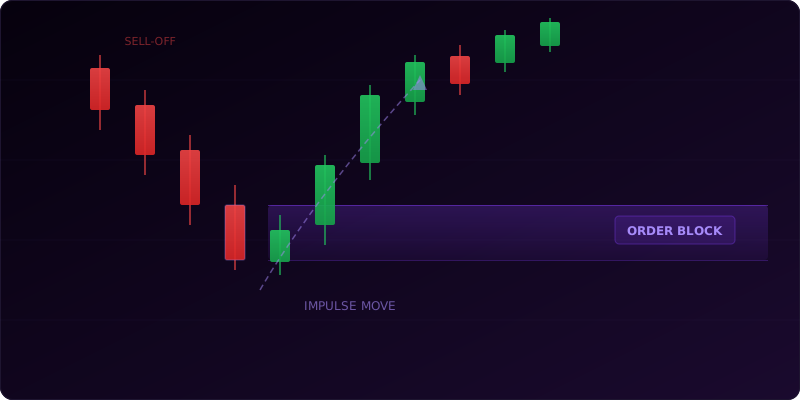
Most order block indicators operate on a simple rule: find the last opposing candle before a swing high or low, draw a rectangle, call it an order block. This produces dozens of blocks across any chart. The logic assumes every swing point represents institutional activity worth tracking.
That assumption is wrong.
Real order blocks mark zones where large players established positions that failed to be absorbed by the market on first contact. Not every swing qualifies. The most reliable order blocks form at structural breaks, not random momentum shifts. They appear where market structure changed. Break of Structure. Change of Character. Liquidity sweeps followed by reversal.
A properly implemented order block detector doesn't just look backwards from swing points. It validates the structural context:
Did this candle precede a confirmed structural shift? If you're flagging order blocks at every minor swing, you're not detecting institutional zones. You're highlighting every time the market exhaled.
Was there a liquidity event? The most potent order blocks form after stop hunts. Sweep the high, reject from the block above, reverse through structure. That sequence matters. An indicator that doesn't track liquidity in relation to structure is missing half the picture.
What timeframe is this relevant to? An order block on the 1-minute chart doesn't carry the same weight as one on the daily. Multi-timeframe awareness separates tools that respect market context from those that spam rectangles across every timeframe equally.
The Institutional Price Blocks indicator demonstrates this difference. It doesn't flag every swing. It waits for structural confirmation, validates against liquidity dynamics, and respects timeframe hierarchy. The result: fewer blocks, higher relevance.
Where Do "Institutional Candles" Fit In?
If you have searched for an institutional candle indicator on TradingView, you are looking at the same territory. An institutional candle is a large-bodied displacement candle — small wicks, elevated volume, usually leaving a Fair Value Gap behind — that signals aggressive institutional participation. The candle that originates an order block at a structure break is very often exactly this kind of candle. We cover how to identify them, and how to separate them from news spikes and exhaustion candles, in the institutional candle guide.
The practical point: you do not trade the candle itself, you trade what it leaves behind. That is why an order-block tool like Institutional Price Blocks is what most traders searching for an institutional candle indicator actually need. It detects the order block patterns these candles create at Break of Structure and Change of Character points, then projects the zones where price is most likely to react on the retest.
How Should an FVG Indicator Detect Imbalances?
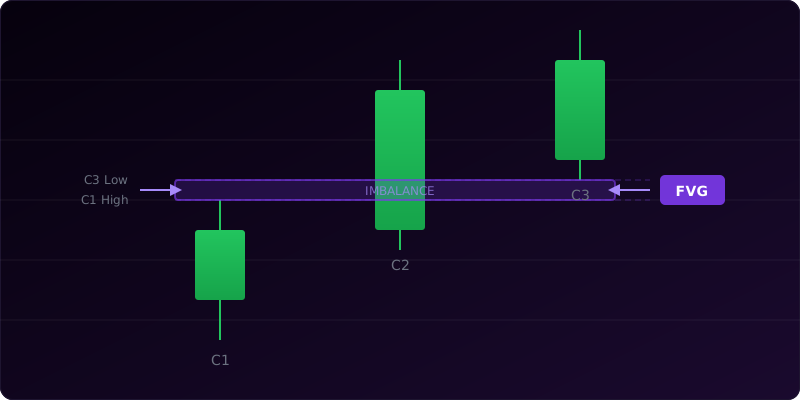
Fair Value Gaps have become synonymous with SMC. The pattern is simple: three candles where the wick of candle one doesn't overlap the wick of candle three. That imbalance becomes your FVG.
Every script on TradingView can detect this. The question is: should every three-candle imbalance be treated equally?
No. Not remotely.
Context determines FVG validity. A gap that forms during low-volume consolidation holds less weight than one that forms during a structural break. A gap in the direction of the prevailing trend has different implications than one counter to trend. A gap that's already been tested and rejected is not the same as an untested gap.
Shallow FVG indicators treat all gaps the same. They detect the pattern, draw the box, move on. Deep implementations classify FVGs by:
Formation context: Did this gap form during a Break of Structure? After a liquidity sweep? During a momentum expansion or a ranging period?
Confluence: Does this gap align with an order block? Does it sit at a key level? Is it confluent with multi-timeframe structure?
Test history: Has price already reacted to this gap? If so, how? Full mitigation, partial, rejection, or absorption?
The Smarter Money Suite includes FVG detection that accounts for these variables. It doesn't just flag every imbalance. It prioritizes gaps that form at structurally significant moments and tracks how price interacts with them over time.
How Does Market Structure Detection Work?
Order blocks, Fair Value Gaps, liquidity sweeps: none of it matters if the underlying market structure detection is broken.
Most SMC indicators use fixed pivot lookback periods to determine swing highs and lows. This creates a fundamental problem: market rhythm isn't constant. A 5-period pivot setting might work during trending conditions and completely miss structural shifts during compression. A 20-period pivot might catch major swings but lag so severely it's useless for real-time decision making.
Break of Structure and Change of Character are not cosmetic labels. They represent regime shifts. A BoS confirms continuation. A ChoCh signals potential reversal. Misidentifying these shifts contaminates every downstream signal your indicator produces.
Real market structure detection adapts. It doesn't rely solely on fixed pivots. It considers:
Relative swing strength: Not all swing highs are created equal. A marginal new high during low volatility doesn't carry the same structural weight as an explosive breakout high.
Volume and momentum context: Structure that breaks on increasing volume and momentum is more reliable than structure that breaks on a single candle with no follow-through.
Multi-timeframe alignment: A Break of Structure on the 5-minute chart means little if the higher timeframe structure remains bearish. True structural shifts often align across timeframes.
Indicators that ignore these nuances produce market structure labels that look authoritative but lack substance. They'll mark a BoS at every minor new high, flooding your chart with false continuation signals.
How Do Smart Money Indicators Track Liquidity?
Institutions hunt liquidity. Retail traders place stops at obvious levels. Smart Money knows where those stops sit and targets them before reversing. This is not conspiracy theory. It's market mechanics.
An SMC indicator that doesn't track liquidity is incomplete. But tracking liquidity requires more than drawing lines at swing highs and lows and calling them "liquidity pools."
Real liquidity detection identifies:
Where stops are likely clustered: Equal highs and lows, breakout points, round numbers, previous day/week/month highs and lows.
When those levels get swept: A sweep isn't just touching the level. It's violating it, triggering stops, then immediately reversing. The violation and reversal sequence matters.
How price reacts after the sweep: Does it reverse with momentum? Does it fail to sustain the move? A true liquidity grab shows immediate absorption and reversal. Weak follow-through after a sweep is a tell.
The Liquidity Heatmap helps with this analysis by mapping where historical trading activity concentrates around key levels — showing you which zones have attracted the most volume and are most likely to produce meaningful reactions.
GrandAlgo
See these concepts automated on your charts
18 TradingView indicators — smart money, price action, supply/demand, and more.
Why Does Session Awareness Matter for SMC Indicators?
Markets aren't homogeneous across time. The London session behaves differently than the New York session. Asian session structure often sets the range that gets swept during London open. Institutional activity concentrates during specific windows.
Yet most SMC indicators treat all hours equally. They detect order blocks at 3 AM with the same logic they use at 9:30 AM ET. They mark Fair Value Gaps during low-volume overnight periods the same way they mark gaps during high-volatility session opens.
This is a mistake. Institutional footprints are clearest during institutional hours. A sweep of Asian session highs at London open is a known pattern. An order block that forms during New York session close carries different weight than one that forms during Tokyo drift.
Session-aware indicators adjust their detection logic based on time of day. They prioritize signals that form during high-volume, high-participation windows. They filter out noise from low-volume periods unless there's strong structural context.
The Session Fib Fan and other session-based tools in our suite account for this. They don't treat the market as a continuous feed of candles. They recognize that context shifts with the clock.
Why Does Multi-Timeframe Confluence Matter?
Single-timeframe analysis is incomplete. A bullish signal on the 15-minute chart means little if the 1-hour is bearish and the 4-hour is in a downtrend. Real edge comes from confluence: when multiple timeframes align.
Most SMC indicators analyze one timeframe. They detect structure, mark order blocks, flag gaps, all within the chart's current resolution. Then you, the trader, are left to manually check higher timeframes and mentally synthesize the information.
This is inefficient and error-prone. You miss alignments. You misjudge structural hierarchy. You take trades that look clean on the lower timeframe but violate higher timeframe structure.
The best SMC tools integrate multi-timeframe analysis directly. They check whether the current signal aligns with higher timeframe bias. They flag when lower timeframe structure confirms higher timeframe setups. They show you MTF confluence without requiring you to flip between 5 different chart tabs.
This isn't just convenience. It's a qualitative improvement in signal accuracy. Trades that align across timeframes tend to have higher win rates and better risk/reward profiles.
Why Are Repainting Indicators Dangerous?
We've covered this in depth before in What Is Indicator Repainting, but it's worth restating: if an SMC indicator repaints, it's worthless.
Repainting means the indicator changes its historical signals after the fact. That order block that appeared three bars ago? On a repainting script, it might disappear or move once the next candle closes. Those market structure labels? They can shift retroactively.
This makes backtesting impossible. It makes real-time decision making impossible. You're trading based on signals that might not exist in five minutes.
Non-repainting implementation requires more sophisticated logic. You can't use future data to validate current signals. You can't wait for confirmation candles to retroactively upgrade a swing to structure. You must commit to signals in real-time, based only on information available at that moment.
Most developers take shortcuts. They use functions that peek forward. They redraw historical signals for visual clarity. The result: indicators that look perfect on historical data and fail miserably in live trading.
Real SMC tools lock signals on close. What you see is what you get. The Smarter Money Suite guarantees this. Every order block, every FVG, every structure label: they commit when the candle closes and never change — the one exception is the optional Early Breaks mode, which confirms structure intra-bar if you choose speed over confirmation.
What's the Difference Between Tools and Trading?
Even the best SMC indicator is not a trading system. It's a lens. It helps you see what's happening beneath price action. But it doesn't tell you when to enter, where to place your stop, or how to manage the trade.
That's your job.
An indicator that detects a high-quality order block and a Fair Value Gap in confluence with a Break of Structure after a liquidity sweep gives you a high-probability zone to watch. It doesn't give you a trade. You still need to decide:
- Do I wait for confirmation or enter on first touch?
- Where's my invalidation point?
- What's my target? First TP at the next structure level? Trail to capture the full move?
- What's my position size relative to my risk tolerance?
This is why we built free tools to help with risk management and encourage traders to keep a trading journal. The indicator is one piece of the system. Execution, risk management, and psychology are the others.
How Do You Evaluate an SMC Indicator?
If you're shopping for a Smart Money indicator, here's your due diligence checklist:
1. Check the logic documentation. Does the developer explain how order blocks are validated? How market structure is detected? If the description is vague or just says "detects institutional zones," skip it.
2. Verify it doesn't repaint. Test it on historical data. Note where signals appear. Refresh the page. Do they stay put? If they move or disappear, walk away.
3. Assess signal frequency. If the indicator is plastering order blocks and FVGs all over your chart, it's not selective enough. More signals does not equal more edge. Often it means less.
4. Look for multi-timeframe awareness. Does it integrate higher timeframe context or force you to do that work manually?
5. Check for liquidity tracking. Does it just mark levels or does it actively monitor for sweeps and reactions?
6. Test it. Not with backtesting software. Forward test. Use it on live charts. Track your decisions. See if it actually improves your edge or just adds noise.
Most won't pass this filter. That's fine. You don't need most indicators. You need one good one.
Frequently Asked Questions
Smart Money Concepts is a framework for reading price action through the lens of institutional behavior. It assumes large players move markets by accumulating positions at specific zones, hunting retail liquidity, and shifting market structure to create directional moves. SMC tools attempt to identify those footprints — order blocks, Fair Value Gaps, liquidity sweeps, and Break of Structure events — rather than relying on lagging retail indicators.
Demand structural validation for order blocks, contextual classification for Fair Value Gaps, active liquidity sweep detection rather than passive level marking, multi-timeframe confluence checks, and session-aware filtering. The indicator should commit signals on candle close and never redraw historical output. If a script flags every swing high as institutional activity, it lacks the selectivity required to deliver real edge.
A repainting indicator changes its historical signals after new candles form. That order block from three bars ago can vanish or shift once the next candle closes. Backtesting becomes meaningless because the historical chart no longer reflects what was actually visible in real time. Live decisions get made on signals that may not exist minutes later. Any SMC tool that repaints is unusable for serious trading.
Critical. A bullish setup on the 15-minute chart carries little weight if the 1-hour structure is bearish and the 4-hour is in a confirmed downtrend. Real edge emerges when timeframes align — when lower timeframe entries confirm higher timeframe bias. Indicators that integrate multi-timeframe confluence directly remove the manual chart-flipping that introduces error and missed alignments into your process.
Most free SMC scripts on TradingView are shallow implementations: fixed pivot logic, no liquidity awareness, repainting issues, and no multi-timeframe integration. A few free tools are genuinely useful for learning the concepts. But if you're trading capital, the difference between a $0 script that flags every swing and a properly engineered tool with structural validation and lock-on-close signals justifies the cost. Test before you commit either way.
Why We Built Differently
GrandAlgo exists because we got tired of shallow implementations being passed off as institutional tools. We trade these concepts ourselves. We know the difference between an order block that's structurally validated and one that's drawn at a random swing. We know a Fair Value Gap that forms during a BoS is not the same as one that forms mid-range.
So we built indicators that respect those distinctions. Deep logic. Multi-timeframe confluence. Liquidity awareness. Session context. No repainting. No compromises.
The Smarter Money Suite combines order block detection, FVG tracking, market structure labels, and liquidity monitoring in one coherent system. It's not five separate indicators duct-taped together. It's integrated logic where each component informs the others.
The Institutional Price Blocks indicator focuses exclusively on high-probability order blocks: structurally validated, confluence-filtered, timeframe-aware.
The MTF Confluence Key Levels shows you when multiple timeframes align at the same zone, eliminating the need to manually flip between charts.
These aren't the only SMC tools on TradingView. But they're built by people who understand the difference between detecting patterns and detecting institutional behavior. That difference shows in the quality of the signals.
Final Word: Quality Over Hype
The Smart Money Concepts space is crowded with hype and thin on substance. Developers slap "SMC" on their scripts because it's a selling point. Most don't understand the underlying mechanics well enough to implement them properly.
You don't need another indicator that draws boxes on your chart. You need one that understands market structure, respects context, and gives you signals you can actually trade.
The best SMC indicator for you is the one that improves your decision-making without overwhelming you with noise. That requires deep implementation, not marketing fluff.
Do your due diligence. Test thoroughly. Demand transparency. And remember: the indicator is the tool, not the strategy. How you use it determines whether it works.
If you want to see what proper SMC implementation looks like, explore our indicators or check out the performance data to see how these concepts translate to real trades. No hype. No gimmicks. Just tools built by traders who know the difference.


