Fair Value Gap Indicator: What to Look For
Not all FVG indicators are the same. What separates useful fair value gap tools from chart clutter — classification, filtering, and MTF support.

Search "FVG indicator" on TradingView and you'll get hundreds of results. Community scripts, invite-only tools, premium packages. Most of them do the same thing: detect a three-candle gap and draw a box on your chart.
The problem is that basic gap detection is trivial. Any script can check if Candle 3's high is below Candle 1's low. That's a few lines of Pine Script. What separates a useful fair value gap indicator from chart clutter is everything that happens after detection.
Here's how to tell the good ones from the useless ones.
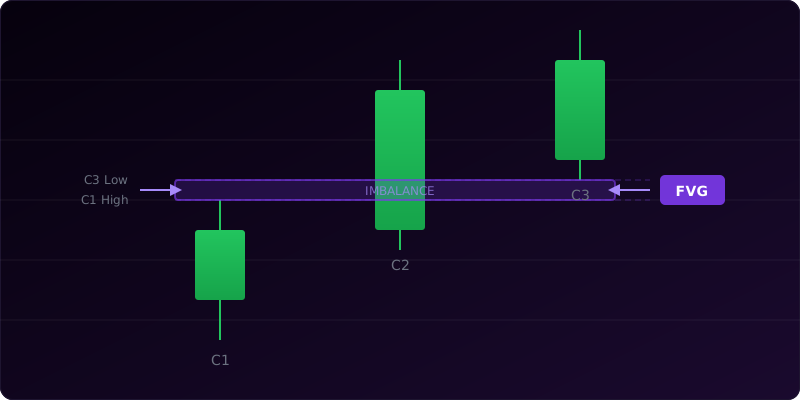
What Should an FVG Indicator Actually Do?
At minimum, a fair value gap indicator needs to handle five things:
- Detect the gap - Identify the three-candle imbalance pattern accurately, for both bullish and bearish directions.
- Classify the type - Not all FVGs carry the same weight. Standard, inverting, engulfing, and retracing gaps have different trading implications.
- Show mitigation status - Track whether the gap has been partially filled, fully filled, or remains open.
- Support multi-timeframe analysis - Display higher-timeframe FVGs on your current chart without switching tabs.
- Provide alerts - Notify you when price approaches, enters, or mitigates a gap.
If your indicator only handles the first point, it's doing 20% of the job. You're left doing the other 80% manually.
What Is the FVG Classification Problem?
Most FVG indicators treat every gap the same. A box is a box. But the types of fair value gaps behave very differently:
- Standard FVG - Baseline probability. Needs additional confluence to trade.
- Inverting FVG - The gap was filled and price continued through. High-probability reversal signal.
- Engulfing FVG - The impulse candle engulfs the prior candle's entire range. Strong directional conviction.
- Retracing FVG - Forms during a pullback within an existing trend. Continuation signal.
- Long-Tail FVG - A boundary candle's wick partially fills the gap. The true zone is smaller than it appears.
- Balancing FVG - A new gap forms while closing an old one. Equilibrium-seeking behavior.
An indicator that doesn't classify these types forces you to do the analysis manually on every single gap. At that point, the tool is creating work, not reducing it.
The classification is what gives each gap its edge. Without it, you're staring at rectangles with no context.
What Features Should You Compare in FVG Indicators?
Not all FVG indicators offer the same depth. Here's what you typically get across different tiers:
| Feature | Basic Free | Mid-Tier | Premium |
|---|---|---|---|
| Bullish/Bearish FVG detection | Yes | Yes | Yes |
| FVG type classification | No | Partial (2-3 types) | Full (6+ types) |
| Mitigation tracking | No | Basic (filled/unfilled) | Detailed (partial, CE, full) |
| Consequent encroachment line | No | Sometimes | Yes |
| Multi-timeframe FVGs | No | Limited (1 extra TF) | Full (multiple HTFs on LTF) |
| LTF refinement zones | No | No | Yes |
| Context-based filtering | No | Basic | Advanced (trend, session, recency) |
| Alert conditions | No | Price enters gap | Approach, enter, CE, mitigate |
| Auto-removal of mitigated gaps | Rare | Sometimes | Yes |
| Performance optimization | Often laggy | Moderate | Optimized for live charts |
The gap between "basic free" and "premium" is not cosmetic. It's the difference between a tool that clutters your chart and one that surfaces actionable information.
Why Does Multi-Timeframe FVG Detection Matter?
Higher-timeframe FVGs are the ones that carry institutional weight. A 4-hour FVG represents a much larger imbalance than a 5-minute one. But if you're trading entries on the 5-minute chart, you need to see that 4-hour gap on your execution timeframe.
This is where multi-timeframe (MTF) support becomes critical.
Without MTF support, you have to:
- Switch to the higher timeframe to identify the gap
- Memorize or mark the price level
- Switch back to your execution timeframe
- Hope you remembered the zone correctly
With MTF support, the higher-timeframe gap is drawn directly on your lower-timeframe chart. You see the institutional zone and your execution candles simultaneously.
The best FVG indicators let you overlay multiple timeframes at once - daily, 4-hour, and 1-hour FVGs all visible on your 15-minute chart. This is how you identify where higher-timeframe demand or supply sits while timing entries with precision.
Tools like the Smarter Money Suite are built around this principle - higher-timeframe context displayed on any execution timeframe.
GrandAlgo
See these concepts automated on your charts
18 TradingView indicators — smart money, price action, supply/demand, and more.
FVG Mitigation and Invalidation
A gap on the chart is only useful if you know its current status. There are three states every FVG indicator should track:
Open - Price has not returned to the gap. The imbalance remains untested.
Partially mitigated - Price has entered the gap but hasn't reached the midpoint (consequent encroachment). Some orders have been filled, but the zone still has influence.
Fully mitigated - Price has closed through the entire gap. The imbalance has been resolved. The zone should be removed or visually dimmed.
The consequent encroachment level - the 50% midpoint of the gap - is a key decision point. Many traders use this level as an entry reference. If price pushes past it, the probability of a full fill increases significantly.
Indicators that don't track mitigation leave stale zones on your chart. You end up trading gaps that are already dead. That's not analysis - it's guessing.
What Red Flags Should You Avoid in FVG Indicators?
Watch for these warning signs when evaluating any fair value gap tool:
Repainting FVG boundaries. The gap zone shifts after it's been drawn. If an indicator adjusts its box edges based on future price action, it's repainting - and the levels it showed you in real-time were wrong.
No type classification. Every gap gets the same color, same size, same treatment. You have no way to distinguish a high-probability inverse FVG from a low-significance balancing gap.
No filtering by context. The indicator draws every three-candle gap on the chart regardless of market structure, trend direction, or session. You end up with dozens of boxes and no hierarchy.
Drawing every gap regardless of significance. A two-tick gap on a 1-minute chart during the Asian session is not the same as a 50-pip gap on the 4-hour chart during London open. If your indicator treats them equally, it's useless for decision-making.
No removal of mitigated zones. Old, fully-filled gaps remain on the chart forever. The more history you load, the more clutter you get. This actively degrades your analysis.
Laggy performance. Poorly optimized scripts slow down your TradingView chart, especially on lower timeframes with lots of data. If the indicator makes your platform sluggish, it's costing you execution speed.
How to Test an FVG Indicator
Before trusting any FVG tool with real capital, run it through these checks:
Step 1: Historical comparison. Apply the indicator to a chart you've already analyzed manually. Do its detections match your own FVG markings? Does it catch the gaps you identified? Does it flag gaps you wouldn't consider valid?
Step 2: Classification accuracy. If the indicator claims to classify FVG types, verify it. Find a known inverse FVG on your chart. Does the indicator label it correctly? Check engulfing and retracing gaps the same way.
Step 3: Mitigation tracking. Scroll through price action where FVGs were formed and then revisited. Does the indicator properly mark gaps as mitigated when price fills them? Does it show the consequent encroachment level accurately?
Step 4: Cross-timeframe consistency. If the indicator offers MTF support, check that a gap identified on the 4-hour chart appears at the exact same price level when projected onto your 15-minute chart. Discrepancies here mean the MTF logic is broken.
Step 5: Real-time behavior. Run the indicator on a live chart for at least a few sessions. Watch for repainting - gaps that shift or disappear after they were drawn. Compare what the indicator showed in real-time to what it shows on the same candles after the fact.
Step 6: Performance under load. Load 5,000+ candles on a lower timeframe. Does the chart remain responsive? An indicator that works on 500 candles but freezes on 5,000 is not production-ready.
Frequently Asked Questions
A good FVG indicator should detect valid three-candle imbalances, label bullish and bearish gaps, track mitigation, support multiple timeframes, and filter out tiny or low-context gaps that only clutter the chart.
They detect every small imbalance without filtering for size, displacement, context, or timeframe. That creates noise. Useful FVG tools should help identify the gaps that matter, not mark every minor candle inefficiency.
FVG mitigation happens when price returns into the gap and partially or fully rebalances the inefficient price area. A good indicator should show whether the gap is untouched, partially mitigated, fully filled, or invalidated.
Yes. Higher-timeframe FVGs often carry more weight than lower-timeframe gaps. Multi-timeframe support lets traders see major imbalance zones while still using lower timeframes for precise entries and confirmation.
No. It can speed up detection, but traders still need to judge structure, liquidity, session timing, and risk. An FVG in the wrong context is just a gap on a chart, not a complete trade setup.
What Matters
- Basic FVG detection is trivial - what matters is classification, mitigation tracking, and filtering
- There are six distinct FVG types, and indicators that don't classify them leave you doing the analysis manually
- Multi-timeframe support is essential for seeing institutional-level gaps on your execution chart
- Mitigation tracking (open, partial, full) prevents you from trading dead zones
- Red flags include repainting boundaries, no filtering, and no zone removal
- Always test an indicator against your own manual analysis before trusting it with capital
- One well-built FVG tool with proper classification beats stacking multiple basic detectors
The fair value gap retest is one of the highest-probability setups in Smart Money trading. But only if you're working with the right gaps. A good FVG indicator doesn't just show you where gaps are - it tells you which ones matter.


