CRT Trading Strategy: Candle Range Theory Explained
Candle Range Theory (CRT) is one of ICT's most actionable concepts. How CRT setups work, where to find them, and how to trade them at key levels.

Candle Range Theory is one of the most practical concepts in ICT trading. While other Smart Money ideas require extensive chart markup - drawing order blocks, mapping out structure, identifying imbalances across multiple timeframes - CRT gives you a clean, repeatable pattern that works on any timeframe.
One candle sets the range. The next candle sweeps beyond it. Then price reverses. That's the entire framework.
If you've been looking for a concept that cuts through the noise and gives you something you can actually trade, CRT is it.
What Is Candle Range Theory?
Candle Range Theory (CRT) is built on a simple observation: when the current candle sweeps beyond the high or low of the previous candle, then reverses back inside that range, it signals a liquidity grab has occurred.
The "range" is the high-to-low of the prior candle. That range defines the battlefield. Stop-losses likely sitting above the high or below the low of that candle represent resting liquidity - orders waiting to be triggered.
A bullish CRT occurs when price sweeps below the prior candle's low, triggers the stops sitting there, and then reverses back up inside the range. The sweep below was the grab. The reversal is the trade.
A bearish CRT occurs when price sweeps above the prior candle's high, triggers the buy stops and breakout orders, and then reverses back down inside the range. The spike above was engineered. The reversal is where the money is.
The key distinction: the sweep must be followed by a convincing move back inside the prior candle's range. A sweep that holds beyond the range is a breakout, not a CRT.
Why Does CRT Work?
CRT isn't a pattern for the sake of a pattern. It works because it maps directly to how institutional order flow operates.
Stop-losses cluster at predictable levels. Retail traders place stops above the prior candle's high and below the prior candle's low. These are the most obvious levels on any chart, which makes them the most targeted.
Institutions need counter-party liquidity. A large fund that wants to go long needs sellers. The easiest way to generate sell orders is to push price below a level where stop-losses are sitting. Those triggered stops become market sell orders - exactly the liquidity the institution needs to fill its buy position.
The reversal supports the thesis. Once the triggered orders have been absorbed, there's no reason for price to stay beyond the range. It snaps back. The sweep was the entry mechanism. The reversal is the signal.
This is the same principle behind liquidity sweeps, but CRT packages it into a candle-by-candle framework that's faster to read and easier to act on.
How Do You Trade the CRT Setup Step by Step?
Step 1: Identify the Prior Candle Range
Mark the high and low of the most recent closed candle. This is your reference range. The timeframe depends on your trading style - CRT works on the 5-minute, 15-minute, 1-hour, 4-hour, or daily chart.
Higher timeframes add context because they represent more accumulated liquidity. For intraday execution, recent internal testing has favored 1H and 4H reference levels as repeatable filters, while daily and weekly levels remain important but lower-frequency context.
Step 2: Wait for a Sweep Beyond the High or Low
Watch the current candle. You need price to push beyond the prior candle's high or low. This is the sweep - the liquidity grab that triggers resting orders.
A sweep doesn't need to be dramatic. Even a few ticks beyond the level is enough to trigger the cluster of stops sitting there.
Step 3: Confirm the Reversal Back Inside the Range
This is the critical step. After the sweep, price must reverse and move back inside the prior candle's range. You're looking for:
- A strong rejection wick at the sweep level
- The candle body closing back inside the prior range
- Momentum shifting in the opposite direction of the sweep
If price sweeps and holds beyond the range, it's not a CRT. Walk away.
Step 4: Enter With Stop Beyond the Sweep Wick
Entry: On the close of the reversal candle, or on a lower timeframe confirmation (structure shift, FVG formation).
Stop-loss: Beyond the wick of the sweep. If price pushed 10 ticks below the prior candle's low, your stop goes a few ticks below that wick. If the sweep level breaks, the setup is invalidated.
Step 5: Target the Opposite End of the Range or Midpoint
Conservative target: The 50% level (midpoint) of the prior candle's range. This is where equilibrium sits.
Standard target: The opposite end of the prior candle's range. If you entered on a bullish CRT (sweep of the low), target the prior candle's high.
Extended target: Beyond the range, toward the next key level or liquidity pool. This is for runners after partials.
Where Does CRT Get Powerful at Key Levels?
A CRT in isolation is useful. A CRT at a key institutional level is high-probability.
CRT at Previous Day High/Low: When price sweeps beyond yesterday's high or low and reverses, it is interacting with a widely watched liquidity reference. Treat PDH/PDL as high-context levels, not automatic trades; they work best when the reversal also has session timing, displacement, or lower-timeframe confirmation.
CRT at Session Levels: Asia session high/low swept during London open. London high/low swept during New York open. Session-level CRTs align with the natural rhythm of institutional order flow.
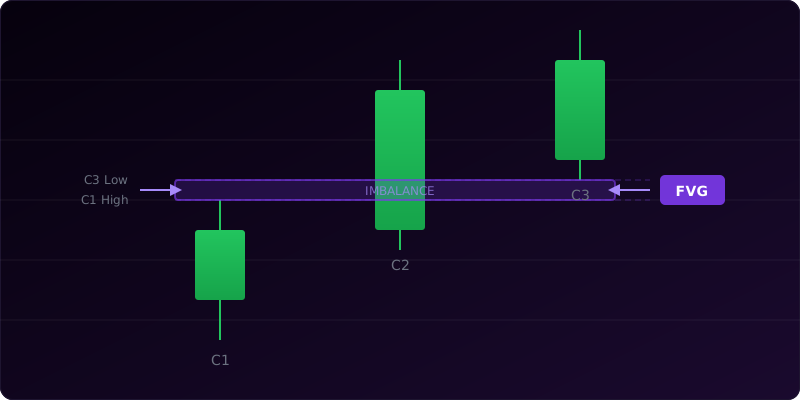
CRT at Fair Value Gaps: When a CRT sweep lands directly into an unmitigated FVG, you have dual confirmation. The FVG provides the institutional reference level. The CRT provides the entry trigger. This is one of the confluence types worth prioritizing before less precise levels.
CRT at Order Blocks: A CRT sweep into an order block combines two major Smart Money concepts. The order block marks where significant positioning likely occurred. The CRT suggests that level is still being respected.
The principle is straightforward: context matters more than the candle pattern by itself. A naked CRT in the middle of a range is low-conviction. A CRT at a 1H or 4H level, inside a session window, with FVG or order-block context is a different trade entirely.
GrandAlgo
See these concepts automated on your charts
18 TradingView indicators — smart money, price action, supply/demand, and more.
How Does Multi-Timeframe CRT Work?
The real edge with CRT comes from mapping higher-timeframe setups to lower-timeframe entries.
The framework: Identify the higher-timeframe level or range you care about, often 1H, 4H, or daily. Then drop to a lower timeframe (5m, 15m) and look for structural confirmation inside the CRT sweep.
Example: The 4-hour candle sweeps below the prior 4-hour candle's low and starts reversing. You drop to the 15-minute chart. Inside that 4-hour CRT, you look for a Change of Character - a break of the bearish structure that was driving the sweep. That CHoCH on the 15-minute is your precision entry inside the higher-timeframe CRT.
This gives you two things a single-timeframe approach can't: tighter risk (stop based on 15m structure instead of 4H wick) and better timing (entering at the structural shift, not the candle close).
Multi-timeframe CRT is how professional traders use this concept. The CRT with Key Levels indicator can help automate detection of these setups across timeframes, highlighting CRT formations at significant structural levels in real time.
How Is CRT Different From Other Reversal Patterns?
CRT often gets compared to classic candlestick reversal patterns. Here's how it differs.
| Pattern | What It Reads | Liquidity Context | Institutional Logic |
|---|---|---|---|
| CRT | Sweep beyond prior candle range + reversal | Directly maps to stop-hunt mechanics | Built on liquidity grab framework |
| Pin Bar | Long wick rejection at a level | Implies rejection but doesn't require sweep | No explicit liquidity reference |
| Engulfing | Current candle fully engulfs prior candle | Shows momentum shift, not necessarily a sweep | Doesn't distinguish sweep from breakout |
| Liquidity Sweep | Price pushes beyond key level and reverses | Identical concept, broader application | Same institutional logic, different framing |
The key difference: CRT explicitly defines the liquidity source (the prior candle's range) and requires a sweep-and-reversal sequence. Pin bars and engulfing candles can occur anywhere. CRT is anchored to a specific liquidity event.
A pin bar at a random level is noise. A CRT at a session high with FVG confluence is a trade.
What CRT Mistakes Should You Avoid?
Trading CRT without key level confluence. A CRT in the middle of a range, away from any significant level, is low-probability. Always ask: what institutional level is this CRT interacting with? If the answer is "none," skip it.
Entering before the reversal confirms. The sweep is not the entry. The reversal is. Traders who jump in the moment price crosses the prior candle's high or low get caught in genuine breakouts. Wait for price to move back inside the range.
Using CRT during low-volume periods. CRT works because it reflects institutional activity. During dead zones - pre-market, lunch hour, holiday sessions - there isn't enough institutional flow to make the pattern meaningful. Stick to kill zones for the cleanest setups.
Ignoring the bigger structure. A bullish CRT inside a strong bearish trend on the higher timeframe is counter-trend. It might work for a scalp, but the odds are against a larger move. Always check whether the CRT aligns with the higher-timeframe direction.
Setting stops too tight. Your stop needs to be beyond the sweep wick, not at it. Institutional sweeps can dig a few extra ticks before reversing. Give the trade room to breathe or you'll get stopped out on the final push of the grab.
Key Takeaways
- CRT identifies liquidity grabs at the prior candle's high or low, followed by a reversal back inside the range
- The pattern works because institutions use triggered stop-losses to fill positions, then price reverses
- Enter after the reversal confirms, not during the sweep - the candle must close back inside the range
- CRT at key levels (1H/4H ranges, PDH/PDL, session levels, FVGs, order blocks) is higher quality than naked CRT
- Multi-timeframe CRT - identifying the setup on a higher timeframe and entering on a lower timeframe structure shift - offers tighter risk and better timing
- Avoid CRT during low-volume periods, against the higher-timeframe trend, or without any confluence
CRT strips away the complexity of chart analysis and gives you a repeatable question to ask on every candle: did price sweep beyond the prior range and reverse? If yes, and if it happened at a level that matters, you have a trade. That simplicity is what makes it one of the most practical tools in the ICT framework. For a printable summary of these rules, see the CRT cheat sheet, and for timing entries with session data, read CRT + Kill Zones.
The CRT with Key Levels indicator automates CRT detection with FVG overlay, so you can spot these setups instantly on any TradingView chart.
Frequently Asked Questions
Candle Range Theory (CRT) is an ICT-based price action setup where one candle defines a high-to-low range, the next candle sweeps beyond that range to grab liquidity, then reverses back inside. The reversal is the trade. The pattern works on every timeframe and across all asset classes.
CRT works on every timeframe, from 1-minute charts to weekly. Higher timeframes provide more meaningful liquidity context, but intraday traders should test which levels repeat in their market. Recent GrandAlgo testing has favored 1H and 4H context for 15-minute execution, with daily levels acting as lower-frequency high-context references.
Place the stop loss beyond the sweep wick, not at it. Institutional sweeps often dig a few extra ticks before reversing. A safe stop is 1-2 ATR beyond the highest (or lowest) point of the sweeping candle, giving the trade room to breathe through any final push of the grab.
CRT explicitly defines the liquidity source (the prior candle's high or low) and requires a sweep-and-reversal sequence. Pin bars and engulfing candles can occur anywhere on a chart. CRT is anchored to a specific liquidity event at a defined level, making it more reliable than generic candlestick patterns.
No. CRT can be traded with naked candles by visually identifying the prior candle's range and watching for sweep-then-reverse behavior. An indicator like CRT with Key Levels automates detection and overlays Fair Value Gaps for confluence, but the underlying pattern is fully readable by eye.


