
ETH Jun 15 - 15M Three CRT Setups
- Market
- Crypto
- Timeframe
- 15M
- Date
- June 15, 2026
Ethereum 15-minute chart. 3 CRT setups and 22 PDH/PDL key levels in the display window. The setup markers frame rotations around prior-day range boundaries.
Detects Candle Range Theory liquidity sweeps filtered by key institutional levels -Previous Day H/L, Previous Week H/L, or Fair Value Gaps.
Key Levels
3 modes
Markets
All
Style
Overlay
Alerts
Built-in
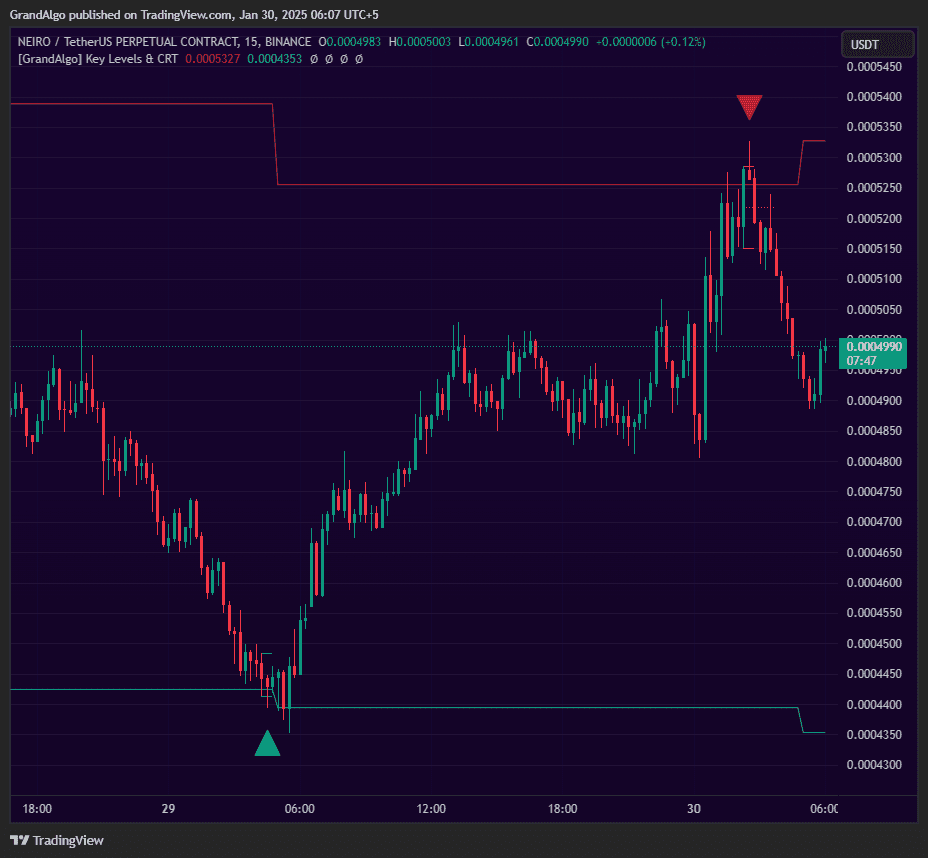
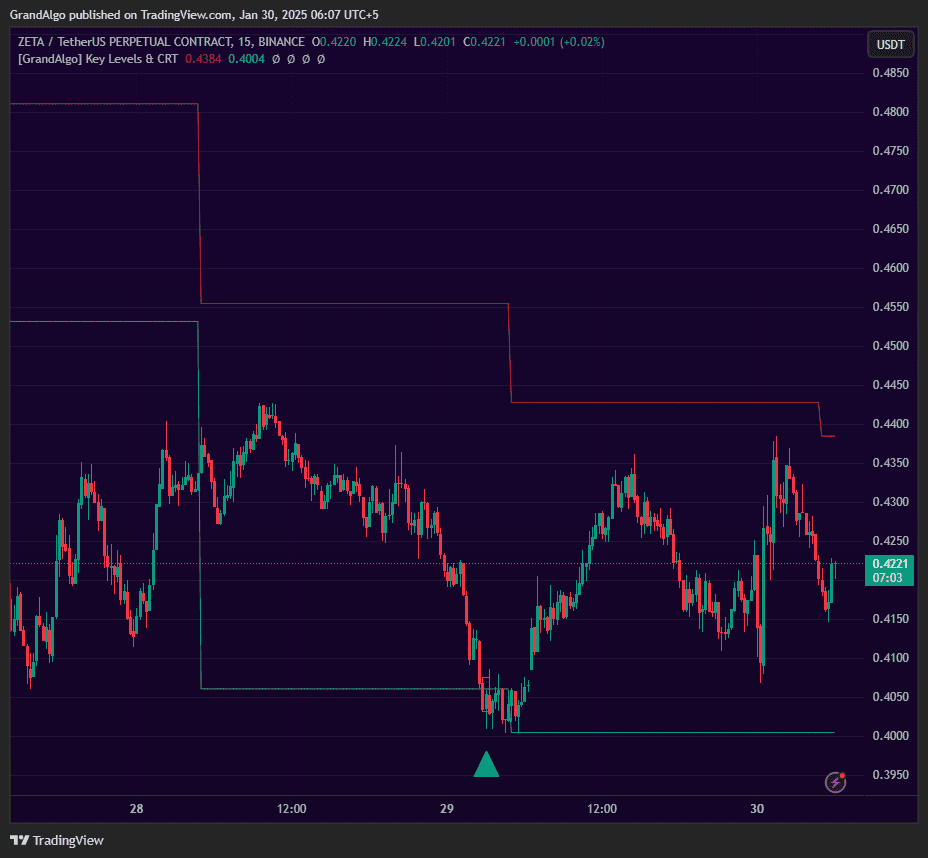
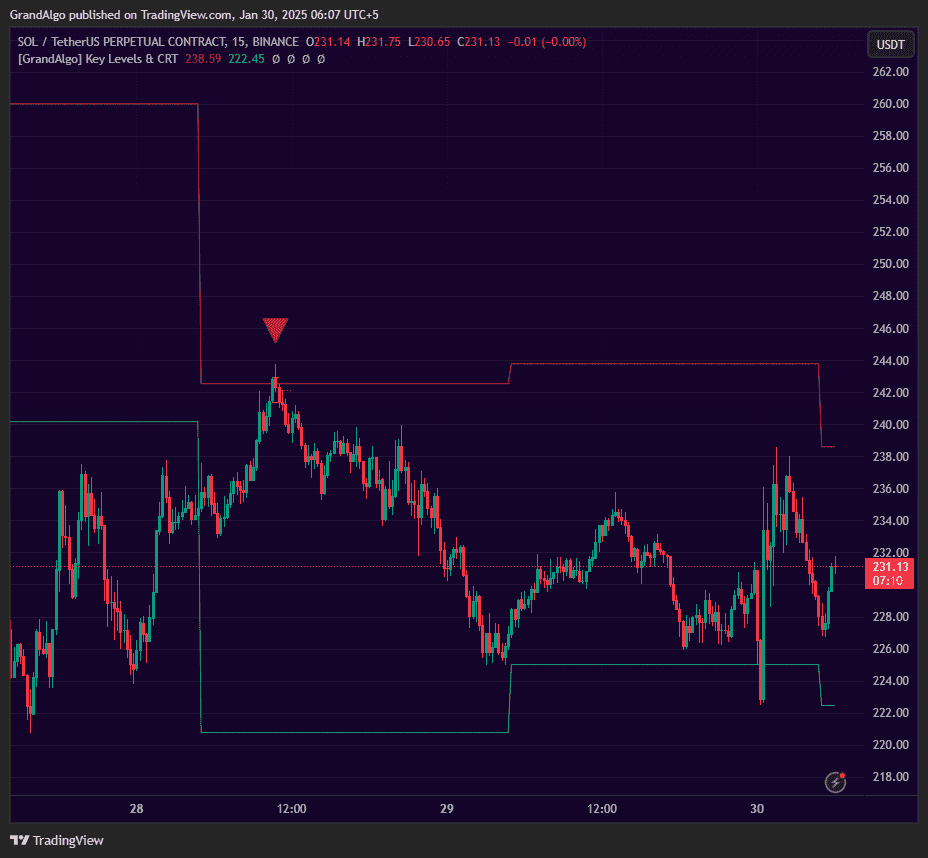
CRT with Key Levels identifies Candle Range Theory setups -patterns where price briefly sweeps beyond a prior candle's high or low before reversing back, trapping traders on the wrong side. The indicator filters these patterns for confluence with key institutional levels: Previous Day High/Low, Previous Week High/Low, or Fair Value Gaps. When a CRT pattern occurs at a key level, it draws the candle range with a midpoint level and places a directional triangle signal. The result is a precise system that catches institutional liquidity grabs where they matter most -at the levels that big players are watching.
CRT with Key Levels identifies Candle Range Theory patterns -- candles that sweep beyond a prior candle's high or low before reversing and closing back within the range. This classic institutional pattern reveals liquidity grabs where market makers run stops beyond a key level before pushing price in the opposite direction. The indicator cross-references each CRT candle against one of three key level modes to ensure the sweep happens at a significant institutional level.
In PDH/PDL mode, the indicator plots the Previous Day High and Low and only triggers signals when a CRT sweep interacts with one of those daily levels. In PWH/PWL mode, it uses Previous Week High and Low for wider-timeframe significance. In FVG mode, it detects Fair Value Gaps on the chart and triggers when a CRT sweep occurs at a gap boundary, validating the FVG zone against the last several candles to ensure freshness.
When a qualifying CRT pattern is detected at a key level, the indicator draws the candle's high, low, and midpoint as horizontal lines. The midpoint serves as the primary entry or target level, since CRT theory holds that price tends to return to the 50% mark of the sweep candle. A directional triangle signal (up for bullish, down for bearish) marks the event, and dedicated alert conditions let you get notified of both bullish and bearish CRT setups in real time.
Dated CRT with Key Levels charts from the public proof archive: what the indicator marked, and how price behaved around it. No win-rate claims.
Ethereum 15-minute chart. 3 CRT setups and 22 PDH/PDL key levels in the display window. The setup markers frame rotations around prior-day range boundaries.

Solana 1-hour chart. 2 CRT setups confirmed by PDH/PDL key levels. Price sweeps the previous day's range boundary then reverses — classic CRT pattern with key level confluence.

Ethereum 1-hour chart. 2 CRT setups with PDH/PDL key levels marking the reversal zones. Each setup caught the turning point where price swept a key level and reversed.
Identifies candles that sweep beyond the prior candle's high or low then reverse back -the classic institutional liquidity grab pattern.
Filter CRT signals by Previous Day High/Low, Previous Week High/Low, or Fair Value Gaps for institutional confluence.
Draws the CRT candle's high, low, and midpoint as horizontal levels that serve as targets and entry zones.
Clear triangle markers for bullish CRTs at key lows and bearish CRTs at key highs, with built-in alert conditions.
Practical ways to trade with CRT with Key Levels.
Trade the classic CRT liquidity sweep at the previous day's extreme, entering as price reverses back into range after the stop hunt.
Combine CRT liquidity sweeps with FVG zones for institutional-grade confluence. The FVG mode validates that the sweep occurs at an active price imbalance.
Use the PWH/PWL mode for higher-timeframe significance, catching major institutional liquidity sweeps at weekly extremes for multi-day holds.
Key settings you can configure in TradingView. See the full setup guide for detailed walkthroughs.
| Parameter | Type | Default | Description |
|---|---|---|---|
| Show Only Trade Setup CRT | bool | true | When enabled, only shows CRT patterns that occur at key levels. Disable to see all CRT patterns regardless of level confluence. |
| Key Level Mode | string | PDH/PDL | Choose which institutional levels to filter by: Previous Day High/Low, Previous Week High/Low, or Fair Value Gaps. |
| Max FVG Lookback | int | 3 | When using FVG mode, how many bars back to search for a qualifying Fair Value Gap. |
CRT patterns without key level confluence are less reliable. The filter ensures every signal has institutional level backing.
CRT patterns are most effective on 1-minute to 15-minute charts where the liquidity sweep and reversal happen quickly within a few candles.
The CRT candle's full range provides a natural stop-loss placement. If price breaks beyond the sweep high/low, the pattern has failed.
Candle Range Theory identifies candles that briefly sweep beyond a prior candle's high or low before reversing and closing back within the range. This pattern indicates a liquidity grab -- market makers push price beyond a key level to trigger stop-loss orders, then reverse direction. The CRT candle's range (high, low, and midpoint) then becomes the framework for the subsequent price move.
PDH/PDL (Previous Day High/Low) is the most popular choice for intraday traders on 5m-1H charts, as daily levels are heavily watched by institutional participants. PWH/PWL (Previous Week High/Low) works better for swing traders on 1H-4H charts who want fewer but more significant signals. FVG mode is ideal for traders who already incorporate Fair Value Gaps into their methodology and want CRT confluence at institutional imbalance zones.
The midpoint line is drawn at the 50% level of the CRT candle's range. In CRT theory, after a liquidity sweep, price tends to retrace to the midpoint of the sweep candle before continuing in the reversal direction. This makes the midpoint an optimal entry level for the reversal trade or a first target for partial profit-taking.
The CRT pattern detection works on any timeframe, but the key level modes are timeframe-dependent. PDH/PDL requires your chart timeframe to be lower than daily (1m-4H works well), and PWH/PWL requires a timeframe lower than weekly. FVG mode works across all timeframes since Fair Value Gaps are detected on the same chart. For best results, use timeframes between 5 minutes and 4 hours.
Included with every subscription plan alongside all 18 premium indicators. Subscribe today for just $19/mo.
