Best TradingView Indicators for Smart Money Trading in 2026
The TradingView indicators that actually work for ICT and Smart Money trading — what to look for, what to avoid, and how to build a complete system.

Most TradingView indicators are built on the same recycled logic: moving average crossovers, RSI thresholds, MACD divergences. They were designed for a version of trading that institutions abandoned decades ago. If you're trading Smart Money concepts, these tools are worse than useless - they actively mislead you.
Smart Money trading requires a fundamentally different toolkit. You need indicators that detect structure, not momentum. That identify institutional footprints, not retail patterns. That track liquidity, not lagging oscillators.
Here's what actually works - and what to avoid.
What Do Smart Money Indicators Actually Need to Do?
ICT and Smart Money trading is built on a specific set of market mechanics: institutions accumulate positions at key levels, engineer liquidity sweeps to fill orders, and leave structural footprints that repeat across every market and timeframe.
Your indicators need to detect these mechanics directly. Not approximate them with math. Not infer them from momentum oscillators.
Specifically, a Smart Money indicator should:
- Detect market structure shifts - Break of Structure and Change of Character, not just "trend up" or "trend down"
- Identify fair value gaps - Real imbalances in order flow, classified by type and significance
- Mark institutional order blocks - The specific zones where significant positioning occurred, with automatic invalidation
- Track liquidity - Where stop-losses cluster, where sweeps are likely, where sessions leave exploitable levels
- Generate signals from confluence - Not from a single formula, but from multiple independent conditions agreeing
If your indicator can't do at least two of these things well, it doesn't belong on a Smart Money chart.
What Indicator Categories Does Every SMC Trader Need?
1. Market Structure Detection
This is the foundation. Without knowing whether you're in bullish or bearish structure, every other tool is guesswork. You need an indicator that tracks swing highs and lows, labels Break of Structure (BoS) and Change of Character (ChoCh) events, and offers configurable sensitivity so it works across timeframes.
Market structure tells you which direction to trade. Everything else is secondary.
2. Fair Value Gap Detection
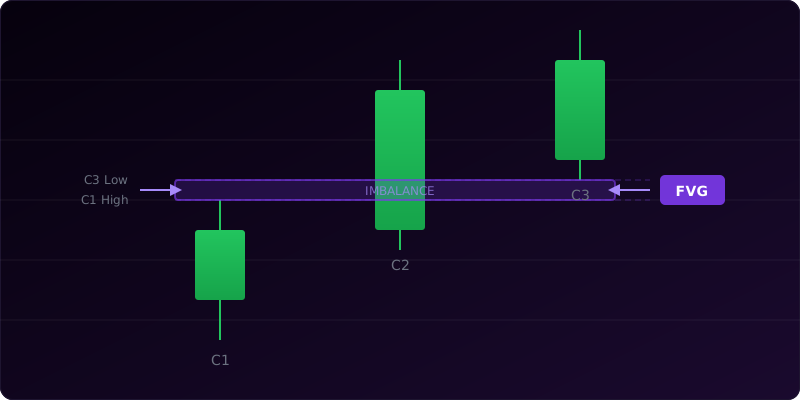
FVGs represent genuine institutional imbalances - price moved so aggressively that normal two-sided trading didn't occur. But not all FVGs are equal. A basic indicator that draws a box around every three-candle gap floods your chart with noise.
What you need is classification depth. Standard gaps, inverting gaps, engulfing gaps, long-tail gaps - each type has different implications for how price will interact with the zone. An indicator that classifies seven or more FVG types gives you an actual edge over traders who treat them all the same.
3. Order Block Identification
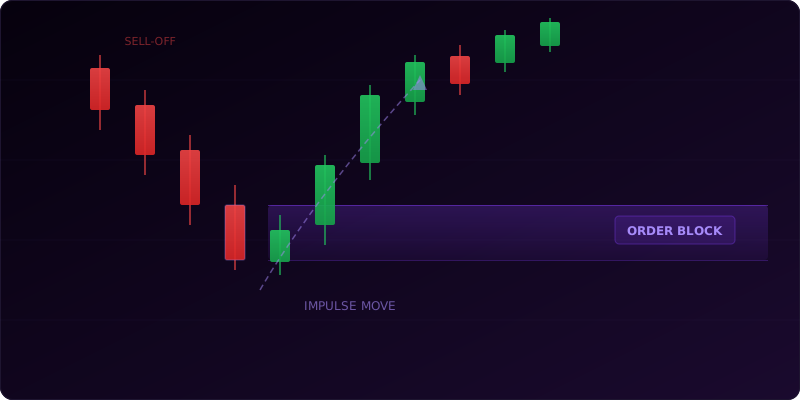
Order blocks mark where significant accumulation or distribution likely occurred. When price returns to these zones, unfilled orders can trigger a reaction. But the concept only works when the block forms at a confirmed structure break - not at every random swing candle.
A good order block indicator detects blocks only at BoS or ChoCh points, projects targets beyond the zone boundary, and automatically removes blocks that have been mitigated. For a detailed breakdown of what separates reliable order block tools from noise, see Order Block Indicators: How to Find One That Actually Works.
4. Liquidity Tools
Liquidity is the fuel that moves price. Institutions need it to fill large orders, and they engineer moves specifically to access it. You need tools that track session highs and lows, previous day/week levels, and identify where stop-loss orders are clustering.
Supply and demand pressure indicators add another layer - showing where buying or selling pressure is building, not as a static zone, but as a dynamic force that shifts with market activity.
5. Buy/Sell Signal Systems
Signals are the final layer, not the first. A good signal system fires only when multiple independent conditions align - market structure direction, proximity to a key zone, volume confirmation, and FVG confluence. One signal is never enough. The best systems run multiple detection engines simultaneously and only trigger when they agree.
Every signal should include a defined stop-loss and take-profit level. If an indicator just shows arrows with no risk framework, it's incomplete.
What Separates Premium From Free Smart Money Indicators?
There are hundreds of free Smart Money indicators on TradingView. Some have thousands of likes. But there's a consistent quality gap between free and premium tools that matters in live trading.
| Feature | Free Indicators | Premium Indicators |
|---|---|---|
| FVG classification | Basic (1-2 types) | Deep (7+ types) |
| Order block detection | Every swing candle | Structure-break only |
| Multi-timeframe | Rarely | Built-in HTF overlay |
| Invalidation logic | Manual or missing | Automatic |
| Repainting | Common | Non-repainting (verify before buying) |
| Alert system | Basic or none | Per-event customizable |
| Code optimization | Often slow | Performance-optimized |
| Updates | Abandoned after upload | Actively maintained |
The classification depth alone is worth the cost. A free FVG indicator that marks every gap identically gives you dozens of zones with no way to prioritize. A premium tool that classifies gap types, tracks mitigation status, and filters by significance narrows your focus to the setups that matter.
Multi-timeframe support is the other major differentiator. Smart Money trading is inherently multi-timeframe - you analyze structure on the higher timeframe and execute on the lower one. An indicator that can overlay HTF zones on your LTF chart saves significant time and reduces the risk of missing key levels.
An all-in-one suite that combines structure, FVGs, order blocks, and supply/demand under a single detection engine ensures internal consistency. When different indicators use different swing detection logic, their outputs inevitably conflict.
GrandAlgo
See these concepts automated on your charts
18 TradingView indicators — smart money, price action, supply/demand, and more.
What Smart Money Indicator Red Flags Should You Avoid?
Repainting
The single biggest scam in the indicator world. A repainting indicator changes its signals after the fact. That perfect entry you see on the chart was never there in real-time. Test every indicator on a live chart over multiple sessions before trusting it. If signals move, disappear, or change retroactively - delete it immediately.
No Invalidation
Order blocks, supply/demand zones, and FVGs all have a shelf life. When price mitigates a zone, it should disappear from your chart. Indicators that leave stale zones everywhere are giving you outdated information that leads to losing trades.
Cluttered Charts
If adding an indicator makes your chart unreadable, it's poorly designed. Good tools use clean visualization - gradient fills, distinct colors for bullish vs. bearish zones, and proximity filtering that hides irrelevant distant levels. Fifty rectangles on your chart is not analysis. It's noise.
Single-Formula Signals
Any indicator that generates buy/sell signals from a single mathematical condition - an RSI level, a moving average cross, a momentum threshold - is not a Smart Money tool. It's a dressed-up oscillator. Real confluence requires multiple independent detection engines agreeing before a signal fires.
No Backtesting Capability
If you can't verify an indicator's historical performance, you can't trust it forward. Look for tools that let you review past signals on historical data and measure actual win rates, not just cherry-picked screenshots from the developer.
How Do You Build a Complete Smart Money System on TradingView?
The pieces need to fit together in a specific hierarchy. This isn't about stacking as many indicators as possible - it's about building a layered system where each component serves a distinct purpose.
Layer 1: Direction (Market Structure)
Start with structure. Identify the current trend on your higher timeframe. Bullish structure means you only look for long setups. Bearish structure means you only look for shorts. This single filter eliminates many losing trades before you even look at a chart.
Layer 2: Zones (FVGs + Order Blocks + Supply/Demand)
Once you know the direction, identify where high-probability entries exist. Look for FVGs that align with unmitigated order blocks. Look for supply/demand zones at structural levels. The more confluence a zone has, the higher the probability of a reaction.
Layer 3: Timing (Session Levels + Liquidity)
Not all hours are equal. ICT killzones - the London and New York sessions - are when institutional activity peaks. Track session highs and lows, previous day levels, and identify where liquidity is likely to be swept. The best setups occur when a killzone sweep delivers price into a confluent zone.
Layer 4: Execution (Signals + Risk Management)
With direction, zone, and timing aligned, you execute. A signal system that integrates with the layers above - firing only when structure, zone, and session context align - produces far fewer but far better entries. Every entry should have a defined stop-loss (beyond the zone boundary) and a take-profit (at the next structural level or projected target).
The System in Practice
- Check HTF structure - bullish or bearish?
- Mark key zones on your entry timeframe - where do FVGs, order blocks, and supply/demand overlap?
- Wait for a killzone session and a liquidity sweep toward your zone
- Enter when a signal fires at the zone with defined SL/TP
- Manage the trade - break-even after 1R, partial profits at first target
This framework works because each layer filters the next. You're not trading every signal. You're not entering at every zone. You're waiting for the rare moments when direction, zone, timing, and signal all agree.
Frequently Asked Questions
The best indicators identify market structure, liquidity pools, order blocks, fair value gaps, session levels, and confluence across timeframes. They should help traders read institutional behavior rather than produce simple buy and sell arrows.
Some do, especially tools that mark swings or structure before a candle closes. A serious Smart Money indicator should clearly define when signals confirm, avoid changing completed signals, and make its repainting behavior transparent.
Free indicators can help with individual concepts such as FVGs or swing structure. Premium tools become useful when they combine concepts cleanly, reduce manual chart work, support alerts, and filter weak or low-context signals.
A complete system should include structure, liquidity, imbalance, order block, session, and risk context. No single signal is enough. The edge comes from confluence between where liquidity sits, how structure shifts, and where price offers entry.
Avoid indicators that repaint without disclosure, mark every candle as a signal, ignore higher-timeframe context, or use Smart Money terminology for ordinary momentum logic. More labels do not mean more edge.
Bottom Line
- Most TradingView indicators are built on lagging math - Smart Money trading requires tools that detect structure, imbalances, and liquidity directly
- The five categories you need covered: market structure, FVG detection, order blocks, liquidity tools, and confluence-based signals
- Classification depth and multi-timeframe support are the biggest quality differentiators between free and premium tools
- Always test for repainting on a live chart before trusting any indicator with real capital
- Build your system in layers: direction first, then zones, then timing, then execution
- Fewer high-confluence setups will always outperform more frequent low-quality signals
- One well-built suite with consistent detection logic beats stacking five separate indicators with conflicting swing definitions
The indicator market is flooded with tools that look impressive on screenshots and fail in live trading. The traders who consistently profit aren't using the most popular indicators - they're using the most structurally sound ones, combined with a system that filters aggressively for quality over quantity.


