Confluence Trading: Why One Signal Is Never Enough
Single-factor trading decisions lose money. What confluence means, how to stack multiple factors for higher-probability trades, and when enough is enough.

A moving average crosses over - do you buy? RSI hits oversold - do you buy? An order block is retested - do you buy?
If your answer to any of these is "yes" based on that single factor alone, you're trading without confluence. And trading without confluence is how most accounts blow up.
What Is Confluence?
Confluence means multiple independent factors pointing to the same conclusion. Instead of entering because one thing says "buy," you enter because three, four, or five things all agree.
Each factor on its own has a modest edge. But when several unrelated factors align, the probability stacks in your favor.
Think of it like a court case. One piece of evidence is circumstantial. Five independent pieces of evidence pointing to the same conclusion is compelling.
Why Single-Factor Trading Fails
Any Single Signal Has Noise
Every indicator, every pattern, every level produces false signals. A moving average cross works roughly 50-60% of the time. An order block retest perhaps 55-65%. RSI oversold works maybe 45% of the time.
None of these win rates alone are enough to ensure consistent profitability without strong risk-to-reward discipline - especially after accounting for spread, slippage, and the emotional cost of losing streaks.
Markets Are Complex
Price moves based on multiple interacting forces: institutional flow, retail sentiment, news, positioning, time of day, market structure. No single factor captures all of this.
A setup that accounts for multiple dimensions of market context is fundamentally more robust than one that relies on a single signal.
False Confidence
One signal that aligns with your bias feels like confirmation. But it's not confirmation - it's a single data point. True confirmation requires independent factors agreeing.
What Types of Confluence Matter?
Structural Confluence
Multiple structural factors agree:
- Market structure is bullish (higher highs, higher lows) AND
- Price is at a demand zone AND
- A Break of Structure just confirmed the trend
Multi-Timeframe Confluence
Different timeframes point to the same conclusion:
- Daily trend is bullish AND
- 4H shows a demand zone AND
- 15m shows a Change of Character at the zone
Technical Confluence
Different technical concepts align at the same price:
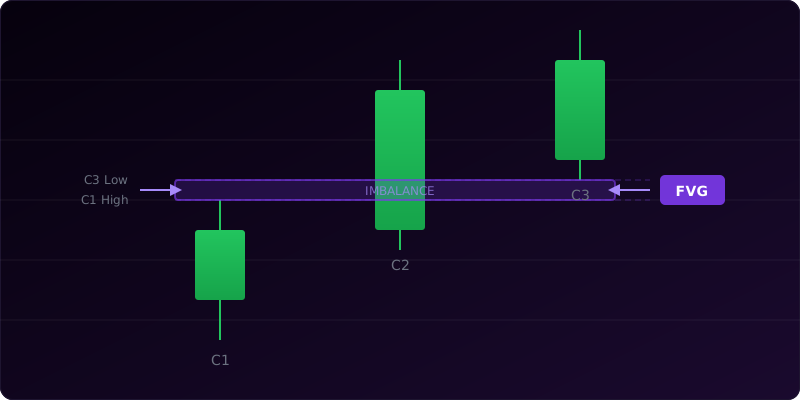
- An order block sits at the same level as a fair value gap AND
- The level coincides with a Fibonacci retracement AND
- Volume increases at the zone
Time-Based Confluence
The setup aligns with favorable timing:
- The signal fires during a kill zone AND
- It's within the first two hours of a session AND
- The daily narrative supports the direction
How to Stack Confluence
The Minimum Stack (3 Factors)
At minimum, every trade should have:
- Direction - Market structure confirms the trend
- Location - Price is at a significant zone (S/D, OB, FVG, key level)
- Trigger - A specific event fires at the zone (reversal candle, structure shift, signal)
This three-factor minimum keeps you from taking random trades while being achievable on most setups.
The Ideal Stack (5+ Factors)
The highest-probability trades have five or more factors:
- Higher TF structure confirms direction
- Price is in the correct pricing zone (discount for longs, premium for shorts)
- A zone exists at the current price (order block, supply/demand, FVG)
- Multi-timeframe agreement (HTF zone + LTF trigger)
- Confirmation trigger fires at the zone
- Session timing supports the trade (within a kill zone)
When all of these align, you have a genuinely high-probability setup.
The Diminishing Returns Point
There's a balance. Too little confluence = poor win rate. Too much confluence = you never take a trade.
3-4 factors is the sweet spot for most traders. Enough to filter noise, not so many that you're paralyzed waiting for perfection.
GrandAlgo
See these concepts automated on your charts
18 TradingView indicators — smart money, price action, supply/demand, and more.
How Do You Build a Confluence Checklist?
Create a personal checklist that you verify before every trade:
Example: Long Trade Checklist
| Factor | Check | Weight |
|---|---|---|
| HTF structure bullish | BoS on 4H/Daily | Required |
| Price in discount zone | Below 50% of current range | Preferred |
| Zone present | OB, FVG, or S/D zone at price | Required |
| Trigger fired | Reversal candle or LTF ChoCh | Required |
| Risk-reward ≥ 1.5:1 | SL and TP calculated | Required |
| Position sized | Risk per trade defined | Required |
| Kill zone active | London or NY session | Preferred |
| Volume confirmation | Above-average volume at zone | Bonus |
Required items must all be present. Preferred items increase confidence. Bonus items are nice but not necessary.
What Confluence Mistakes Should You Avoid?
Mistake 1: Correlated Factors
Three moving averages all crossing up is NOT three-factor confluence. It's one factor (trend following) measured three ways. True confluence requires independent factors.
Independent examples:
- Structure (BoS) + Zone (OB) + Trigger (FVG) = 3 independent factors
- RSI oversold + Stochastic oversold + CCI oversold = 1 factor measured 3 ways
Mistake 2: Confirmation Bias
You want to take the trade, so you "find" confluence that isn't really there. The order block is "close enough," the structure is "sort of bullish," the FVG is "almost aligned."
Fix: Define your criteria before looking at the chart. If the setup doesn't meet your checklist objectively, skip it.
Mistake 3: Analysis Paralysis
Waiting for 7+ factors to align means you rarely trade. And when you do, the entry is often late because you spent too long verifying.
Fix: Define your minimum (3-4 factors) and your ideal (5-6). Enter on minimum when the setup is clean. Wait for ideal in ambiguous conditions.
Mistake 4: Ignoring Conflicting Factors
Three factors say buy, but one significant factor says sell (like a higher timeframe supply zone overhead). Many traders ignore the conflicting signal.
Fix: Conflicting factors reduce confluence. If a major factor opposes your trade, reduce size or skip it entirely.
How Should Signal Indicators Fit Into Confluence?
The best signal indicators build confluence into their logic:
- Multiple detection engines that must agree before firing
- Volume filters that confirm strong market conviction
- FVG filters that require structural imbalance
- Trend filters that align signals with market structure
When a signal indicator requires built-in confluence before generating an entry, each signal it produces has already passed multiple independent checks. Tools like the MTF Confluence Key Levels indicator, for example, scan across timeframes to find where multiple levels converge. This is fundamentally different from a single-formula indicator that fires on one condition.
Frequently Asked Questions
Confluence means multiple independent factors point toward the same trade idea. Examples include higher-timeframe trend, liquidity sweep, support or resistance, market structure shift, fair value gap, session timing, and favorable risk-reward.
Three to five meaningful factors are usually enough. More is not always better. If the factors are independent and relevant, they can improve probability. If they all measure the same thing, they create false confidence rather than true confluence.
Bad confluence is stacking redundant indicators or adding random filters after the setup appears. For example, RSI, stochastic, and MACD may all measure similar momentum. That is not three independent reasons; it is one idea repeated three times.
Yes. Too many requirements can create analysis paralysis and cause missed trades. A good checklist defines the minimum evidence needed before the session starts, then lets the trader execute when those criteria are met.
Indicators should support the thesis, not replace it. A signal indicator is most useful when it confirms structure, liquidity, timing, or risk location. If an indicator gives a signal with no market context, it is weak confluence.
Core Principles
- Confluence means multiple independent factors pointing to the same conclusion
- 3-4 factors is the sweet spot - enough to filter noise, not so many you never trade
- Factors must be independent - three oscillators agreeing is still one factor
- Every trade needs: direction + location + trigger at minimum
- Define your checklist before looking at the chart to avoid confirmation bias
- Conflicting factors reduce probability - don't ignore them
- The best signal indicators build confluence into their logic with multiple engines and filters


