Why Supply and Demand Zones Fail (And How to Fix It)
Your supply and demand zones keep breaking? Here are the real reasons zones fail and actionable fixes to improve your zone trading.

You mark a demand zone. Price returns. You go long. Price drops straight through the zone and hits your stop.
Sound familiar? It happens to every supply and demand trader. The question is whether it happens because of bad luck or because of fixable mistakes.
Usually, it's fixable mistakes.
Why Does Trading Against the Trend Break Zones?
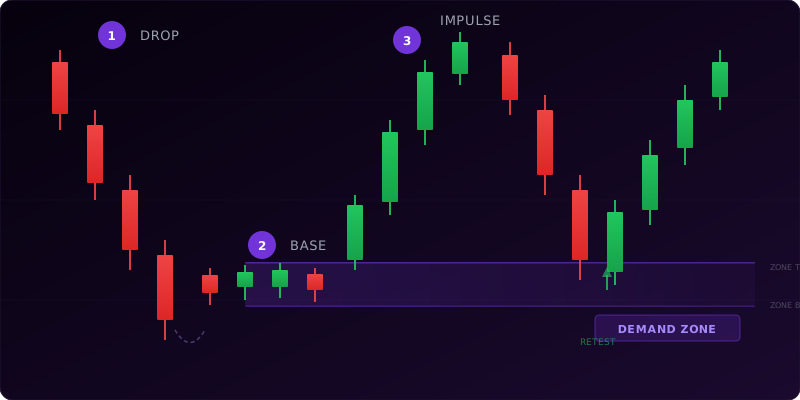
The problem: A demand zone in a bearish market. A supply zone in a bullish market. The zone is technically valid - it has a structure break and impulse. But the broader trend is against you.
Counter-trend zones get swept far more often than zones aligned with the trend. In a strong downtrend, bullish demand zones are liquidity pools - they attract price, absorb the buying, and then price continues lower.
The fix: Only trade demand zones in bullish structure. Only trade supply zones in bearish structure. Check the higher timeframe before entering. For a complete framework, see how to combine supply and demand with market structure.
Why Do Stale Zones Fail?
The problem: The zone has already been tested once, twice, or three times. Each test filled some of the institutional orders at that level. By the third test, there might not be enough unfilled orders to cause a reaction.
The fix: Prioritize first-test zones. Accept reduced probability on second tests (require additional confluence). Avoid third tests entirely unless the context is exceptional.
The psychology: It's tempting to trade tested zones because they "held before." But the logic is backwards - S/D zones weaken with each test, unlike traditional support/resistance.
Why Does Weak Departure Make Zones Fail?
The problem: The impulse move from the zone was slow, choppy, or small. A weak departure suggests weak institutional positioning. If the institutions weren't aggressive leaving the zone, their commitment to the level is questionable.
The fix: Only trade zones with strong, impulsive departures - multiple large candles in the same direction with minimal pullback. If the departure looks like a slow grind, skip the zone.
How to measure: Compare the impulse candles to the average candle size on that timeframe. The departure should be notably larger and more directional than normal candles.
Why Do Zones Need a Structure Break?
The problem: Price bounced from an area and you marked it as a zone. But the bounce didn't break any structural swing point. Without a structure break, you don't have confirmation that the move was institutionally driven.
The fix: Require a BoS or ChoCh as part of the impulse before validating any zone. No structure break = no zone.
Why Do Wide Zones Fail?
The problem: You included too many candles in the base, creating a zone that spans a large price range. When price enters the zone, your stop-loss is at the far end - far away from your entry - giving you terrible risk-reward.
Wide zones are also less precise. Price might react at the top, middle, or bottom of the zone, making entry timing a guess.
The fix: Focus on the last 1-3 candles before the impulse. Tighter zones give you tighter stops and clearer reaction points. See the full guide on drawing supply and demand zones correctly for detailed zone construction rules.
GrandAlgo
See these concepts automated on your charts
18 TradingView indicators — smart money, price action, supply/demand, and more.
Why Does the Wrong Timeframe Break Zones?
The problem: A 5-minute demand zone might work for a quick scalp, but it's invisible to the institutions trading on the hourly or 4-hour chart. Small timeframe zones carry minimal institutional weight.
The fix: Use higher timeframe zones (1H, 4H, Daily) for primary trade decisions. Drop to lower timeframes only for entry timing within a higher TF zone.
Rule of thumb: If your zone doesn't appear on a timeframe at least one level above your entry chart, it's probably not significant enough.
Why Does No Confirmation at the Zone Fail?
The problem: Price touches the zone and you immediately enter. But "touching the zone" isn't the same as "reacting at the zone." Price can easily wick into a zone and continue through.
The fix: Wait for confirmation:
- A reversal candlestick at the zone
- A lower timeframe structure shift within the zone
- Volume increase as price enters the zone
- A fair value gap forming at the zone level
Entering without confirmation turns zone trading into limit order gambling.
Why Does Ignoring Nearby Supply or Demand Fail?
The problem: You enter at a demand zone, but there's a significant supply zone just above - limiting your upside and making the risk-reward poor. Or there's a higher timeframe supply zone that encompasses your demand zone entirely.
The fix: Before entering at any zone, check what's above and below:
- For longs: Is there a major supply zone nearby that will cap the move?
- For shorts: Is there a major demand zone nearby that will halt the drop?
If opposing zones are too close, the trade doesn't have enough room to work.
How Can You Improve Your Zone Win Rate?
1. Be Selective
You don't need to trade every zone. Focus on the top 20% - fresh zones with strong departures, structure breaks, trend alignment, and higher timeframe context.
2. Combine With FVGs
A fair value gap at or near your S/D zone significantly increases probability. The zone provides the area; the FVG provides the imbalance. Supply Demand Pressure Cloud can automate zone detection while you focus on FVG confluence.
3. Check Multiple Timeframes
A zone visible on both the 1H and 4H chart is far more significant than one visible only on the 1H.
4. Use Proper Position Sizing
Even with perfect zone identification, some zones will fail. Risk 1-2% per trade so that failures don't damage your account.
5. Track Your Results
Log every zone trade: which zones worked, which failed, and why. After 50+ trades, patterns emerge - maybe you're consistently losing on counter-trend zones or third-test zones. Fix those specific patterns.
Frequently Asked Questions
Zones fail when they are stale, against trend, too wide, weakly formed, missing a structure break, or entered without confirmation.
A strong zone is fresh, narrow enough to define risk, formed by strong displacement, aligned with trend, and located at a meaningful liquidity or structure area.
Usually no. Waiting for confirmation such as rejection, displacement, or a structure shift reduces the chance of catching a zone that is about to fail.
Higher-timeframe zones carry more weight, while lower-timeframe zones are useful for entries. The best trades align both.
Define invalidation before entry, size positions correctly, avoid wide stale zones, and track which zone types fail most often in your journal.
Key Takeaways
- Most zone failures are fixable mistakes, not random bad luck
- Trade with the trend - counter-trend zones have significantly lower win rates
- Fresh zones are strongest; avoid third+ tests
- Require strong departures and structure breaks before validating any zone
- Tighter zones produce better risk-reward than wide ones
- Always wait for confirmation at the zone - don't blindly enter on touch
- Check for opposing zones nearby that could limit your trade's potential
- Be selective - trade the best zones, skip the marginal ones


