How to Combine Supply and Demand With Market Structure
Supply and demand zones become far more powerful with market structure analysis. How to integrate the two for higher-probability trade setups.

Supply and demand zones tell you where to trade. Market structure tells you which direction to trade. When you combine both, you eliminate the majority of losing setups.
Most zone trading losses come from one problem: trading zones against the structure. This guide shows how to integrate the two properly.
Why Does Structure Matter for Zone Trading?
A demand zone in a downtrend is a target for sellers, not a launchpad for buyers. Price returns to the zone, absorbs the remaining demand, and continues lower. The zone fails because the broader momentum overwhelms the local orders.
Market structure is the filter. It tells you:
- Which zones to trade (aligned with the trend)
- Which zones to avoid (counter-trend)
- When the trend might be changing (ChoCh at a zone)
Without this filter, you're trading every zone blindly - and losing on the half that fight the trend.
What Is the Integration Framework?
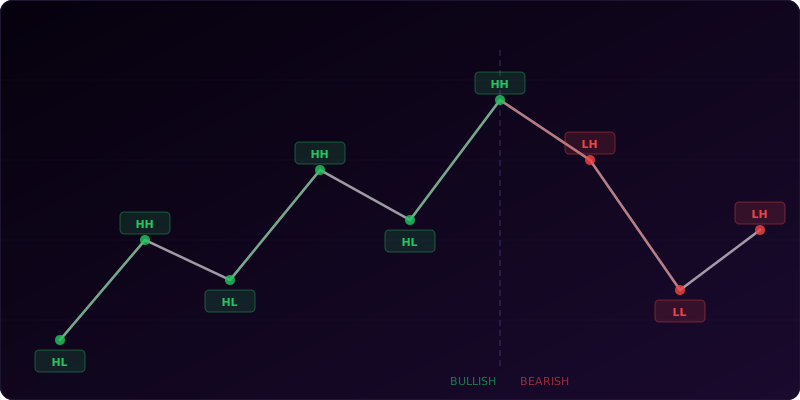
Step 1: Determine Structure First
Before looking at any zone, establish the market structure on your trading timeframe:
- Bullish (HH, HL): Only look for demand zones to buy
- Bearish (LH, LL): Only look for supply zones to sell
- Unclear: Wait for structure to clarify before taking zone trades
This single step eliminates counter-trend zone trades - the most common source of losses. If you need a refresher on drawing zones correctly, start there before combining them with structure.
Step 2: Identify Zones at Structure Events
The most powerful zones form at structural break points:
Demand zones at BoS:
- Price breaks above a swing high (bullish BoS)
- The base candles before this break form a demand zone
- This zone is confirmed by the structure break - institutions pushed price higher from here
Supply zones at BoS:
- Price breaks below a swing low (bearish BoS)
- The base candles before this break form a supply zone
- Confirmed by the structure break
Zones at ChoCh:
- When price breaks structure against the trend for the first time
- The zone at the ChoCh origin represents where the trend reversal started
- These are powerful but require more confirmation (the ChoCh needs to be validated)
Step 3: Grade Zone Probability by Structural Context
Not all aligned zones are equal:
| Zone Type | Structure Context | Probability |
|---|---|---|
| Demand at BoS | Bullish trend continues | High |
| Supply at BoS | Bearish trend continues | High |
| Demand at ChoCh | Trend reversing to bullish | Moderate-High (needs confirmation) |
| Supply at ChoCh | Trend reversing to bearish | Moderate-High (needs confirmation) |
| Demand in downtrend | Counter-trend | Low (avoid) |
| Supply in uptrend | Counter-trend | Low (avoid) |
Step 4: Use Structure for Stop Placement
Market structure provides natural stop-loss levels:
For demand zones (buying):
- Stop below the zone boundary (standard)
- Extra confirmation: the stop should also be below the most recent higher low
- If the stop is beyond both the zone AND the structural low, your invalidation is double-confirmed
For supply zones (selling):
- Stop above the zone boundary (standard)
- Extra confirmation: above the most recent lower high
Step 5: Use Structure for Targets
Market structure also defines your profit targets:
For demand zone longs:
- Target 1: The most recent swing high
- Target 2: The swing high that formed the BoS
- Target 3: The next supply zone or liquidity target above
For supply zone shorts:
- Target 1: The most recent swing low
- Target 2: The swing low that formed the BoS
- Target 3: The next demand zone or liquidity target below
How Do You Combine Multi-Timeframe Structure and Zones?
The real power emerges with multi-timeframe analysis:
The Setup
- Higher TF (Daily/4H): Identify market structure direction
- Trading TF (1H): Find supply/demand zones aligned with HTF structure
- Entry TF (15m/5m): Time entries within the zone using LTF structure shifts
Example
- Daily structure is bullish (higher highs and higher lows)
- 1H chart shows a demand zone at the most recent higher low
- Price pulls back to the 1H demand zone
- On the 15m, you see a bullish ChoCh within the zone → Entry
This three-layer alignment (HTF direction + MTF zone + LTF trigger) produces the highest-probability zone trades. Tools like Supply Demand Pressure Cloud can help automate the zone identification step so you can focus on structural alignment.
GrandAlgo
See these concepts automated on your charts
18 TradingView indicators — smart money, price action, supply/demand, and more.
What Happens When Structure Changes at a Zone?
Sometimes price returns to a supply/demand zone and structure shifts while at the zone. This is critical information:
Scenario: Demand Zone + Bullish Structure Holds
Price returns to a demand zone. On the lower timeframe, price makes a higher low within the zone and then a higher high (bullish structure maintained). Enter long - structure confirms the zone.
Scenario: Demand Zone + Structure Breaks
Price returns to a demand zone. Instead of bouncing, price makes a lower low within the zone (breaking structure). Don't enter - structure is warning that the zone may fail.
Scenario: Failed Zone Creates ChoCh
Price breaks through a demand zone, creating a Change of Character on the higher timeframe. The zone is invalidated, and the ChoCh suggests the trend is reversing. Look for supply zones in the new bearish structure.
What Supply-Demand and Structure Mistakes Should You Avoid?
-
Analyzing zones without structure - You end up trading both with and against the trend, significantly reducing your win rate.
-
Different structure on different timeframes - The 15m might be bearish while the 4H is bullish. Always defer to the higher timeframe for direction.
-
Ignoring ChoCh warnings - If a ChoCh occurs near your zone, it's a warning that structure might be changing. Don't blindly hold your bias.
-
Only using one timeframe - A zone on the 15m without higher TF structural support is weak. The combination requires multiple timeframes.
Frequently Asked Questions
Supply and demand zones show where price may react, but market structure tells you whether buyers or sellers are currently in control. Combining them helps avoid buying weak demand in a downtrend or shorting weak supply in an uptrend.
A zone is stronger when it aligns with higher-timeframe structure, forms after displacement, remains fresh, sits near liquidity, and causes a clear structure shift on reaction. A random zone in the middle of a choppy range is much weaker.
In an uptrend, mark the demand zones responsible for breaking structure higher. Wait for price to pull back into the zone, then look for lower-timeframe confirmation such as rejection, CHOCH, FVG formation, or a fresh bullish impulse.
Ignore zones that have been tapped repeatedly, sit against strong higher-timeframe structure, lack displacement, or fail to produce any reaction. If price accepts through the zone, it may flip from support to resistance or from resistance to support.
No. Structure gives directional context, while zones give trade location. The best setups need both: a reason to expect a direction and a precise area where risk can be defined.
Key Takeaways
- Structure determines direction; zones determine location - combine both for complete setups
- Only trade demand zones in bullish structure and supply zones in bearish structure
- The most powerful zones form at structural break points (BoS and ChoCh)
- Use structure for stop placement (beyond zone AND structural level) and targets (next swing point)
- Multi-timeframe alignment (HTF structure + MTF zone + LTF trigger) produces the highest probability
- Watch for structure changes at zones - they tell you whether the zone is likely to hold or fail
- This combination eliminates counter-trend trades - the single biggest source of zone trading losses


