Why Most Buy/Sell Signal Indicators Are Garbage
Most signal indicators promise easy profits and deliver losses. Here's what makes them fail and what to actually look for in a signal system that works.

Open any indicator marketplace and you'll find hundreds of buy/sell signal tools. Green arrow: buy. Red arrow: sell. Follow the signals, make money. Simple, right?
It's not. The vast majority of signal indicators are genuinely terrible - and traders lose real money trusting them. Here's why most of them fail and what actually separates a useful signal system from a decorative one.
What Problems Do Most Signal Indicators Have?
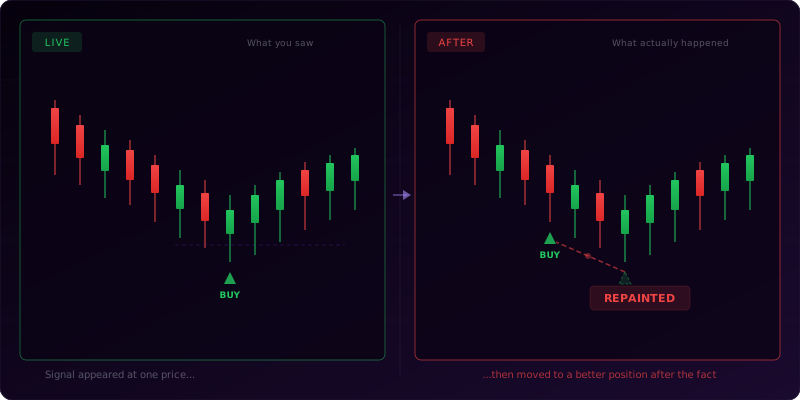
Problem 1: They Repaint
This is the biggest scam in the indicator world. A repainting indicator changes its signals after the fact. That perfect entry arrow you see on the chart? It wasn't there in real-time. The indicator retroactively placed it after the move already happened.
How to test for repainting:
- Add the indicator to a live chart
- Watch it generate a signal in real-time
- Refresh the page or change timeframes and come back
- If the signal moved, disappeared, or changed - it repaints
Any indicator that repaints is useless for live trading. Full stop.
Problem 2: No Confluence - Just Math
Most signal indicators use a single mathematical formula. An RSI crossover, a moving average cross, a momentum threshold. When the formula triggers, an arrow appears.
The problem: a single condition is never enough. Markets are complex. A moving average cross in a ranging market produces whipsaw after whipsaw. An RSI oversold reading in a strong downtrend just keeps getting more oversold.
Good signals require multiple independent conditions agreeing before firing. One formula = noise. Multiple confluences = actual signal.

Problem 3: No Trend Context
The signal fires regardless of market direction. Buy signal in a downtrend. Sell signal in a strong uptrend. The indicator doesn't know and doesn't care.
This is how traders get chopped up. They follow every arrow, half of which are fighting the prevailing trend. The result: a low win rate that makes profitability difficult without exceptional risk-reward discipline.
Problem 4: No Risk Management
A green arrow appears. Now what? Where's your stop-loss? Where's your target? How much should you risk?
Most signal indicators answer none of these questions. They tell you when to enter but nothing about how to manage the trade. This forces traders to improvise - which usually means emotional decisions.
Problem 5: Way Too Many Signals
More signals doesn't mean more profit. It means more noise. Some indicators fire 20+ signals per day. Even if 60% are winners, the transaction costs, emotional fatigue, and inevitable overtrading destroy the account.
A good signal system should be selective. Fewer signals, higher quality, better outcomes.
Problem 6: Curve-Fitted to Look Perfect
Indicator developers can tweak parameters until their tool looks amazing on historical data. This is called curve fitting - the indicator is optimized for past data but breaks down on new data.
Signs of a curve-fitted indicator:
- Incredible backtest results (90%+ win rate)
- Parameters are oddly specific (RSI length of 13.7, MA length of 47)
- Works beautifully on one asset/timeframe but fails on others
- Performance degrades significantly on recent data vs. the showcase period
What Actually Makes a Signal Indicator Work
Multiple Independent Engines
Instead of one algorithm making the decision, the best signal systems run multiple independent detection engines simultaneously - like Momentum Reversal Engines. Each engine looks for different reversal or continuation patterns. A signal only fires when multiple engines agree.
This is fundamentally different from stacking conditions within a single algorithm. Independent engines catch different types of market behavior and cross-validate each other.
Volume Confirmation
Signals that fire during thin, low-volume markets are unreliable. Genuine institutional moves come with volume. An optional volume filter that suppresses signals during quiet periods immediately improves quality.
Fair Value Gap Filtering
Signals that coincide with a fair value gap carry significantly more weight. The FVG represents an institutional imbalance - when a signal fires at that same level, you have confluence between the signal's algorithm and actual market structure.
Directional Alignment
Every signal should be checked against the prevailing market structure. A buy signal in confirmed bearish structure is a counter-trend trade - it can work, but the probability is lower. Filtering signals to only fire in the direction of the trend dramatically improves win rates.
Built-In Stop-Loss and Take-Profit
Every signal should come packaged with:
- Entry level - Where exactly to enter
- Stop-loss - Where you're wrong (invalidation)
- Take-profit - Where to exit with profit
This removes emotional decision-making from trade management. You know your risk before you enter, and you have a plan for exit.
How to Evaluate a Signal Indicator
Step 1: Test for Repainting
Add it to a live chart. Watch signals form in real-time over several sessions. If signals move, disappear, or change retroactively - delete it immediately.
Step 2: Count the Signals
Too many signals per day (10+) is a red flag. Quality signal systems are selective - they might fire 2-5 signals per day, sometimes zero.
Step 3: Check Across Multiple Markets
Apply it to different assets (crypto, forex, indices) and different timeframes. A reliable system performs consistently across markets. A curve-fitted one only works on the specific asset and timeframe it was designed for.
Step 4: Verify Risk Management
Does every signal include a stop-loss and take-profit level? Are these levels derived from market structure (not arbitrary fixed pips)? If the indicator just shows arrows with no risk framework, it's incomplete.
Step 5: Look at Losing Trades
Every system loses. The question is how it loses. Are losing trades small and controlled? Or does the system hold losers hoping they'll reverse? Check the historical signals and measure the average loss vs. average win.
Step 6: Check the Logic
Does the indicator use multiple confirmation layers? Does it filter by trend? Does it account for volume? Or is it just a single formula with arrows?
If you want to see this standard applied to our own tools, the GrandAlgo review covers what the 18 indicators actually do, pricing, refund policy, and who should skip them.
GrandAlgo
See these concepts automated on your charts
18 TradingView indicators — smart money, price action, supply/demand, and more.
How Do You Build a Signal-Based Trading System?
Even with a good signal indicator, you need a framework:
Pre-Trade
- Identify the trend using market structure (BoS/ChoCh)
- Mark key zones - supply/demand, order blocks, previous session levels
- Wait for a signal that fires at or near a key zone and aligns with the trend
Entry
- Confirm the signal has a defined SL and TP
- Check risk-reward - minimum 1.5:1, skip anything lower
- Size the position based on the stop distance and your risk per trade (1-2% max)
Post-Trade
- Move SL to break-even after 1R of profit
- Take partial profits at the first target
- Log the trade for review
Rules That Keep You Alive
- Max 2-3 trades per day, no exceptions
- No trading outside of your defined sessions
- Skip signals that don't align with higher timeframe structure
- If you hit your daily loss limit, stop
What Is the Signal Quality Spectrum?
Approximate heuristic ranges (actual results vary with market, timeframe, and execution):
| Quality Level | Characteristics | Expected Win Rate |
|---|---|---|
| Garbage | Single formula, repaints, no filters | 30-40% |
| Basic | Non-repainting, single algorithm, no SL/TP | 40-50% |
| Decent | Trend filter, multiple conditions, basic SL/TP | 50-55% |
| Good | Multiple engines, volume/FVG filters, structural SL/TP | 55-65% |
| Institutional | Deep confluence, multi-engine, adaptive filters, full risk mgmt | 60-70% |
The jump from "garbage" to "good" is enormous - and it comes from confluence, filtering, and risk management, not from fancier math.
Frequently Asked Questions
They fail because they repaint, ignore trend and liquidity context, trigger too often, lack risk rules, or were optimized only to look good on historical charts.
A useful signal indicator is non-repainting, selective, transparent, tested across markets, and paired with clear stop-loss and take-profit rules.
Use live observation, bar replay, out-of-sample markets, different timeframes, and manual backtesting that includes spread, slippage, and losing streaks.
No. The bad ones pretend context does not matter. Better systems use signals as one part of a complete trade plan.
Beginners can use them as training tools, but they still need to understand market structure, risk management, and why each signal appears.
Key Takeaways
- Test for repainting first - if it repaints, nothing else matters
- Multiple independent engines beat a single smart algorithm
- Volume and FVG filters add real confluence, not just complexity
- Every signal needs built-in stop-loss and take-profit levels
- Signals must align with market structure direction to be reliable
- Fewer, higher-quality signals beat frequent noisy ones every time
- No signal indicator replaces a trading plan and risk management
The harsh truth: if an indicator's marketing shows a chart covered in perfect green and red arrows, it's probably garbage. Real performance looks messy. Real edges are modest. The traders who profit from signal indicators are the ones who combine them with structure, zones, and strict risk management - not the ones who blindly follow arrows.


