SMT Divergence: How to Spot Smart Money Divergences Between Correlated Assets
How SMT divergence between correlated pairs like EUR/USD vs GBP/USD or NASDAQ vs S&P 500 reveals institutional positioning before the move happens.

Most ICT concepts focus on a single chart - market structure, fair value gaps, order blocks. SMT divergence is different. It compares two correlated assets to reveal when institutions are positioning in one while using the other as camouflage.
When EUR/USD makes a new low but GBP/USD doesn't, something is wrong. That discrepancy isn't noise - it's a signal that smart money is accumulating in one while letting the other appear weak. Recognizing this divergence gives you a directional edge before the move is visible on either chart alone.
What Is SMT Divergence?
SMT (Smart Money Technique) divergence occurs when two positively correlated assets fail to confirm each other's price action at key structural levels. Specifically:
- Bullish SMT divergence: Asset A makes a lower low while Asset B makes a higher low (or fails to make a new low). This suggests the selling pressure is not genuine - institutions are accumulating.
- Bearish SMT divergence: Asset A makes a higher high while Asset B makes a lower high (or fails to make a new high). This suggests the buying pressure is not genuine - institutions are distributing.
The logic: If two assets are genuinely correlated and the macro environment is driving both in the same direction, they should make new highs and lows together. When one fails to confirm, it reveals a divergence in institutional order flow between the two instruments.
Why Does SMT Divergence Work?
Institutional Execution Across Correlated Markets
Large institutions don't just trade one instrument. A bank accumulating a long USD position might sell EUR/USD and GBP/USD simultaneously. But they don't execute evenly across both - they may concentrate selling in EUR/USD (more liquid) while only partially selling GBP/USD.
This imbalance creates divergence. EUR/USD hits a new low from the concentrated selling, but GBP/USD can't make a new low because the selling pressure is lighter. The failure to confirm reveals where the institutional order flow is actually concentrated.
Liquidity Engineering Across Markets
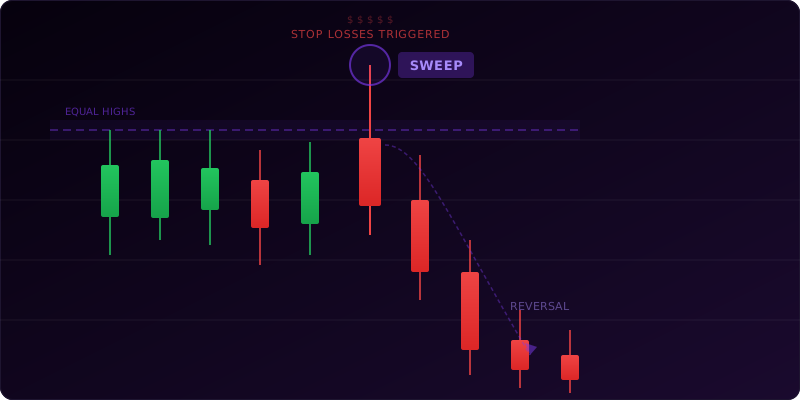
Institutions sometimes use one market to engineer liquidity while positioning in another. For example:
- Push EUR/USD to a new low, triggering stop losses from long positions
- The stops provide sell-side liquidity for institutions to buy into
- Meanwhile, GBP/USD doesn't make a new low - there's no genuine bearish pressure
- The EUR/USD low was a liquidity sweep, and GBP/USD's refusal to follow confirms it
SMT divergence catches this dynamic in real time.
What Are Key Correlated Pairs for SMT Analysis?
Forex Pairs
| Pair A | Pair B | Correlation | Why It Works |
|---|---|---|---|
| EUR/USD | GBP/USD | Positive | Both driven by USD strength/weakness |
| EUR/USD | DXY (inverted) | Inverse | Euro is ~57% of the Dollar Index |
| GBP/USD | GBP/JPY | Moderate | Both driven by GBP strength |
| AUD/USD | NZD/USD | Strong positive | Both commodity currencies, similar fundamentals |
| USD/CAD | USD/CHF | Moderate positive | Both USD-driven |
The most popular SMT pair: EUR/USD vs GBP/USD. Both are primarily driven by USD flow, making divergences between them highly significant for identifying USD directional bias.
Indices
| Index A | Index B | Correlation | Why It Works |
|---|---|---|---|
| S&P 500 (ES) | NASDAQ 100 (NQ) | Very strong | Both US equity markets, tech overlap |
| NASDAQ 100 (NQ) | Dow Jones (YM) | Strong | Tech vs industrials divergence |
| S&P 500 (ES) | Russell 2000 (RTY) | Moderate | Large cap vs small cap risk appetite |
The most popular SMT for indices: ES vs NQ. When NQ makes a new high but ES doesn't (or vice versa), the divergence signals that the rally lacks broad institutional participation.
Crypto
| Asset A | Asset B | Correlation | Why It Works |
|---|---|---|---|
| BTC | ETH | Strong positive | ETH typically follows BTC direction |
| BTC | Total crypto market cap | Very strong | BTC dominance shifts |
How Do You Identify SMT Divergence?
Step 1: Identify a Key Structural Level
SMT divergence is most significant at swing highs and swing lows - the points where market structure is defined. You're looking for moments where both correlated assets approach a structural level simultaneously.
The level should be significant:
- A previous swing high or low that has been tested or is being approached
- A session high/low (Asian, London, NY)
- A previous day/week high/low
- A level where liquidity is resting (equal highs/lows, likely stop clusters)
Step 2: Compare the Swing Points
When both assets reach the structural level, compare what happens:
Bullish SMT (at swing lows):
- Asset A pushes to a new low - below the previous swing low
- Asset B fails to make a new low - it holds above the previous swing low or makes a higher low
- The divergence suggests the new low in Asset A is a liquidity sweep, not genuine selling
Bearish SMT (at swing highs):
- Asset A pushes to a new high - above the previous swing high
- Asset B fails to make a new high - it holds below the previous swing high or makes a lower high
- The divergence suggests the new high in Asset A is a liquidity sweep, not genuine buying
Step 3: Confirm with Price Action
SMT divergence identifies the potential. Confirmation comes from:
- A change of character on the asset that made the new extreme (the one that swept liquidity)
- An FVG forming on the reversal
- A shift in market structure on either asset
- The divergence occurring within a kill zone
The confirmation tells you the divergence is resolving - the move you anticipated is beginning.
How Do You Trade SMT Divergence?
Bullish SMT Setup
- EUR/USD and GBP/USD are both trending toward a key support level
- EUR/USD makes a new low, sweeping previous liquidity
- GBP/USD does not make a new low - it holds above its previous swing low
- EUR/USD shows a reversal candle or a lower timeframe CHoCH
- Enter long on EUR/USD (the one that swept liquidity)
- Stop below the new low
- Target the next structural resistance or FVG above
Why enter on the asset that made the new low? Because it swept the liquidity and is now set up for a reversal. The other asset (GBP/USD) already showed strength by refusing to make a new low - the better risk-reward entry is on the asset that's about to catch up.
Bearish SMT Setup
- ES (S&P 500) and NQ (NASDAQ) are both rallying toward resistance
- NQ makes a new high, sweeping buy-side liquidity
- ES does not make a new high - it stalls below its previous swing high
- NQ shows a bearish reaction (wick, reversal candle, LTF structure break)
- Enter short on NQ (the one that swept liquidity)
- Stop above the new high
- Target the next structural support
Which Asset to Trade?
You can trade either asset, but each has different characteristics:
Trade the asset that swept liquidity (made the new extreme):
- Better risk-reward (tight stop at the new extreme)
- Trading the reversal from the liquidity grab
- More aggressive - requires the reversal to happen immediately
Trade the asset that showed strength (refused to confirm):
- More conservative entry
- Already showing the directional bias
- Wider stop (further from the structural level)
- Lower risk-reward but potentially higher win rate
Most traders trade the asset that swept liquidity for the better risk-reward profile.
GrandAlgo
See these concepts automated on your charts
18 TradingView indicators — smart money, price action, supply/demand, and more.
How Do You Combine SMT Divergence With ICT Confluence?
SMT divergence becomes significantly more powerful when combined with other ICT concepts:
SMT + Premium/Discount
If a bullish SMT divergence occurs with both assets in the discount zone of their respective ranges, the probability increases substantially. The divergence confirms accumulation, and the discount positioning confirms favorable pricing.
SMT + Order Block
When the asset that swept liquidity reverses into an order block, you have institutional positioning confirmed by both inter-market analysis (SMT) and single-chart analysis (OB).
SMT + Kill Zone Timing
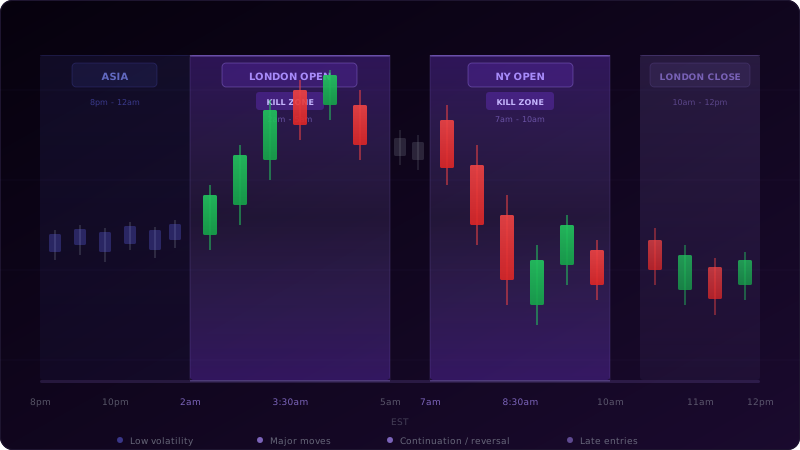
SMT divergence during London or New York kill zones carries more weight than divergence during Asian consolidation. Institutional participation is higher during kill zones, making the divergence more meaningful.
SMT + FVG Entry
After identifying SMT divergence, use a fair value gap on the reversal as your precise entry point. The SMT gives you the directional bias; the FVG gives you the exact entry level.
Which Timeframes Work for SMT Analysis?
Higher timeframes (Daily, 4H):
- Most significant divergences
- Fewer occurrences but higher reliability
- Swing trading setups with larger targets
- Look at weekly swing highs/lows
Mid timeframes (1H, 15m):
- Intraday swing setups
- Session high/low comparisons
- Good balance between frequency and reliability
Lower timeframes (5m, 1m):
- Micro-level divergences during kill zones
- Scalping entries within a known daily bias
- More noise, requires strict filtering
- Best used to refine entries after an HTF divergence is identified
Recommended approach: Identify SMT divergence on the 1H or 15m chart, then drop to the 5m or 1m for entry timing with FVGs or structure shifts.
What Common SMT Divergence Mistakes Should You Avoid?
1. Comparing Uncorrelated Assets
SMT divergence only works between assets that should move together. Comparing EUR/USD with Gold or Bitcoin with the S&P 500 introduces too many independent variables. Stick to highly correlated pairs.
2. Ignoring the Macro Context
If one asset is being driven by an independent fundamental event (e.g., a UK-specific data release moving GBP/USD while EUR/USD is unaffected), the divergence isn't institutional positioning - it's a fundamental gap. SMT works best when both assets are driven by the same underlying factor (USD flow, equity risk sentiment).
3. Looking for Divergence Everywhere
Not every minor swing difference is an SMT divergence. The divergence must occur at significant structural levels - previous swing highs/lows, session extremes, or key liquidity levels. Two assets briefly desyncing during low-volume chop is not a signal.
4. Trading Without Confirmation
SMT divergence identifies the potential for a reversal. It does not guarantee one. Always wait for price action confirmation (CHoCH, FVG, rejection) before entering. The divergence tells you to watch; the confirmation tells you to act.
5. Only Watching One Side
Check for divergence at both highs and lows. Many traders only look for bullish SMT at lows and miss bearish setups at highs (or vice versa). The concept works symmetrically.
What Should Be on an SMT Divergence Checklist?
| Factor | Check | Required? |
|---|---|---|
| Assets are genuinely correlated | Same macro driver | Yes |
| Divergence at a structural level | Swing high/low, session extreme | Yes |
| One asset makes new extreme, other doesn't | Clear failure to confirm | Yes |
| No independent fundamental driver | Divergence isn't event-driven | Yes |
| Price action confirmation | CHoCH, FVG, or rejection candle | Yes |
| Kill zone active | London or NY session | Preferred |
| Aligned with HTF bias | Not counter-trend | Preferred |
| R:R ≥ 2:1 | Stop beyond the swept level | Yes |
Frequently Asked Questions
SMT divergence is when two correlated assets fail to confirm the same high or low, signaling relative strength or weakness between them.
Common pairs include correlated forex pairs, equity indices such as ES and NQ, and related crypto assets such as BTC and ETH.
No. SMT is context. Traders still need price action confirmation such as a sweep, structure shift, FVG, or order block reaction.
Many traders trade the stronger asset for longs and the weaker asset for shorts, but the final choice depends on liquidity, spread, and cleaner structure.
SMT fails when assets are not truly correlated, macro context diverges, or traders force divergence without a key level or confirmation.
What Are the Core Principles of SMT Divergence?
- SMT divergence compares two correlated assets at structural levels to identify institutional positioning
- Bullish SMT: Asset A makes a lower low while Asset B makes a higher low - selling pressure isn't genuine
- Bearish SMT: Asset A makes a higher high while Asset B makes a lower high - buying pressure isn't genuine
- The best pairs for SMT: EUR/USD vs GBP/USD (forex), ES vs NQ (indices), BTC vs ETH (crypto)
- Trade the asset that swept liquidity for better risk-reward, or the asset that showed strength for a more conservative approach
- Always confirm divergence with price action - CHoCH, FVGs, or structural shifts on the reversing asset
- SMT divergence is most reliable at significant structural levels during active kill zones
- Combine with premium/discount analysis, order blocks, and FVGs for highest-probability setups


