How to Pass a Prop Firm Challenge Using Smart Money Indicators
A structured approach to passing prop firm evaluations using ICT and Smart Money indicators - from chart setup to risk management to daily execution.

Most traders who fail prop firm challenges know how to trade. They understand market structure. They can identify order blocks. They know what a fair value gap is.
They still fail.
Not because of knowledge. Because of discipline. A prop firm evaluation is a risk management test disguised as a trading challenge. Smart Money indicators give you a genuine edge — but only when paired with strict rules, a defined playbook, and the self-control to follow both.
Why Do Smart Money Concepts Work for Prop Firms?
Prop firm rules punish two things: large drawdowns and inconsistency. Smart Money Concepts are built to avoid both.
Institutional logic produces high-probability setups. When you trade based on how institutions actually move price — through liquidity sweeps, order blocks, and structural shifts — you're aligning with the dominant force in the market, not fighting it.
Clear invalidation means tight stops. Every SMC setup has a defined point where the thesis is wrong. Order block broken? Out. FVG violated? Out. No ambiguity, no hoping, no "let me give it more room." This keeps individual losses small.
Defined risk on every trade. You always know your stop before you enter. You always know your target. There's no guessing, no adjusting mid-trade based on feelings. This is exactly what prop firms reward.
Repeatable setups across all sessions. The same structural patterns appear in London, New York, and even Asia. You're not hunting for one-off trades — you're running a system.
What Indicator Setup Works for Prop Firm Trading?
The biggest mistake traders make when preparing for a prop firm challenge is loading their chart with too many indicators. Clutter creates hesitation. Hesitation creates missed entries or late entries. Both cost money.
You need four functions on your chart. Not four indicators — four functions.
-
Market structure — Identifies trend direction, Break of Structure, and Change of Character. This is your directional filter. If structure is bullish, you only take longs. Period.
-
Zones — Order blocks, fair value gaps, and supply/demand zones. These are your entry areas. Price arrives at a zone that aligns with structure, and you start looking for a trigger.
-
Session levels — Asian range, London high/low, PDH/PDL. These are your liquidity targets and timing references. They tell you where price is likely heading and when moves are most probable.
-
Signal confirmation — A trigger that fires when conditions align. Not a standalone buy/sell signal, but a confirmation layer that validates the structural setup.
The Smarter Money Suite handles the first three functions. For signal-based confirmation on entries, tools like Momentum Reversal Engines add a final execution layer without cluttering the chart.
Keep your chart clean. If you can't explain what every element on your screen does in one sentence, remove it.
What Daily Routine Should You Follow Before the Session?
Consistency starts before the market opens. Run this checklist every day before your trading session:
-
Mark higher timeframe structure. Open the 4H and Daily. Is the current trend bullish or bearish? Where was the last Break of Structure? This determines your directional bias for the day.
-
Identify key zones. Mark unmitigated order blocks and unfilled fair value gaps on the 1H and 4H. These are your entry areas.
-
Plot session levels. Mark the Asian range high/low, PDH/PDL, and any obvious swing points. These are your liquidity targets.
-
Check the economic calendar. High-impact news events change everything. If a major release is scheduled during your session, either sit out or reduce size.
-
Set alerts at key levels. Don't stare at charts for hours. Set alerts at your zones and session levels. When price arrives, you assess. Otherwise, you wait.
This process takes 10-15 minutes. It prevents you from taking impulsive trades and forces you to operate within a defined framework every single day.
GrandAlgo
See these concepts automated on your charts
18 TradingView indicators — smart money, price action, supply/demand, and more.
What Is the 3-Setup Playbook?
You don't need twenty setups to pass a prop firm challenge. You need two or three that you execute perfectly. Here are the three highest-probability Smart Money setups for funded account evaluations.
Setup 1: Break of Structure + FVG Retest
This is the bread-and-butter trend continuation trade.
- Context: Higher timeframe structure is bullish (or bearish). A fresh Break of Structure occurs on your execution timeframe.
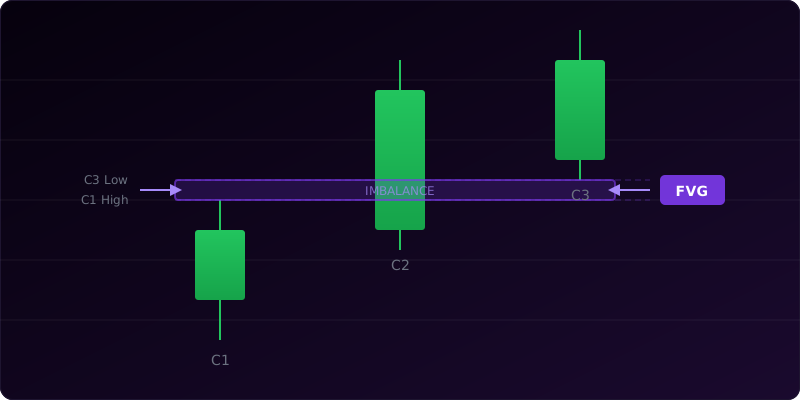
- Entry: Price retraces into the fair value gap left by the BoS candle. Enter at the 50% level of the FVG.
- Stop: Below the FVG (for longs) or above it (for shorts). If the FVG is fully filled, the setup is invalid.
- Target: The next structural swing high (for longs) or low (for shorts). Minimum 1.5:1 risk-reward.
This setup works because the FVG represents an imbalance — a zone where one side overwhelmed the other. Institutional traders use these zones to add to positions on pullbacks.
Setup 2: Liquidity Sweep + Change of Character
This is the reversal trade. Higher risk, higher reward.
- Context: Price sweeps a key liquidity level — PDH/PDL, session high/low, or obvious swing point. Immediately after the sweep, a Change of Character occurs on the lower timeframe.
- Entry: At the order block that formed at the origin of the ChoCH. Or on the retest of the inverse FVG if one formed during the sweep.
- Stop: Beyond the sweep wick. If price pushes deeper, the sweep has failed and it's a genuine breakout.
- Target: The opposite liquidity level. Swept the PDL? Target the PDH. Minimum 2:1 risk-reward.
This is the setup where confluence matters most. A sweep alone isn't enough. You need the structural shift to confirm that the directional bias has shifted.
Setup 3: Session Level Sweep + Signal Confirmation
This is the session-based execution trade.
- Context: London opens and sweeps the Asian range high or low. Or New York opens and sweeps London's high or low.
- Entry: After the session level is swept, wait for a signal confirmation on the 5m or 15m — a structural shift, a reversal candle at a zone, or a signal trigger from your indicator suite.
- Stop: Beyond the session level sweep wick.
- Target: The opposite session level or the next key zone. Minimum 1.5:1 risk-reward.
This setup is effective because session liquidity sweeps are among the most consistent patterns in the market. Institutions use session transitions to fill large orders.
What Risk Management Rules Help Pass Challenges?
Your setups are only half the equation. These rules keep you from blowing the evaluation.
| Rule | Setting | Why |
|---|---|---|
| Risk per trade | 1-2% of account | Survives losing streaks without breaching max drawdown |
| Max trades per day | 2-3 | Prevents overtrading and emotional spiraling |
| Daily loss limit | Half of max drawdown | If the firm allows 5% max drawdown, stop at 2.5% daily |
| Revenge trade rule | None allowed | After 2 consecutive losses, stop for the day |
| Risk-reward minimum | 1.5:1 | Supports positive expectancy at 45-50% win rate |
| Position sizing | Fixed risk, not fixed lots | Adjust lot size per trade based on stop distance |
The daily loss limit is the most important rule on this list. Most prop firm blow-ups happen in a single day — a trader loses twice, gets emotional, doubles their size, and wipes out. Setting your daily loss limit at half the firm's maximum drawdown ensures that even your worst day doesn't end the challenge.
If your strategy can survive 10 losses in a row, it can survive any prop firm evaluation. That's the standard you're building toward.
What Common Mistakes Blow Prop Accounts?
Overtrading
Taking 5-8 trades per day when 2-3 high-quality setups is all you need. More trades means more commission, more spread cost, more emotional fatigue, and more exposure to random outcomes. Quality over quantity — always.
Fighting Structure
Taking long trades in a bearish market because you "see a demand zone." If the higher timeframe structure is bearish, that demand zone is probably getting run through. Trade with structure, not against it.
Trading Outside Kill Zones
The London open (3:00-5:00 AM ET) and New York open (8:00-10:00 AM ET) are where the highest-probability moves happen. Trading during low-volume hours (late NY, early Asia) produces choppy, unreliable price action that grinds accounts down.
Moving Stops
You set your stop at the correct structural level. Price gets close. You move it further away "just in case." Now when it hits, the loss is twice what you planned. Your stop was placed for a reason. If it gets hit, the setup was wrong. Accept it and move on.
No Daily Journal
If you're not recording your trades — entry reason, outcome, what you did right, what you did wrong — you're not improving. A simple spreadsheet with screenshots is enough. Review it weekly.
For a deeper look at prop firm rules and the math behind passing, start with a structured risk model and layer your setups on top.
Frequently Asked Questions
They can help by marking structure, liquidity, FVGs, and session levels faster, but they only work if paired with strict risk limits and selective execution.
A small playbook of two or three repeatable setups is usually better than trading every signal. Fewer, cleaner trades reduce drawdown volatility.
Many traders stay between 0.25% and 1% depending on the firm's drawdown rules. The tighter the limits, the smaller the risk should be.
Usually no. Trading only during high-liquidity windows can reduce chop and help avoid random low-probability setups.
The biggest mistake is overtrading after a loss. Prop rules punish emotional recovery attempts more than they punish slow, disciplined progress.
What Rules Should You Trade By?
- Prop firm challenges are risk management tests, not trading skill tests — discipline matters more than knowledge
- Smart Money setups provide clear invalidation and defined risk, which is exactly what evaluations demand
- Keep your chart setup minimal: structure, zones, session levels, signal confirmation
- Run a pre-session checklist daily — mark structure, identify zones, plot session levels, check news
- Use 2-3 high-probability setups: BoS + FVG retest, liquidity sweep + ChoCH, session sweep + signal
- Risk 1-2% per trade, cap at 2-3 trades per day, and set your daily loss limit at half the firm's max drawdown
- Never revenge trade, never move stops, never trade outside kill zones
- Journal every trade — the review process is where real improvement happens


