ICT vs SMC: What's the Difference?
ICT and Smart Money Concepts are often used interchangeably, but they're not the same. What separates them and which approach fits your trading.

Walk into any trading community and you'll hear "ICT" and "SMC" thrown around interchangeably. They share many of the same concepts - order blocks, fair value gaps, liquidity sweeps, market structure. But they're not the same thing, and understanding the difference helps you choose the right approach.
What Is ICT and Where Did It Come From?
ICT (Inner Circle Trader) refers specifically to the methodology developed by a single educator. It's a defined framework with specific terminology, rules, and a particular way of analyzing markets.
Key characteristics of ICT:
- Time-based analysis - Heavy emphasis on killzones (London, NY, Asian sessions)
- Daily narrative building - Analyzing higher timeframes to predict the day's movement
- Specific entry models - Optimal Trade Entry (OTE), 2022 model, Silver Bullet, etc.
- Defined terminology - CISD, displacement, premium/discount, institutional order flow
- Session-specific setups - Many models only work during specific killzones
ICT is prescriptive. It tells you when to trade (killzones), where to look (FVGs, order blocks), and how to enter (specific models with defined rules).
What Is SMC as the Broader Umbrella?
Smart Money Concepts (SMC) is a broader category that encompasses ICT ideas along with concepts from other sources. Think of it as the genre; ICT is one artist within that genre.
SMC includes:
- All ICT concepts (structure, FVGs, order blocks, liquidity)
- Additional concepts from other educators and traders
- Variations in terminology and application
- More flexibility in how concepts are combined
- Less emphasis on specific time-based models
Many SMC traders use the same building blocks as ICT but apply them differently - sometimes more flexibly, sometimes in combination with other analysis methods.
Which Concepts Overlap Between ICT and SMC?
Both ICT and SMC use:
| Concept | ICT Term | SMC Term |
|---|---|---|
| Trend continuation | Break of Structure (BoS) | Break of Structure (BoS) |
| Trend reversal signal | Change of Character (ChoCh) | Market Structure Shift (MSS) |
| Price imbalances | Fair Value Gap (FVG) | Imbalance / FVG |
| Institutional zones | Order Block (OB) | Order Block (OB) |
| Stop-loss targeting | Liquidity sweep | Liquidity grab / Stop hunt |
| Zone of interest | Point of Interest (POI) | Point of Interest (POI) |
The concepts are largely identical. The differences emerge in how they're applied.
GrandAlgo
See these concepts automated on your charts
18 TradingView indicators — smart money, price action, supply/demand, and more.
Where Do ICT and SMC Diverge?
Time Sensitivity
ICT: Time is everything. Specific models work only during specific killzones. The Asian session builds range; London sweeps one side; NY continues or reverses. Your setup must align with the session.
SMC: Time is a factor but not a strict filter. Many SMC traders apply concepts across any session, using structure and price action as the primary filters rather than clock-based rules.
Rigidity vs. Flexibility
ICT: More rigid. Specific models (Silver Bullet, 2022 model) have defined rules - specific timeframes, specific sessions, specific confluences required.
SMC: More flexible. Traders combine concepts however they see fit. An order block at a structural break with an FVG is a valid setup regardless of which specific model it falls under.
Narrative Building
ICT: Central to the methodology. Before each session, you're expected to analyze higher timeframes and build a story: "Today, price is likely to sweep the Asian low, fill the daily FVG, and target the weekly high."
SMC: Narrative is less emphasized. Many SMC traders focus on reacting to price action at key levels rather than predicting the day's movement in advance.
Entry Models
ICT: Has named entry models with specific criteria. The Optimal Trade Entry uses precise Fibonacci levels. The Silver Bullet targets specific 1-hour windows. Each model has rules.
SMC: Entries are typically based on general confluence - structure + zone + confirmation - without named models. The approach is "enter when enough factors align."
Which Should You Learn?
Choose ICT if:
- You want a structured, rule-based approach
- You trade during specific sessions (London/NY)
- You're willing to study a large body of content
- You prefer predicting market direction through narrative
- You trade forex or indices where session timing matters most
Choose SMC if:
- You want flexibility in how you apply concepts
- You trade across various sessions or markets
- You prefer reacting to price action rather than predicting
- You want to combine smart money concepts with other analysis
- You trade crypto or markets that don't follow traditional sessions as strictly
Or Learn Both
Many successful traders start with ICT to learn the underlying concepts deeply, then evolve into a broader SMC approach where they apply those concepts more flexibly. The foundation is the same - the application differs.
What Is the Real-World Difference Between ICT and SMC?
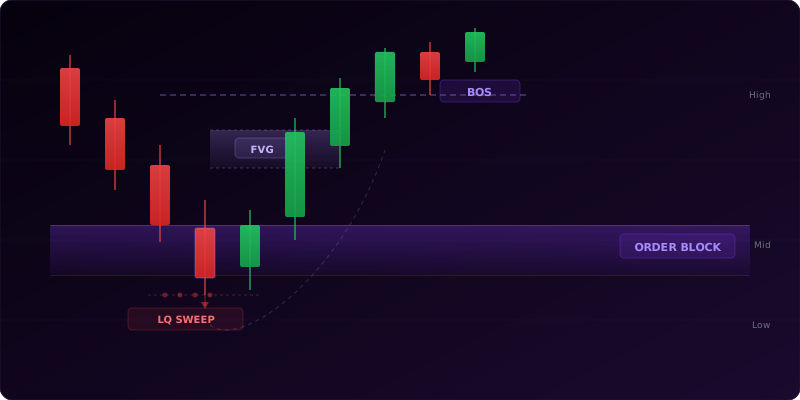
In practice, the line between ICT and SMC is blurry. A trader who uses order blocks, FVGs, and market structure with a session-based approach is using ICT concepts whether they call it ICT or SMC.
The label matters less than the execution:
- Do you understand market structure?
- Can you identify genuine institutional zones?
- Do you wait for confluence before entering?
- Is your risk management defined before every trade?
If yes, you're trading smart money concepts effectively - regardless of which label you use. Tools like Smarter Money Suite can automate the mechanical detection of these concepts so you can focus on execution. If you are weighing options, our SMC indicator comparison covers what separates deep implementations from repackaged retail scripts.
Frequently Asked Questions
No. ICT is a specific methodology with named models and time-based rules. SMC is a broader category of smart money concepts used by many traders and educators.
Neither is automatically better. ICT gives more structure and timing rules, while SMC can be easier to adapt. The better choice depends on how much precision and rule depth you want.
Beginners can learn ICT first, but it may feel dense. Many traders start with SMC basics like market structure, liquidity, order blocks, and FVGs before moving into ICT models.
They share many concepts, including liquidity, market structure, fair value gaps, order blocks, and premium or discount. ICT usually defines them with more specific rules.
Yes. Many traders use SMC terminology for broad structure and ICT models for timing, session context, and specific entry rules.
What Are the Key Takeaways for ICT vs SMC?
- ICT is a specific methodology with defined models, rules, and heavy time-based analysis
- SMC is a broader umbrella that includes ICT concepts plus additional variations
- The core concepts (structure, FVGs, order blocks, liquidity) are the same in both
- ICT is more structured and prescriptive; SMC is more flexible and adaptive
- Most traders blend elements of both in practice
- The label doesn't matter - understanding institutional behavior and executing with discipline does


