CISD Trading: Change in State of Delivery Explained (ICT Guide)
CISD trading explained — how to identify when institutional order flow shifts direction using the Change in State of Delivery concept from ICT methodology.

CISD trading — built around the Change in State of Delivery concept from ICT — is how experienced Smart Money traders identify the exact moment when institutional order flow shifts from one direction to the other. At its core, CISD tells you when the market has stopped delivering price in one direction and started delivering it in the opposite direction.
Think of it as the moment institutions stop buying and start selling - or vice versa. Identifying this shift is how you catch reversals early.
What Does "State of Delivery" Mean?
In ICT terminology, "delivery" refers to how price is being moved - the direction and intent behind price movement.
Bullish delivery: Price is being actively pushed higher. Candles close near their highs, impulse moves are to the upside, pullbacks are shallow.
Bearish delivery: Price is being actively pushed lower. Candles close near their lows, impulse moves are to the downside, rallies are weak.
A Change in State of Delivery occurs when the market transitions from one state to the other - from bullish delivery to bearish, or bearish to bullish.
How to Identify CISD
The Candle-Level View
The simplest way to spot CISD is through candle closings relative to a reference level:
- Mark a key candle - typically a candle that swept a liquidity level or sits at an important zone
- Watch subsequent candles - are they closing above or below that reference?
- CISD occurs when candles shift from closing on one side to closing on the other
Example (Bearish CISD):
- Price sweeps above a swing high (liquidity grab)
- The sweep candle or the next candle closes below the open of the sweep candle
- Subsequent candles continue closing lower
- The state of delivery has changed from bullish to bearish
The Structural View
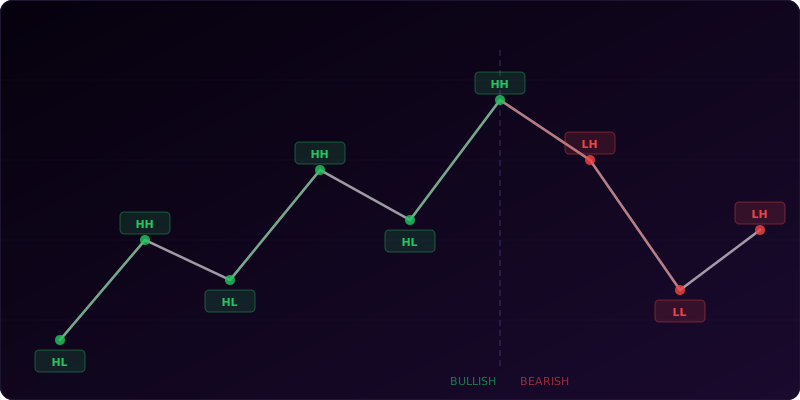
On a broader level, CISD aligns with market structure shifts:
- In an uptrend, price delivers bullishly (higher highs, higher lows)
- A bearish CISD is confirmed when price breaks below a key swing low - the delivery state shifts
- This is a Change of Character (ChoCh) viewed through the lens of order flow
The difference between CISD and ChoCh is perspective: ChoCh describes the structural event, while CISD describes the order flow shift behind it.
How Does CISD Work in Practice?
Setup: Liquidity Sweep + CISD
The most common CISD trade:
- Price sweeps a key level - Previous day high, session high, swing high
- CISD confirms - The candle that swept the level (or the very next candle) closes back below the level, showing the sweep was a grab, not a breakout
- Enter on confirmation - A fair value gap or inverse FVG on the reversal provides the entry
- Stop above the sweep wick - If price pushes higher than the sweep, CISD has failed
This is the institutional playbook in one setup: sweep liquidity, shift delivery state, fill positions in the new direction.
CISD and Fair Value Gaps
CISD and FVGs work together naturally:
- The sweep creates the liquidity event
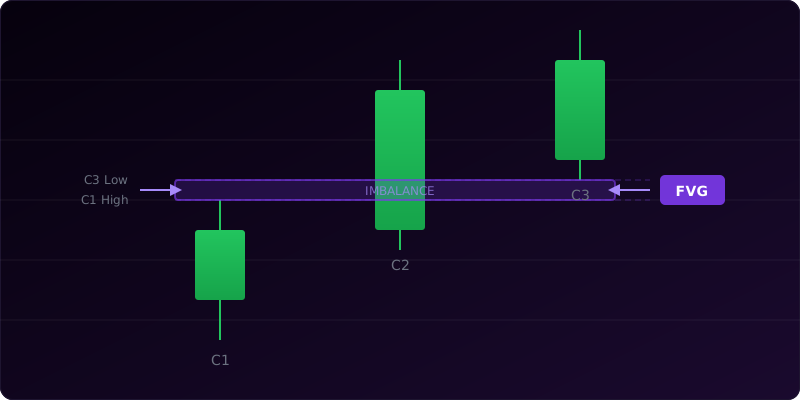
- The CISD candle often creates a fair value gap as it reverses aggressively
- The FVG becomes your entry zone when price retests it
- The combination (sweep + CISD + FVG) is one of the highest-conviction setups, and tools like the Smarter Money Suite can help detect these shifts automatically
CISD Across Timeframes
CISD on higher timeframes carries more weight:
- 5-minute CISD - Short-term delivery shift. Good for scalp entries within a killzone.
- 1-hour CISD - Session-level delivery shift. Good for intraday swing trades.
- 4-hour/Daily CISD - Major delivery shift. Can signal multi-day trend changes.
Use higher timeframe CISD for directional bias and lower timeframe CISD for entry timing.
GrandAlgo
See these concepts automated on your charts
18 TradingView indicators — smart money, price action, supply/demand, and more.
How Does CISD Compare With Other Reversal Signals?
| Signal | What It Shows | When to Use |
|---|---|---|
| CISD | Order flow shifts direction | Confirming a liquidity sweep reversal |
| ChoCh | Market structure breaks against the trend | Identifying trend reversal potential |
| BoS (counter) | Structure break in the new direction | Confirming the new trend |
| Engulfing candle | One candle fully engulfs the prior | Quick reversal confirmation |
CISD is the earliest of these signals. It fires when the delivery shifts, often before a full ChoCh is confirmed. This makes it powerful but also riskier - you're entering earlier than traders who wait for structural confirmation.
When Does CISD Fail?
CISD isn't infallible. Common failure scenarios:
False sweep: Price pushes above a level and the candle closes below (CISD signal), but the sweep was just the beginning of a genuine breakout. The next candle pushes higher again.
Low-timeframe noise: On very small timeframes (1m, 3m), CISD signals fire frequently and many are noise. Use higher timeframe context to filter.
Against strong momentum: A bearish CISD in a powerful uptrend is fighting momentum. The trend often resumes after a brief pause.
How to reduce failures:
- Only trade CISD at significant liquidity levels (PDH/PDL, session H/L, obvious swing points)
- Require FVG confluence alongside the CISD
- Check that the higher timeframe structure supports the reversal direction
- Use appropriate stop-loss placement (beyond the sweep wick, not at the CISD candle)
Frequently Asked Questions
CISD means Change in State of Delivery. It describes the moment price stops being delivered in one direction and begins being delivered in the opposite direction. In practice, traders use it to identify an early order-flow shift before a larger reversal is fully confirmed.
CISD and CHOCH are related but not identical. CHOCH describes the structural break on the chart, while CISD describes the delivery or order-flow shift behind that break. A clean reversal often contains both: delivery changes first, then structure confirms.
The strongest CISD setup usually appears after a liquidity sweep at a major level. Price takes stops, shifts delivery back inside the range, creates displacement or a fair value gap, then offers a pullback entry with invalidation beyond the sweep wick.
Higher timeframe CISD carries more directional weight, while lower timeframe CISD is useful for timing entries. A common workflow is to use the 1-hour or 4-hour chart for bias, then use the 5-minute or 15-minute chart for the actual trigger.
CISD trades fail when the apparent shift is only noise, when the sweep becomes a true breakout, or when the trade fights strong higher-timeframe momentum. The best filter is context: significant liquidity level, FVG confluence, and alignment with higher-timeframe structure.
Key Takeaways
- CISD identifies when institutional order flow shifts direction
- It's the delivery-based view of what ChoCh shows structurally
- The highest-probability CISD trades occur at liquidity sweeps - sweep + CISD + FVG
- Higher timeframe CISD carries more weight than lower timeframe
- CISD fires early - before full structural confirmation - which means both earlier entries and higher risk
- Always require confluence (key level + FVG + structure context) before acting on a CISD signal
- Place stops beyond the sweep wick, not at the CISD candle itself


