Best Scalping Indicators on TradingView in 2026: 1-Minute, 5-Minute & Crypto
Best scalping indicator TradingView stack for 1m/5m in 2026: non-repainting structure, filtered order blocks, FVGs, sessions, and MTF confluence.

The lower-timeframe stack, backed by chart snapshots
This article breaks down scalping requirements. These examples show the proof layer for fast structure, pressure, and lower-timeframe reversal confirmation.
Institutional Price Blocks
Recent, filtered structure zones instead of lower-timeframe clutter.
MTF Confluence Key Levels
Nearby 5M, 15M, and higher-timeframe levels for fast filtering.
Session Fib Fan
Session-derived targets and reaction levels for intraday entries.
Supply Demand Pressure Cloud
Pressure confirmation for breakouts, reversals, and fakeouts.

DOGE 5M pressure zone
- Market
- DOGE/USDT
- Timeframe
- 5M
- Indicator
- Supply Demand Pressure Cloud
- Setup
- Intraday supply/demand zone
A clean 5-minute supply/demand zone with 1 active pressure cloud framed the scalp level.

BTC 5M reversal signals
- Market
- BTC/USDT
- Timeframe
- 5M
- Indicator
- Momentum Reversal Engines
- Setup
- Intraday reversal signals
Reversal signals printed on both sides of the session, each at a visible intraday momentum shift.

XAU/USD 5M sell bias
- Market
- XAU/USD
- Timeframe
- 5M
- Indicator
- Momentum Reversal Engines
- Setup
- Sell-side momentum signals
3 sell signals aligned with the bearish leg on gold, with no long signals firing against the move.
Use the proof archive to inspect lower-timeframe examples, then subscribe when you are ready to build a cleaner scalping chart.
Get StartedIf you use ICT kill zones or SMC concepts for scalping, start with our ICT Trading Basics guide to build the foundation first.
Scalping is the hardest way to trade, and most indicators make it harder.
The problem isn't that indicators don't work on lower timeframes. Most indicators were designed for 4-hour, daily, or weekly charts — then traders try to force them onto 1-minute or 5-minute charts and wonder why the signals fall apart.
You can't just slap a standard order block indicator on a 1-minute chart and expect it to work. Scalping requires different logic, different timeframes for confluence, and fundamentally different expectations about signal quality.
This post breaks down what actually makes a good scalping indicator, what features you need on lower timeframes, and why most "scalping indicators" are just swing trading tools with faster settings.
What Are the Best Scalping Indicators for TradingView in 2026?
If you want the list without the explanation, here are the indicator types that actually work for scalping on 1-minute and 5-minute charts:
| Rank | Indicator Type | Best For | Why It Works |
|---|---|---|---|
| 1 | FVG Indicators | Precise entries with clear invalidation | Gaps form and fill fast on LTF — perfect for quick in-and-out trades |
| 2 | Order Block Indicators (filtered) | High-probability reversal zones | Only works with aggressive filtering — unfiltered OBs create chart clutter |
| 3 | Session Range Tools | Anchoring trades to session structure | Asia range, London/NY highs and lows are the backbone of every LTF setup |
| 4 | MTF Confluence Tools | Filtering noise | Only take trades when 5M and 15M agree on direction |
| 5 | Supply/Demand Pressure | Confirming breakouts vs fakeouts | Real-time buying/selling pressure tells you if the move has conviction |
What doesn't work: Moving averages (too much lag), RSI/MACD/Stochastics (noise on LTF), complex multi-indicator suites (too slow), and any indicator that repaints.
Best kill zones for scalping (all times EST): London (2:00–5:00 AM), NY AM (9:30–11:00 AM), NY PM (1:30–4:00 PM). Avoid NY Lunch (12:00–1:00 PM).
Now let's break down why each of these works and which specific tools to use.
Why Do Most Indicators Fail on Lower Timeframes?
Before we talk about what works, let's talk about why most indicators don't.
Problem 1: Lag Compounds on Lower Timeframes
Every indicator has some degree of lag. Moving averages lag price. Oscillators lag momentum. Even "leading" indicators like RSI are calculated based on past price data.
On a daily chart, a 2-bar lag means waiting 2 days. On a 1-minute chart, a 2-bar lag means waiting 2 minutes — and in that time, your entire setup could invalidate. When you're scalping, seconds matter. Indicators that are "fast enough" on higher timeframes become useless when speed is critical.
Problem 2: Noise Dominates Structure
Lower timeframes have more noise. A 1-minute candle can spike from a single large market order. A 5-minute wick might just be a stop hunt, not a true rejection. Indicators that rely on clean structure (order blocks, FVGs, liquidity zones) struggle because the structure itself is messier.
Swing trading indicators assume price moves with intention. Scalping indicators need to account for the fact that half the price action is noise.
Problem 3: Session Context Matters More
On a daily chart, sessions blend together. On a 1-minute chart, the difference between the Asian session, London open, and New York morning is massive. Volume, volatility, and liquidity change dramatically across sessions.
An indicator that doesn't account for session context will give you the same signals during dead Asian hours as it does during the London/NY overlap — and those signals are not equally valid.
Problem 4: Repainting is Harder to Detect
Repainting indicators are bad on any timeframe, but they're especially destructive on lower timeframes because you don't have time to verify signals before they disappear.
A repainting signal on a 4-hour chart might take hours to invalidate, giving you time to notice. A repainting signal on a 1-minute chart can appear, trigger an alert, and vanish before you even open your chart. By the time you realize the signal is gone, you've already entered a bad trade.
What Makes a Good Scalping Indicator?
If most indicators fail on lower timeframes, what actually works? Scalping indicators need these specific characteristics:
1. Fast Structure Detection Without Lag
You need indicators that identify key levels (order blocks, FVGs, support/resistance) in real-time, not 3-5 bars after the fact. Look for tools that:
- Lock zones on candle close (no repainting)
- Use minimal bars for calculation (fewer bars = less lag)
- Focus on recent structure (last 20-50 bars, not 200)
The best scalping structure indicators don't try to map out the entire chart history. They focus on the most recent significant levels because those are the only ones that matter in the next 5-10 minutes.
2. Session Awareness
A good scalping indicator knows what session you're in and adjusts expectations accordingly.
Asian session? Lower volume, tighter ranges, mean-reversion setups. London open? Volatility spikes, breakout opportunities. NY morning? Trending moves, directional plays.
Look for indicators that:
- Mark session boundaries visually
- Generate session-specific zones (Asian range, London highs/lows, etc.)
- Adjust signal sensitivity based on current session volatility
Session Fib Fan, for example, automatically plots fibonacci levels from the previous session's range — giving you key levels to watch as the new session opens. This is critical for scalpers who trade session opens.
3. Multi-Timeframe Confluence (Not Higher Timeframe Structure)
Scalpers can't wait for daily or 4-hour structure to play out. But they still need context.
The trick is using moderately higher timeframes for confluence: if you're scalping on 1-minute, check 5-minute and 15-minute. If you're on 5-minute, check 15-minute and 1-hour.
Good scalping indicators reference these timeframes without cluttering your chart:
- Show HTF zones without redrawing the entire chart
- Indicate when your timeframe aligns with the HTF bias
- Filter signals based on HTF structure (only show longs if 15min is bullish)
MTF Confluence Key Levels handles this well by showing you where multiple timeframes agree on key levels. When you're scalping, you don't need to know the daily bias — you need to know if 5min and 15min are aligned right now.
4. Tight Invalidation Zones
Scalping is about high win rate, small stops, and quick exits. You can't afford wide stop losses or vague "support zones." You need precise invalidation levels.
Look for indicators that:
- Define exact entry and stop levels (not ranges)
- Give you clear exit criteria (not just "take profit somewhere above")
- Show you where the setup is invalidated (price below this = wrong)
Candle Trap Zones, for instance, identify specific candles where traders are likely trapped, giving you exact entry zones with built-in stop placement. That's what you need for scalping — precision, not possibilities.
5. Volume and Liquidity Awareness
Scalping without volume context is gambling. You need to know:
- Where liquidity likely sits (probable stop clusters, areas of concentrated activity)
- Where supply/demand pressure is building
- When volume is confirming or diverging from price moves
Supply Demand Pressure Cloud tracks real-time buying and selling pressure, giving you a visual read on whether the current move has conviction or is just noise. On lower timeframes, this is the difference between a real breakout and a fakeout that reverses in 2 minutes.
Which Indicator Types Work for Scalping?
Not all indicator categories are equally useful for scalping. Here's what actually helps:
Order Block Indicators (with Caveats)
Order blocks work on lower timeframes, but only if the indicator is designed for it.
Standard order block indicators look for the last bullish/bearish candle before a break of structure. On a 1-minute chart, that might happen every 5 minutes — giving you dozens of blocks that don't matter.
You need an order block indicator that:
- Filters for significant blocks (minimum size, volume, or displacement)
- Removes tested blocks quickly (once price interacts with it, it's done)
- Prioritizes recent blocks over historical ones
Institutional Price Blocks does this by filtering out weak blocks and focusing on the ones with real institutional footprints — large volume, clean rejection, multi-timeframe alignment. If you're evaluating tools, use this checklist: Best Order Block Indicator for TradingView: How to Find One That Works.
Fair Value Gap (FVG) Indicators
FVGs are excellent for scalping because they give you precise entry zones with clear invalidation. If price fills the gap, the setup is done.
The key is finding an FVG indicator that:
- Only shows unfilled gaps (hides filled ones automatically)
- Works on lower timeframes without cluttering the chart
- Gives you context on gap significance (size, volume, timeframe)
Most FVG indicators show every single gap, which is useless. You need one that filters for gaps worth trading.
Liquidity Zone Indicators
Scalpers live and die by liquidity. Knowing where stops likely cluster, where significant activity concentrates, and where liquidity is thin gives you an edge on lower timeframes.
Look for indicators that:
- Identify liquidity pools above/below price
- Show you when liquidity is taken (stop hunts, sweeps)
- Give you visual cues for high-probability reversal zones
This is where most traders fail. They enter on breakouts without realizing they're just providing exit liquidity for smarter traders who are fading the move.
Session Range Tools
Session highs, lows, and opening ranges are some of the most reliable levels for scalpers. An indicator that automatically plots these zones saves you time and keeps your chart clean. The opening range breakout framework builds entire strategies around these session-derived levels.
The Session Fib Fan is built specifically for this — it tracks the previous session's range and projects fibonacci levels you can use as intraday targets and reversals.
Volume Profile and Delta Indicators
Volume profile shows you where the most trading activity happened at specific price levels. Delta (buying pressure vs selling pressure) shows you who's in control.
For scalping, you want real-time delta and session-based volume profiles, not entire chart history. If your volume indicator is showing you data from 3 days ago, it's not helping your next 5-minute trade.
What Doesn't Work for Scalping?
Just as important as knowing what works is knowing what doesn't:
Moving Averages (Mostly Useless)
Moving averages lag too much on lower timeframes. By the time a 20 EMA crosses a 50 EMA on a 1-minute chart, the move is already over.
Some scalpers use very fast MAs (5 EMA, 9 EMA) for directional bias, but even those are better replaced by raw price action and structure.
Oscillators (RSI, Stochastic, MACD)
If you still want to use MACD despite its lag, the key is combining it with price action context. See how to use MACD properly for strategies that actually work on lower timeframes.
Oscillators are designed to smooth out noise and show momentum trends. Scalping is all about reacting to noise quickly. These don't mix.
RSI divergence might work on a 4-hour chart. On a 1-minute chart, it's just visual clutter.
Complex Multi-Indicator Suites
"All-in-one" indicators that try to do everything (structure, momentum, volume, signals) are too slow for scalping. By the time the indicator calculates all its components, the opportunity is gone.
Scalpers need fast, focused tools. One good order block indicator is better than a suite that does 10 things poorly.
Lagging Signal Indicators
If the indicator generates buy/sell arrows after the move has already started, it's useless for scalping. You need to be in as the move starts, not 3 bars later.
Most buy/sell signal indicators are garbage on any timeframe, but they're especially bad for scalping because you don't have time to wait for confirmation.
How Do You Build a Scalping Indicator Stack?
You don't need 10 indicators. You need 2-3 focused tools that give you structure, confluence, and context.
Here's a clean scalping setup:
1. Structure Indicator (Order Blocks or FVGs)
Pick one. Institutional Price Blocks for order blocks, or an FVG tool for gap-based entries. This is your core — it tells you where to look for setups.
2. Multi-Timeframe Confluence Tool
MTF Confluence Key Levels or similar. This tells you when your timeframe aligns with higher timeframes. Don't take trades if 5min and 15min are fighting each other.
3. Session or Liquidity Awareness Tool
Session Fib Fan or Supply Demand Pressure Cloud. This gives you context — are you trading during high liquidity? Are you near key session levels? Is buying or selling pressure building?
That's it. Three tools. Keep your chart clean, your decisions fast, and your stops tight.
Which GrandAlgo Indicators Fit a Scalping Stack?
If you are comparing the best scalping indicator TradingView options, do not look for one script that claims to do everything. Use a compact stack where every tool has a job:
| Scalping job | GrandAlgo indicator | Why it belongs in the stack |
|---|---|---|
| Find fast structure and invalidation | Institutional Price Blocks | Filters for meaningful blocks instead of filling a 1-minute chart with weak zones |
| Confirm nearby levels across timeframes | MTF Confluence Key Levels | Shows when 5-minute, 15-minute, and higher-timeframe levels overlap |
| Anchor entries to active sessions | Session Fib Fan | Projects session-derived levels that scalpers can use for targets and reversals |
| Filter breakouts and fakeouts | Supply Demand Pressure Cloud | Adds real-time buying/selling pressure so you can avoid weak breakouts |
For most traders, the cleanest lower-timeframe setup is MTF Confluence Key Levels + Supply Demand Pressure Cloud + one structure tool. That gives you level, pressure, and invalidation without turning your chart into a control panel.
What does a confluence tool actually show?
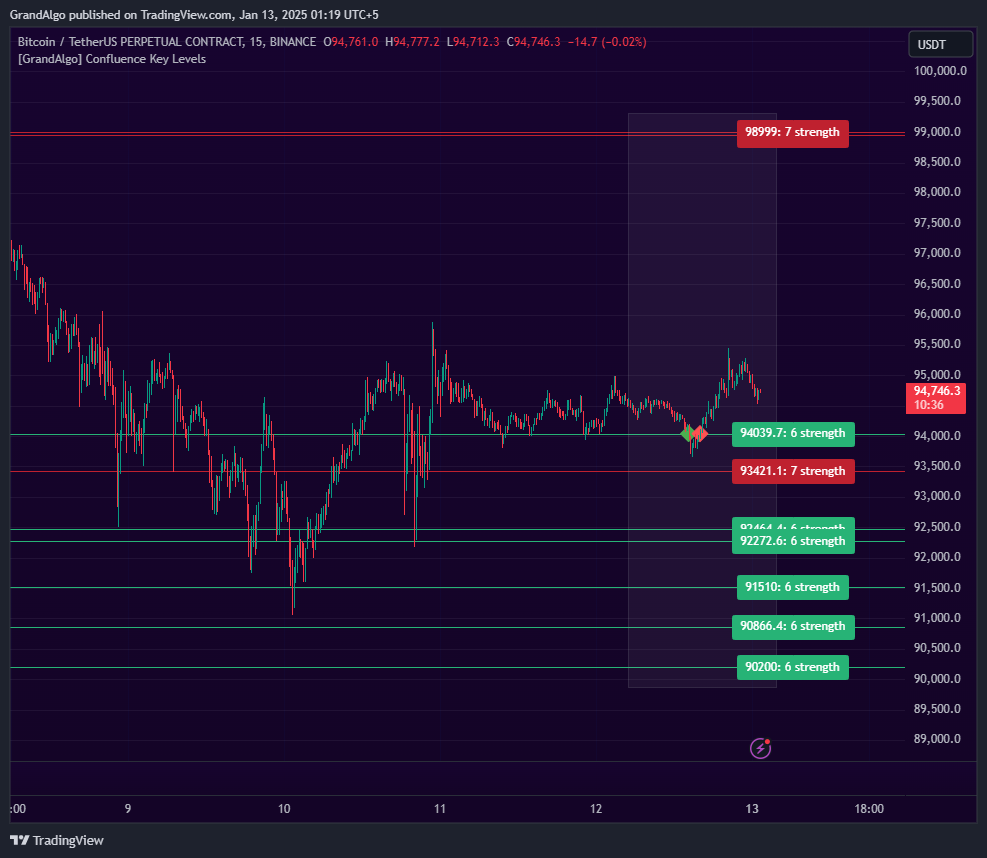
This existing GrandAlgo product screenshot shows 15-minute BTC context, not a 1-minute backtest or a current trade recommendation. Notice the labeled levels around 94,039.7 and 93,421.1. They organize nearby reference prices; the strength labels are not calibrated win probabilities. A screenshot cannot establish live non-repainting behavior or execution quality.
Before adding another indicator, give each reading a decision:
- Location: use MTF Confluence Key Levels to identify the relevant nearby zone. Being near a level is not an entry signal.
- Trigger: define the confirming candle or market structure shift separately. Record when it becomes knowable, rather than choosing it after the move.
- Risk: choose the price that invalidates the idea. For forex, calculate the distance between prices with the pip calculator, then size the position for your risk limit.
Replay both examples that follow through and examples that fail, with spread and fees included. The linked indicator page and guide explain the product; neither replaces that test.
Should You Use This Stack?
Use it if: you scalp 1m–15m crypto or forex, you already understand structure/levels, and you want confluence tools rather than buy/sell arrows.
Skip it if: you want a fully automated signal system, you trade only higher timeframes, or you haven't traded a demo account yet — free tools first.
Start with: MTF Confluence Key Levels + Supply Demand Pressure Cloud. Add a structure tool once those two are part of your routine.
GrandAlgo
See these concepts automated on your charts
18 TradingView indicators — smart money, price action, supply/demand, and more.
What Are the Best Indicators for 1-Minute Scalping?
The 1-minute chart is the most demanding timeframe. You need indicators that lock signals on candle close, respond to micro-structure, and don't clutter the chart with stale levels.
What works on 1-minute:
- FVG indicators that auto-hide filled gaps. On the 1-minute chart, FVGs form and fill constantly. You need an indicator that only shows unfilled gaps from the last 20-30 bars — anything older is noise.
- Session range tools like the Session Fib Fan. The 1-minute chart is entirely session-driven. Asian range, London open, NY open — these session levels are the structural backbone of every 1-minute setup.
- Order blocks with aggressive filtering. On 1-minute, you get dozens of structure breaks per session. An unfiltered order block indicator creates visual chaos. Use one that requires minimum displacement size and auto-removes mitigated zones, like Institutional Price Blocks.
What to avoid on 1-minute: moving average crossovers (lag kills you), oscillators (pure noise at this speed), and any indicator that needs more than 50 bars of lookback.
For a full 1-minute framework, see the 1-minute SMC scalping strategy.
What Are the Best Indicators for 5-Minute Scalping?
The 5-minute chart is the sweet spot for most scalpers. It filters out the worst of the 1-minute noise while still giving you multiple setups per session.
What works on 5-minute:
- Multi-timeframe confluence tools. The 5-minute chart pairs naturally with the 15-minute and 1-hour. MTF Confluence Key Levels shows where these timeframes agree — those confluent levels are the highest-probability 5-minute setups.
- Supply/demand pressure indicators. On the 5-minute, you have enough candle data for pressure readings to be meaningful. Supply Demand Pressure Cloud gives you a real-time read on whether buying or selling pressure is building — critical for confirming breakouts vs. fakeouts.
- Order block + FVG combo. The 5-minute chart produces cleaner structure than 1-minute, so order blocks carry more weight. Look for setups where a 5-minute order block overlaps with a 15-minute FVG — that confluence is one of the most reliable scalping entries.
For the complete 5-minute SMC approach, see 5-minute scalping with Smart Money.
What Are the Best Crypto Scalping Indicators on TradingView in 2026?
Crypto scalping is a different animal. Markets run 24/7, volatility spikes are more extreme, and session structure is less defined than forex or futures.
What matters for crypto in 2026:
Session anchoring is still critical. Even though crypto trades around the clock, the highest volume and cleanest moves happen during traditional session opens — especially the US equity open at 9:30 AM Eastern. Anchor your session tools to this time. The Session Fib Fan works for crypto by projecting fibonacci levels from the most recent high-volume session range.
Liquidity indicators matter more in crypto. Crypto markets have thinner order books than forex or futures. Liquidity sweeps are more violent, and stop hunts are more frequent. An indicator that shows where liquidity likely clusters — above equal highs, below equal lows, around round numbers — gives you an edge that's proportionally larger in crypto than in traditional markets.
Volume delta is your fakeout filter. Crypto breakouts fail constantly. A breakout with flat or negative delta on a crypto pair is almost certainly a trap. The Supply Demand Pressure Cloud tracks this in real time, helping you distinguish between real crypto momentum and manufactured moves.
Pair it with the right assets. BTC and ETH have the deepest liquidity and cleanest structure for scalping. Altcoins can produce wider spreads and more erratic price action that degrades indicator accuracy. If you're scalping altcoins, stick to higher market-cap tokens with tight spreads and established trading history.
For a broader look at crypto indicator selection, see best TradingView indicators for crypto.
Does Confluence Still Matter for Scalping?
Scalping is fast, but it's not reckless. Confluence trading is still the foundation of good setups, even on 1-minute charts.
The difference is you're not waiting for 5 signals to align. You're looking for 2-3:
- Structure (order block, FVG, key level)
- Timeframe alignment (5min and 15min agree)
- Session context (high liquidity, session open, etc.)
If you have those three, you have a trade. If you're missing one, you skip it. Scalping is about execution speed, not trade frequency. You can wait 30 minutes for a clean setup and still get 10+ trades in a session.
Why Is Risk Management More Critical for Scalping?
Scalpers take more trades, which means more opportunities to blow up your account if you're not managing risk properly.
Before you even think about indicators, make sure you have:
- Position sizing locked in: Use a position size calculator to ensure you're risking the same percentage per trade, regardless of stop distance
- Max daily loss rule: If you lose X% in a day, you stop trading. No exceptions.
- Trade journal: Track every trade, every setup, every outcome. Scalping without data is gambling.
The best indicator in the world won't save you if you're risking 5% per trade or revenge trading after a loss. Can your strategy survive 10 losses in a row? Because in scalping, that's not a hypothetical — it's a Tuesday.
What Common Scalping Indicator Mistakes Should You Avoid?
Even with the right tools, traders make predictable mistakes:
Mistake 1: Too Many Indicators
More indicators = more lag = worse entries. Keep your chart clean. If you can't see price action clearly, you have too much on your chart.
Mistake 2: Ignoring Session Context
Trading the Asian session with the same strategy you use for London open is a losing game. Adjust your expectations and settings based on current market conditions.
Mistake 3: Chasing Every Signal
Just because an indicator shows a setup doesn't mean you take it. Filter for quality. If it's a weak order block during low volume, skip it.
Mistake 4: Using Swing Trading Indicators
If the indicator description says "works best on 4H and daily," don't try to force it onto a 1-minute chart. Use tools designed for the timeframe you're trading.
Can You Backtest the Scalping Indicator?
One of the best ways to evaluate a scalping indicator is to backtest it.
If the indicator gives you clear, non-repainting signals, you should be able to scroll back through historical 1-minute data and see how setups played out. If signals disappear when you scroll back, or you can't tell where you would have entered, the indicator is broken.
Good scalping indicators are precise. Bad ones are vague. Backtesting forces you to be honest about which one you're using.
Frequently Asked Questions
There is no single best indicator for every scalper. The strongest TradingView scalping setups usually combine one precise structure tool, such as FVGs or filtered order blocks, with multi-timeframe confluence and session or liquidity context.
The 5-minute chart is the best starting point for most scalpers because it reduces some 1-minute noise while still creating multiple setups per session. Use the 15-minute or 1-hour chart for bias and context.
Order block indicators can work for scalping when they filter aggressively for displacement, recent structure, and mitigation. Unfiltered order block tools usually create too many zones on 1-minute and 5-minute charts.
Some free scalping indicators are useful for learning, but reliability depends on whether the tool repaints, lags, or floods the chart with signals. Always backtest the indicator and confirm that historical signals match what appeared in real time.
Most scalpers should use two or three indicators at most: one for structure, one for confluence, and optionally one for session, liquidity, or pressure context. More indicators usually slow decisions and make entries worse.
The London kill zone and New York morning session usually create the cleanest scalping conditions because volume and volatility are higher. Avoid low-volume windows such as New York lunch unless you are intentionally trading a range strategy.
Final Thoughts: Scalping Indicators are Tools, Not Systems
No indicator will give you a complete scalping system. Indicators show you structure, confluence, and context. You still need to:
- Read price action
- Manage risk
- Adjust for market conditions
- Execute with discipline
The best scalping indicators are the ones that make those decisions easier, not the ones that try to make the decisions for you.
If you're looking for tools designed with lower timeframes in mind, check out our full suite. Everything is built to work across timeframes, including 1-minute and 5-minute charts, with session awareness and non-repainting logic.
Or build your own stack from multiple sources. The point isn't to use specific tools — the point is to use tools that actually work when speed matters.
Scalping is hard enough without fighting your indicators. Use tools that help, not hinder.


