How to Identify Swing Highs and Swing Lows
Swing points are the building blocks of market structure. How to identify them correctly, what sensitivity settings mean, and common mistakes to avoid.

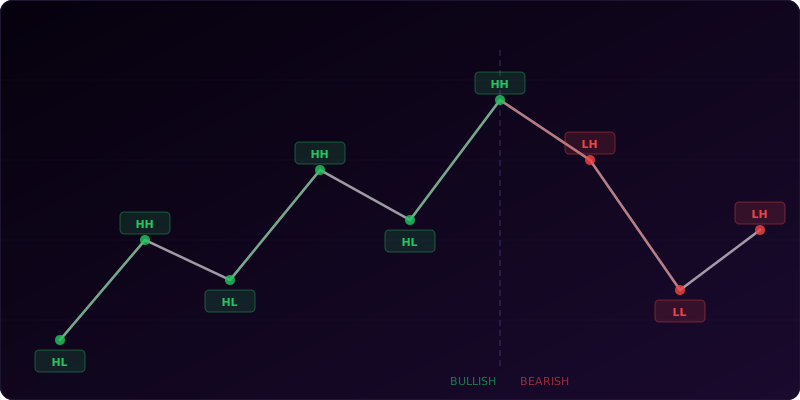
Every concept in Smart Money trading starts with swing points. Market structure? Based on swings. Order blocks? Form at swing-based structure breaks. Liquidity? Clusters above swing highs and below swing lows.
If you identify swings wrong, everything downstream is wrong. Here's how to get it right.
What Is a Swing High?
A swing high is a candle whose high is higher than the highs of the candles on both sides of it. It represents a local peak - price went up, reached this point, and then turned back down.
Simple definition: The candle with the highest high, with lower highs before and after it.
What Is a Swing Low?
A swing low is a candle whose low is lower than the lows of the candles on both sides of it. It represents a local trough - price went down, reached this point, and then turned back up.
Simple definition: The candle with the lowest low, with higher lows before and after it.
How Many Candles Should Define Swing Sensitivity?
The key variable in swing detection is sensitivity - how many candles on each side you require to confirm a swing.
Low Sensitivity (1-2 candles)
- Detects many swing points
- Captures minor fluctuations
- More structure events (more BoS, more ChoCh)
- Good for: Scalping, very short-term trading
- Risk: Lots of noise, many insignificant swings
Medium Sensitivity (3-5 candles)
- Balanced detection
- Captures meaningful swing points while filtering minor noise
- Good for: Day trading, most intraday strategies
- Recommended starting point for most traders
High Sensitivity (7-10+ candles)
- Detects only major swing points
- Fewer but more significant structure events
- Good for: Swing trading, position trading
- Risk: May miss valid intermediate structure
How to Choose
Match your sensitivity to your trading timeframe and style:
| Trading Style | Timeframe | Suggested Sensitivity |
|---|---|---|
| Scalping | 1m-5m | 2-3 candles |
| Day trading | 15m-1H | 3-5 candles |
| Swing trading | 4H-Daily | 5-8 candles |
| Position trading | Daily-Weekly | 8-12 candles |
Once you choose a sensitivity, stick with it. Changing sensitivity mid-analysis creates inconsistent structure readings.
GrandAlgo
See these concepts automated on your charts
18 TradingView indicators — smart money, price action, supply/demand, and more.
Should You Use Close-Based or High/Low-Based Swings?
Two methods for detecting swings:
High/Low-Based (Wick)
Uses the candle's high and low (including wicks) to determine swing points. The wick extremes define the swing.
Pros: Captures the true price extreme. Wider swing identification. Cons: Wicks can be noisy - a long wick might be a liquidity sweep, not a genuine swing.
Close-Based (Body)
Uses the candle's open and close (body only) to determine swing points. Ignores wicks.
Pros: Filters out wick noise. More conservative swing identification. Cons: Misses extreme price points. Narrower swing identification.
Which to Use?
Many traders use high/low-based for swing identification but close-based for structure breaks:
- Swings are defined by the wicks (true extremes)
- But a structure break requires a candle to close beyond the swing (confirmed break)
This combination captures the full swing range while requiring conviction for structural events.
What Swing Identification Mistakes Should You Avoid?
Mistake 1: Inconsistent Sensitivity
Using 3-candle sensitivity for one swing and 5-candle for the next. This creates an inconsistent structure picture where some swings are "more confirmed" than others.
Fix: Pick one sensitivity and apply it uniformly.
Mistake 2: Seeing Swings That Aren't There
In a strong trend, every minor pullback can look like a swing. But a 2-candle pause in a 20-candle rally isn't a meaningful swing low - it's noise.
Fix: Use appropriate sensitivity. In strong trends, increase sensitivity to only capture significant pullbacks.
Mistake 3: Missing Obvious Swings
The flip side - using such high sensitivity that you miss clear, important swing points.
Fix: If a swing point is visible to the naked eye and significant (price moved meaningfully from it), your sensitivity should capture it. Adjust if you're missing obvious points.
Mistake 4: Counting Wicks as Structure Breaks
A candle wicks beyond a swing high but closes below it. Is the swing broken? If you're using close-based structure breaks - no. The wick is likely a liquidity sweep, not a genuine break.
Fix: Require a candle close beyond the swing for structural events.
Mistake 5: Not Using the Same Method Everywhere
Defining swings one way on the 4H chart and differently on the 15m chart creates conflicting structure readings.
Fix: Use the same detection method across timeframes. Only the sensitivity should change (higher sensitivity on higher timeframes).
Can You Automate Swing Detection?
Manual swing identification is straightforward on a clean chart but becomes difficult when:
- You're monitoring multiple timeframes
- The chart is busy with other analysis
- You need consistent detection across sessions
- You want to track structure in real-time
Indicators that automate swing detection:
- Apply consistent sensitivity rules every time
- Mark swing points as they form
- Update structure labels (BoS, ChoCh) automatically
- Work across all timeframes with adjustable sensitivity
The key advantage: consistency. An indicator like Reversal Market Structure applies the same rules to every candle, eliminating the human tendency to see what you want to see.
Frequently Asked Questions
A swing high is a local peak where price trades higher than the candles around it, then turns lower. It marks a potential resistance point, liquidity pool, or structure level depending on timeframe and context.
A swing low is a local trough where price trades lower than nearby candles, then turns higher. It marks potential support, downside liquidity, or a structure level used to identify trend and invalidation.
Common sensitivity settings use one to three candles on each side of the swing point. Lower sensitivity finds more minor swings. Higher sensitivity filters noise and identifies more important structure.
Wicks show true liquidity extremes, while closes show accepted price. SMC traders often monitor both: wicks for sweeps and liquidity, closes for confirmation that structure has accepted beyond a level.
They are the building blocks of market structure. Higher highs and higher lows define uptrends, while lower highs and lower lows define downtrends. They also reveal where stops and breakout orders are likely clustered.
The Short Version
- Swing highs and lows are candles with higher/lower extremes than surrounding candles
- Sensitivity (candle count) determines how many swings you detect - match it to your style
- Close-based vs. wick-based detection serves different purposes - use both strategically
- Consistency is everything - pick your settings and apply them uniformly
- Swings are the building blocks of market structure, which underpins all SMC concepts
- Automated detection ensures consistent application that manual identification can't match


