How to Build a Trading System Around Signals
Signal indicators give you entries. A trading system gives you everything else. Here's how to wrap a complete system around any signal indicator.

A signal indicator fires a buy signal. Now what?
Where's your stop? What's your target? How much do you risk? What if it fires 5 signals today - do you take all of them? What if you're in a losing streak?
Signal indicators give you entries. They don't give you a system. Building the system around them is your job. Here's how.
What Does a Trading System Include?
A signal indicator is one component. A complete system covers:
- Market context - When to listen to signals and when to ignore them
- Entry rules - How to act on a signal
- Risk management - How much to risk per trade
- Trade management - What to do after entry
- Session rules - When to trade and when to stop
- Review process - How to improve over time
Step 1: How Do You Define Your Market Context Filter?
Not every signal should be traded. Define the conditions where signals are valid:
Trend Filter
Only take signals in the direction of the prevailing market structure.
- Bullish structure → Only take buy signals
- Bearish structure → Only take sell signals
- No clear structure → Don't trade, or take only the highest-conviction signals
This single filter dramatically improves most signal indicators.
Zone Filter
Signals at significant price zones (order blocks, supply/demand, FVGs) have higher probability than signals in the middle of nowhere.
System rule example: "Only take buy signals at or below a confirmed demand zone."
Timeframe Filter
The signal's timeframe should align with a higher timeframe bias.
System rule example: "4H structure must be bullish before taking buy signals on the 15m."
Step 2: How Do You Define Your Entry Rules?
When a signal fires and passes your context filters, how exactly do you enter?
Entry Timing
- Candle close entry: Enter at the close of the signal candle. Most conservative.
- Next candle open: Wait for the next candle to open and enter on the first tick. Confirms the signal candle closed without reversing.
- FVG retest entry: If the signal candle creates an FVG, wait for price to retest the gap before entering. Most precise.
Entry Requirements
- Signal has passed all context filters
- Risk-reward is at least 1.5:1 (calculated before entry)
- No conflicting signals on higher timeframes
- Within your daily trade limit
Running through these checks manually before every trade is tedious but essential. A pre-trade checklist turns these requirements into a repeatable routine so nothing gets skipped in the heat of the moment.
Step 3: How Do You Define Risk Management?
Per-Trade Risk
Risk a fixed percentage of your account per trade - typically 1-2%.
| Account Size | 1% Risk | 2% Risk |
|---|---|---|
| $10,000 | $100 | $200 |
| $25,000 | $250 | $500 |
| $50,000 | $500 | $1,000 |
Position Sizing
Calculate position size from the stop distance:
Position size = Risk amount / Stop distance
If your risk is $200 and your stop is 20 pips away, your position size is $200 / 20 = $10 per pip. Our position size calculator does this math instantly for any setup.
Stop-Loss Placement
Three approaches, depending on what the signal provides:
- Indicator-defined SL: If the signal indicator provides a stop-loss level, use it (assuming the R:R meets your minimum)
- Structural SL: Place the stop beyond the nearest structural level (swing low for longs, swing high for shorts)
- Zone-based SL: If you entered at a zone, place the stop beyond the zone boundary
Maximum Daily Loss
Define a circuit breaker - a maximum daily loss that stops you from trading for the rest of the day.
Recommended: 3-5% of account value. After hitting this limit, you're done for the day. No exceptions.
GrandAlgo
See these concepts automated on your charts
18 TradingView indicators — smart money, price action, supply/demand, and more.
Step 4: How Do You Define Trade Management?
Scaling Out
Don't exit your entire position at one target:
- 50% at Target 1 - The first structural level or indicator-defined TP
- Remaining 50% trails - Move stop to break-even and let it run
Break-Even Rule
Once the trade moves 1R in your favor (risk amount = profit), move stop-loss to entry price. This makes the trade effectively risk-free (excluding slippage or gap risk).
Trailing Stop
For the trailing portion, use:
- Structural trail: Move stop below each new higher low (for longs) as price advances
- ATR trail: Trail by a fixed ATR distance behind price
- Indicator-defined: If the signal indicator provides dynamic SL levels, use them
Time-Based Exit
If the trade hasn't moved meaningfully within a defined time (e.g., 2 hours for day trading, 2 days for swing), close it. Dead trades tie up capital and mental energy.
Step 5: How Do You Define Session and Frequency Rules?
Session Rules
- Define which sessions you trade (London, NY, or both)
- Only take signals that fire during your active sessions
- Don't enter trades in the last 30 minutes of your session (not enough time to manage)
Daily Trade Limit
Set a maximum number of trades per day. This prevents overtrading.
Recommended: 2-3 trades per day for day trading. 1 trade per day for beginners.
Daily Stop Rules
- 2 consecutive losses: Reduce position size by 50% for the next trade
- 3 consecutive losses: Stop trading for the day
- Daily loss limit hit: Stop trading for the day
These rules protect you from tilt - the emotional state where losses compound because you're trying to "get it back."
Step 6: How Do You Build a Review Process?
Daily Review (5 minutes)
At the end of each trading day:
- Log all trades taken in your trading journal
- Note what went right and wrong
- Check if you followed your rules - compare against your trading checklist
Weekly Review (30 minutes)
At the end of each week:
- Calculate your weekly P/L and key metrics (win rate, average R)
- Identify any recurring mistakes
- Assess if market conditions have changed
Monthly Review (1 hour)
At the end of each month:
- Review full month performance against your expectations
- Compare to your backtested results
- Decide if any system adjustments are needed
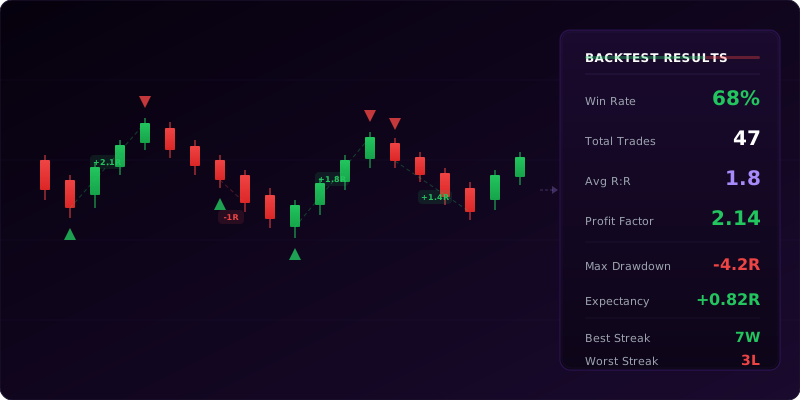
What Does an Example Signal-Based System Look Like?
Signal indicator: A multi-engine reversal system with FVG filter (such as Momentum Reversal Engines)
Context rules:
- 4H market structure must confirm direction
- Only take signals at or near a supply/demand zone
- Only trade during London and NY kill zones
Entry rules:
- Enter at candle close after signal fires
- Minimum R:R of 1.5:1
- Maximum 3 trades per day
Risk rules:
- Risk 1% per trade
- Stop-loss at indicator-defined level (or below zone)
- Daily loss limit: 3%
Management rules:
- Move to break-even at 1R
- Close 50% at first target
- Trail remainder with structural stops
- Close any trade that's flat after 2 hours
Review:
- Log every trade daily
- Weekly metric review
- Monthly system assessment
Frequently Asked Questions
It is the complete rule set that determines when a signal matters, how much to risk, where to enter, where to exit, and when to skip. The signal is only one component inside a larger decision framework.
Signals do not automatically define context, stop placement, targets, position size, market regime, or trade management. Without those rules, traders take the same signal in good and bad conditions and get inconsistent results.
Every system should include market context filters, entry criteria, invalidation, stop-loss rules, target logic, position sizing, session limits, maximum trade frequency, and a review process for measuring performance.
Backtest and forward test it with fixed rules. The signal should improve expectancy, reduce decision friction, or identify opportunities you can execute consistently. If it adds clutter without measurable value, remove it.
Rarely. One indicator can provide the trigger, but a complete system still needs context and risk rules. The trader must define when the signal is valid, when it is ignored, and how the trade is managed after entry.
Key Takeaways
- A signal indicator is an entry tool, not a complete trading system
- Wrap every signal with context filters (trend, zone, timeframe alignment)
- Risk 1-2% per trade with position size calculated from stop distance
- Scale out - take partial profits and trail the remainder
- Set daily trade limits and loss limits to prevent overtrading and tilt
- Build a review process to continuously improve
- Write your system rules down before you start trading, not after


