Do TradingView Indicators Actually Work? An Honest Answer
Most trading indicators fail because they're poorly built or misused. What separates useful tools from noise and how to test if an indicator works.

Do TradingView indicators actually work?
The honest answer: most don't. But not because indicators are inherently useless. They fail because they're either poorly designed, poorly understood, or poorly applied. Often all three.
This matters because the question itself is flawed. "Do indicators work?" is like asking "Do hammers work?" The answer depends entirely on what you're trying to build and whether you know how to swing the damn thing.
Let's strip away the marketing hype and cynical dismissals and examine what actually determines whether an indicator is useful or worthless.
Why Do Most Indicators Fail?
The typical critique of trading indicators focuses on lagging nature. "All indicators lag," the argument goes. "By the time the signal appears, the move is already halfway done."
This is partially true and completely misses the point.
Yes, moving averages lag. RSI lags. MACD lags. They're derived from past price data, so by definition they trail current action. But that's not why they fail. They fail because they provide no structural context.
A moving average crossover tells you momentum shifted. It doesn't tell you whether that shift occurred at a significant structural level or in the middle of nowhere. It doesn't tell you if it aligns with higher timeframe bias or contradicts it. It doesn't tell you if there's institutional activity supporting the move or if it's retail noise that will fade in three candles.
Lagging isn't the problem. Lack of context is the problem.
Then there's repainting. We've covered this extensively in What Is Indicator Repainting and Non-Repaint Indicators: What It Really Means, but the short version: if an indicator changes its historical signals after the fact, it's lying to you. You can't backtest it. You can't trust it in real-time. It's useless.
Repainting indicators fail because they're fundamentally dishonest. They show you what they wish they had signaled, not what they actually signaled.
Finally, there's the problem of overfitting. Many indicators are optimized to look perfect on historical data. The developer tweaks parameters until the win rate hits 85% on the last six months of price action. Then the indicator gets released, and it immediately fails in live conditions because those parameters were curve-fit to noise, not to actual market structure.
These three issues—lack of context, repainting, and overfitting—are why most indicators fail. Not because the concept of indicators is broken. Because the execution is broken.
What Does Working Actually Mean for an Indicator?
Before we can determine whether an indicator works, we need to define what "working" means. And this is where most traders set themselves up for disappointment.
An indicator that "works" does not mean:
- It catches every move
- It has a 90% win rate
- It tells you exactly when to enter and exit
- It eliminates losing trades
- It removes the need for decision-making
None of those are realistic expectations. Not for indicators. Not for any trading tool.
An indicator that works provides a consistent edge over a statistically meaningful sample of trades. That's it. That's the definition.
What does edge look like in practice?
It helps you identify high-probability setups more efficiently than discretionary analysis alone. Instead of scanning charts for hours trying to spot order blocks, the indicator flags them for you. You still validate. You still decide. But the tool narrows your focus to zones worth watching.
It improves your win rate or risk/reward ratio enough that over 100+ trades, you're profitable. Maybe it wins 55% of the time with a 2:1 R/R. That's enough. You don't need 90%. You need a sustainable edge.
It gives you a framework for consistency. Instead of taking trades based on gut feel that varies day to day, the indicator provides objective criteria. This doesn't guarantee wins. It guarantees repeatability. And repeatability is what allows you to measure edge.
If an indicator does those things, it works. If it doesn't, it's noise.
What Is the Role of the Trader vs. the Tool?
Here's where most traders go wrong: they treat indicators as complete trading systems. They see a signal, they take the trade, they blame the indicator when it loses.
Indicators are not trading systems. They're lenses. They help you see certain aspects of price action more clearly. What you do with that information is your job.
Consider a high-quality order block indicator. It detects a structurally validated order block that aligns with a Fair Value Gap and marks it on your chart. That's valuable information. It's not a trade signal.
You still need to decide:
- Do I want to trade this? Does it align with my overall bias?
- Do I enter on first touch or wait for confirmation?
- Where's my stop? Just below the block? Below the structure that created the block?
- What's my target? Next structure level? Opposite side liquidity?
- How much risk am I allocating? What's my position size?
The indicator gave you a zone. You build the trade. If you enter blindly without considering these variables, and the trade fails, that's not the indicator's fault. That's yours.
This is why we've written extensively about building a trading system around signals and why we built free risk management calculators. The indicator is one component. Risk management, bias, confirmation, position sizing: those are the others. Neglect them and even the best indicator becomes worthless.
What Makes Structural Detection Different From Lagging Oscillators?
Not all indicators are created equal. There's a fundamental difference between indicators that detect market structure and those that measure momentum or volatility.
Lagging oscillators—RSI, Stochastic, MACD—tell you about recent price behavior. Overbought. Oversold. Momentum divergence. These can be useful in the right context, but they don't tell you where you are in the market's structure.
Structural indicators—order blocks, Fair Value Gaps, Break of Structure, liquidity levels—tell you how the market is organized. Where institutions likely have positions. Where stops are clustered. Where structure shifted from bullish to bearish or vice versa.
The difference matters because markets are not random. They're fractal, self-similar structures driven by supply and demand dynamics that leave footprints. Structural indicators help you read those footprints. Oscillators just tell you the market moved recently.
This is why we focus on Smart Money Concepts rather than traditional indicators. SMC tools detect institutional behavior: where big players are positioned, where they're hunting stops, where they're defending levels. That's actionable information.
A properly built SMC indicator like the Smarter Money Suite doesn't just draw boxes and lines. It identifies structural shifts, validates order blocks against market context, tracks liquidity sweeps, and integrates multi-timeframe confluence. It's not measuring momentum. It's decoding market mechanics.
That's the difference between an indicator that works and one that generates noise.
GrandAlgo
See these concepts automated on your charts
18 TradingView indicators — smart money, price action, supply/demand, and more.
How to Test If an Indicator Actually Works for You
Theory is useless without verification. You need to test whether an indicator provides edge for your trading. Not someone else's. Yours. Because edge is context-dependent. What works in forex might not work in crypto. What works on the 15-minute chart might fail on the daily. What works for a scalper might be irrelevant for a swing trader.
Here's how to test properly:
Step 1: Forward Test, Don't Just Backtest
Backtesting has value, but it's also easy to manipulate. You can cherry-pick timeframes. You can optimize parameters. You can ignore context. And if the indicator repaints, backtesting is completely worthless.
Forward testing means using the indicator in real-time, on live charts, and tracking your results as they happen. No hindsight. No optimization. Just you, the indicator, and the market.
We've written a full guide on how to backtest a signal indicator, but the short version: if you're not testing forward, you're not testing honestly.
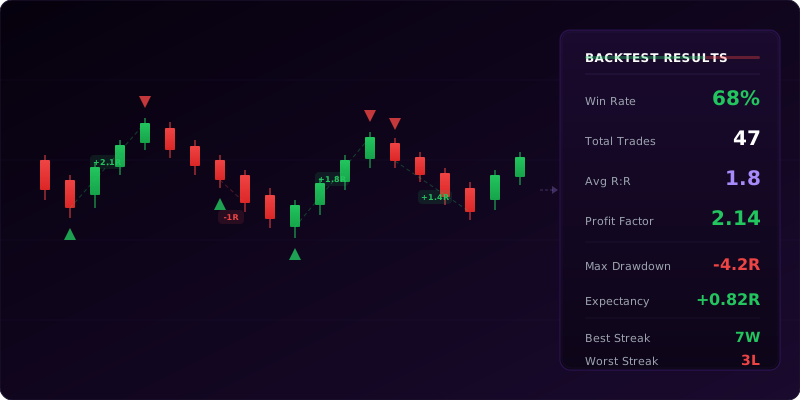
Step 2: Journal Every Trade
You can't measure edge without data. And you can't collect meaningful data without a trading journal.
Track every setup the indicator flags. Track which ones you took and why. Track which ones you skipped and why. Track entry, stop, target, outcome, and any qualitative observations about market context.
After 50-100 trades, patterns will emerge. You'll see which setups have the highest win rate. You'll see which market conditions favor the indicator and which don't. You'll see where your execution deviates from the plan.
This is the only way to know if the indicator is giving you edge or just giving you something to do. We built a free trading journal tool specifically for this purpose. Use it.
Step 3: Measure Against a Statistically Meaningful Sample
Ten trades are not enough. Thirty trades are not enough. You need at least 50, preferably 100+, to start drawing conclusions about edge.
Why? Because variance is real. You can lose ten trades in a row with a strategy that has a 60% win rate. It's unlikely but absolutely possible. If you quit after ten losses, you'll never see the edge materialize.
We've written about this in Can Your Strategy Survive 10 Losses in a Row? The math is unforgiving: small sample sizes tell you nothing. Only meaningful samples reveal edge.
Track your stats:
- Win rate
- Average win vs average loss
- Expectancy (average profit per trade)
- Maximum drawdown
- Consecutive losses
If after 100 trades your expectancy is positive and your drawdown is manageable, the indicator works. If not, it doesn't. At least not for you, in this context, with your execution.
Step 4: Isolate Variables
If you're testing an indicator while simultaneously changing your risk management, trading timeframe, and market focus, you won't know what's working and what isn't.
Test one thing at a time. Keep everything else constant. If you want to test whether the Institutional Price Blocks indicator improves your entries, use it with your existing system. Same markets. Same timeframe. Same risk. Just add the indicator and measure the difference.
This is basic scientific method. Change one variable. Measure the impact. Repeat.
Step 5: Accept That Edge Is Not Comfort
A profitable indicator will still give you losing trades. It will still generate false signals. It will still make you question whether you're doing the right thing.
Edge doesn't feel comfortable. It feels like grinding through variance while trusting the math. If you need every trade to win, no indicator will ever work for you. Because no indicator can deliver that.
What a good indicator delivers is a higher probability of success over time. Emphasis on "over time." Not trade by trade. Not week by week. Over a statistically meaningful sample.
What Performance Data Should an Indicator Show?
We practice what we preach. Our performance page shows real trade results using our indicators. Not hypothetical backtests. Not cherry-picked wins. Just executed trades with entry, exit, and outcome.
Why do we publish this? Because claims without evidence are worthless. "This indicator works" is an empty statement. "This indicator produced X% return over Y trades with Z% win rate and this drawdown profile" is data you can evaluate.
Does that guarantee it will work for you? No. Your execution, risk tolerance, and market focus are variables we can't control. But it shows the tools are capable of generating edge in the right hands.
This is the standard every indicator should meet. If a developer won't show you real performance data, ask yourself why.
What Should You Realistically Expect From an Indicator?
Let's set realistic expectations for what a good indicator provides:
What you CAN expect:
- Faster identification of high-probability setups
- Objective criteria for trade selection
- Improved consistency in your decision-making process
- A framework that allows you to measure and refine your edge
- Time savings by automating pattern detection you'd otherwise do manually
What you CANNOT expect:
- 100% win rate
- Trades that never go against you
- Elimination of risk
- A replacement for market understanding
- Guaranteed profitability without proper execution and risk management
If a developer promises you the second list, they're lying. If you expect the second list, you're setting yourself up for failure.
The best indicators make you a better trader by giving you better information. They don't make you a profitable trader by doing the work for you. That distinction is critical.
Why Did We Build Our Indicators Differently?
GrandAlgo exists because we were frustrated by the gap between marketing promises and actual utility. Most indicator developers are either selling dreams to beginners or rebuilding the same lagging oscillators with new labels.
We're traders first. We use Smart Money Concepts in our own trading. We know what information is actually useful and what's just chart clutter. So we built tools that provide the former and eliminate the latter.
The Smarter Money Suite detects order blocks, Fair Value Gaps, market structure shifts, and liquidity sweeps because those are the structural elements that matter. It integrates them into one coherent system because trading decisions require confluence, not isolated signals.
The MTF Confluence Key Levels shows you when multiple timeframes align because that's where the highest probability setups occur. You could flip between chart timeframes manually and try to synthesize the information mentally. Or the indicator could do it for you. We chose efficiency.
The Session Fib Fan draws Fibonacci levels from session highs and lows because institutional activity concentrates during specific sessions. It's not a generic Fib tool. It's session-aware. That context matters.
These aren't the only indicators on TradingView. But they're built by people who trade them, not by people trying to sell a subscription to tools they don't use. That difference shows in the depth of implementation.
Frequently Asked Questions
Some indicators work when they support a clear strategy and are tested honestly. They do not work as magic signals. The indicator must be non-repainting, context-aware, and useful for a specific decision such as trend, entry, stop placement, or confluence.
Most fail because they lag, repaint, overfit historical data, or are used without a trading plan. Many traders also expect indicators to remove uncertainty, but every strategy still needs risk management and rules for invalidation.
Test it on historical data, replay mode, and forward live conditions. Track win rate, average R, drawdown, signal frequency, and repainting behavior. A useful indicator should improve decision quality over a meaningful sample, not just look good on screenshots.
Not automatically. Paid indicators can be better when they combine useful logic, save time, and provide support or alerts. Free indicators can also be excellent. The difference is evidence, transparency, and fit with your strategy.
Indicators should never replace market context, position sizing, risk management, or trade review. They are tools for reading the chart more consistently, not substitutes for a tested system and disciplined execution.
The Bottom Line: Indicators Are Tools, Not Magic
Do TradingView indicators work?
The good ones do. For traders who understand how to use them. In contexts where their logic applies. With proper risk management and realistic expectations.
The bad ones don't. And most are bad. Poor logic, repainting, overfitting, lack of context: these issues plague the majority of scripts on the platform.
Your job as a trader is to distinguish between the two. That requires due diligence:
- Understand what the indicator is detecting and how
- Verify it doesn't repaint
- Test it forward on live charts
- Journal your results over a meaningful sample size
- Measure edge objectively, not emotionally
If you do that work and the indicator provides consistent improvement in your win rate, risk/reward, or decision-making efficiency, it works. For you. In your context.
If it doesn't, move on. No tool is universal. What works for one trader might be useless for another.
We built our indicators to provide structural information that improves decision-making for Smart Money traders. They work for us. They work for the traders who use them and share their results. But they're not magic. They're tools.
Use them properly, and they'll give you edge. Use them poorly, and they won't. That's true for every indicator ever built.
If you want to explore what proper SMC implementation looks like, check out our indicator suite. If you want to see real performance data instead of marketing hype, visit our performance page. And if you want to build the supporting structure around the tools—risk management, journaling, trade planning—use our free calculators and tools.
The indicator is part of the system. Not the whole system. Get that right, and yes, they absolutely work.


