7 Red Flags When Buying TradingView Indicators
The biggest scams and traps in the TradingView indicator market. Learn how to spot them before you waste your money.

The TradingView indicator market is a minefield. For every legitimate tool, there are ten garbage products designed to separate you from your money as quickly as possible.
The problem isn't that these indicators don't work at all. Most of them do something. They draw lines. They generate signals. They look impressive on a chart. The problem is they don't work in the way that matters: they don't help you make money.
Worse, many of them are deliberately deceptive. Repainting signals marketed as high win rates. Cherry-picked backtests presented as typical results. Fake reviews. Aggressive upsells. The whole playbook.
If you know what to look for, most of these scams are obvious. Here are the seven biggest red flags, how to spot them, and what to look for instead.
1. Are Repainting Signals Being Shown as "90%+ Win Rate"?
This is the most common and most damaging scam in the indicator space.
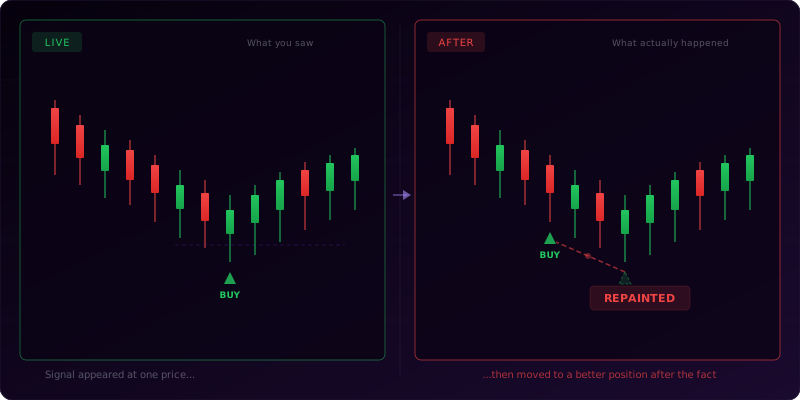
Here's how it works: the indicator generates buy and sell signals based on future price action. When you look at historical data, every signal looks perfect because the indicator already knows what happened next. It places the buy arrow at the exact bottom and the sell arrow at the exact top.
You see a chart covered in flawless entries, a win rate north of 90%, and marketing copy that promises consistent profits. You buy the indicator, start trading it live, and immediately realize the signals don't hold. An arrow appears, you enter the trade, and when you look back later, the arrow has moved or disappeared.
That's repainting. The indicator is showing you what would have worked if you had perfect information, not what you would have actually seen in real-time.
The easiest way to spot this: if the marketing shows a win rate above 80% with no mention of repainting, be extremely suspicious. Real trading doesn't produce 90% win rates unless you're risking far more than you stand to gain on each trade — meaning one loss wipes out many small winners.
How to verify: load the indicator on a live chart. Take a screenshot. Let a few candles close. Compare the screenshot to the current chart. If historical signals have changed, the indicator repaints.
We've covered what repainting is and how to detect it in detail, but the key point is this: if the developer doesn't explicitly state whether the indicator repaints, assume it does.
Legitimate indicators either (a) don't repaint at all, or (b) disclose exactly what repaints and why. If there's no disclosure, the developer is either ignorant or dishonest. Either way, don't buy.
2. Is There No Live Chart Proof?
Marketing screenshots are worthless. They prove nothing.
Any developer can scroll through historical data, find the three cleanest trades, take screenshots, and build a sales page around them. That doesn't mean the indicator works. It means the developer knows how to cherry-pick.
The red flag: the sales page is full of beautiful annotated screenshots showing perfect entries and exits, but there's no live chart proof. No forward testing. No real-time examples. No performance tracking over multiple weeks or months.
This is deliberate. Backtested screenshots let the developer control the narrative. They can exclude the losing trades. They can ignore the signals that would have been unclear in real-time. They can optimize settings for that specific chart and pretend those are the default settings.
Better signal: live chart examples. Video walkthroughs showing the indicator running in real-time. Performance data that spans multiple months, not just a single clean week.
Even better, look for developers who publish ongoing performance results. At GrandAlgo, we maintain a public performance page that tracks how our indicators hold up over time. Not cherry-picked screenshots, actual results across different market conditions.
If a developer can't or won't show you live proof, assume the indicator doesn't perform as advertised. Screenshots are not evidence.
3. Is Lifetime Access Offered With No Updates?
Lifetime access sounds like a great deal. Pay once, use forever. But in practice, it's often a trap.
Here's why: trading indicators need maintenance. TradingView updates its platform. Market conditions change. Bugs get discovered. Features need refinement. An indicator that isn't actively maintained becomes obsolete fast.
When a developer offers lifetime access with no clear update policy, it usually means one of two things. Either they plan to abandon the product after the initial sales rush, or they're going to release a "new version" six months later and charge you again.
The red flag: lifetime access with no mention of updates, no version history, and no active development roadmap.
Green flag: subscription models or lifetime access with a clear commitment to ongoing updates. Check the version history. Has the indicator been updated recently? Are updates frequent? Is there a changelog that shows what's being improved?
Active development is a signal that the developer actually uses the tool. If they're still refining it, it means they're still trading with it. If they've moved on, you shouldn't be buying in.
Also be wary of lifetime deals that are "ending soon." Artificial urgency is a classic sales tactic. If the deal is always ending soon, it's not actually a limited offer. It's just pressure.
4. Are Single-Formula Signals Marketed as "AI"?
The term "AI" has been bastardized to the point of meaninglessness in the indicator market. Developers slap "AI-powered" on anything with a moving average and call it innovation.
Real machine learning in trading indicators is rare and expensive to build. Most "AI" indicators are just traditional technical analysis with a marketing glow-up.
The red flag: an indicator marketed as "AI-powered" or "machine learning" with no explanation of how the AI actually works. No mention of what data it's trained on. No discussion of model architecture. Just vague promises of "advanced algorithms" and "proprietary technology."
This is almost always nonsense. The indicator is using RSI, MACD, or some combination of standard formulas. There's nothing wrong with that, but calling it AI is misleading.
What works: transparent methodology. Even if you're not a developer, you should be able to understand the basic logic behind the indicator. If the developer can't or won't explain how it works, that's a red flag.
Real AI-powered tools will explain what the model is doing, what data it's been trained on, and how it adapts over time. If the explanation is just "our proprietary AI finds high-probability setups," run.
Also consider: do you even need AI? Most profitable trading strategies are built on simple, repeatable patterns. Complexity is not an edge. If the indicator can't explain its logic in plain language, it's probably not as smart as it claims. We wrote a full breakdown of AI trading indicators: what's real and what's marketing if you want to dig deeper.
5. Is There No Refund Policy or Trial?
If a developer is confident their indicator works, they'll offer a refund policy or a trial period. If they're not confident, they won't.
The red flag: no refund policy, no trial, and no way to test the indicator before committing money.
This is a sign the developer knows the product doesn't deliver. They want your money upfront because they know you won't stay once you've actually used it.
How to verify: a clear refund policy, ideally 7-14 days. Or a free trial that lets you test the core functionality before paying.
At GrandAlgo, we offer a 7-day refund window because we know our tools work. If you test the indicator and it doesn't fit your strategy, you get your money back. No tricks, no fine print.
Be especially cautious of developers who lock you into annual subscriptions with no trial and no refund. That's not a business model. That's a cash grab.
Also check the refund terms. Some developers technically offer refunds but make the process so painful that no one actually gets their money back. Look for clear, simple language. If the refund policy requires you to submit trading logs, prove you followed the rules perfectly, or jump through hoops, it's designed to deny refunds, not grant them.
GrandAlgo
See these concepts automated on your charts
18 TradingView indicators — smart money, price action, supply/demand, and more.
6. Is the Social Proof Fake or Bought?
Social proof is powerful, which is why so many developers fake it.
Fake testimonials. Bought reviews on third-party sites. Bots inflating follower counts on social media. Screenshots of Discord or Telegram channels with thousands of members, most of whom are inactive or paid to join.
The red flag: glowing reviews with no specifics. Testimonials that sound like they were written by the same person. Five-star reviews posted on the same day. Social media accounts with high follower counts but low engagement.
How to spot fake reviews: look for details. Real reviews mention specific features, specific use cases, and specific challenges. "This indicator changed my life" is fake. "I use the order block feature on the 15-minute chart and it helps me avoid false breakouts" is real.
Check review dates. If 50 five-star reviews were posted in a single week and then nothing for months, they're fake.
Look at social media engagement. A developer with 10,000 followers and 15 likes per post has bought followers. Real audiences engage.
Also check third-party review sites carefully. Some sites accept paid reviews or allow developers to remove negative feedback. If every review on the site is five stars, the site isn't trustworthy.
The test: organic, detailed feedback. Real users mention both strengths and limitations. They describe how they use the tool, what works, and what doesn't. They post over time, not all at once.
Look for developers who engage with critical feedback instead of deleting it. If someone posts a negative review and the developer responds constructively, that's a good sign. If negative reviews mysteriously disappear, that's a red flag.
If you are specifically checking GrandAlgo before subscribing, use the GrandAlgo review for pricing, what is included, refund policy, and who the indicators are actually built for.
7. Does the Indicator Only Work on One Cherry-Picked Asset or Timeframe?
This is the most subtle red flag, but it's critical.
Some indicators are designed to work brilliantly on a single asset and timeframe, and the developer knows it. They test on EUR/USD daily, find a setup that looks great, and build the entire marketing around that one scenario.
You buy the indicator, try it on BTC/USD 15-minute, and it falls apart. The signals don't align. The logic doesn't translate. It's not broken, it's just optimized for a completely different context.
The red flag: marketing that only shows one asset or one timeframe. No mention of testing across different markets. No discussion of how the indicator adapts to different volatility regimes or market structures.
How to spot this: look at the examples. If every screenshot is SPY daily or BTC/USD 1-hour, ask yourself why. Did they test on other markets? If they did, why aren't they showing those results?
What to look for instead: examples across multiple assets and timeframes. Evidence that the indicator has been validated in different market conditions.
If you trade crypto and the marketing only shows forex examples, ask the developer directly: "Has this been tested on BTC? Can you show me an example?" If they can't, don't assume it will work.
Also be cautious of indicators marketed as "works on all markets, all timeframes." That's often just as misleading. No indicator works equally well everywhere. The best tools are honest about where they perform and where they don't.
If a developer says "this is optimized for trending markets on the 1-hour chart and up," that's useful. If they say "this works on everything," they probably haven't tested it properly.
What Does This Mean for You?
These red flags don't mean every indicator is a scam. They mean you need to be selective.
The best indicators are transparent, well-maintained, and honest about their limitations. They don't promise 90% win rates. They don't hide behind vague marketing. They don't lock you into non-refundable purchases.
Before you buy any indicator, ask yourself:
- Does this repaint? Has the developer disclosed it?
- Are there live chart examples, or just backtested screenshots?
- Is this actively maintained? When was the last update?
- Is the "AI" claim backed by real methodology, or is it just marketing?
- Is there a refund policy or trial?
- Are the reviews detailed and organic, or generic and fake?
- Has this been tested on my market and timeframe, or just cherry-picked examples?
If you can't answer these questions confidently, don't buy.
What Does a Better Counter-Example Look Like?
At GrandAlgo, we've built our entire approach around avoiding these red flags.
Our indicators don't repaint. We disclose this clearly and explain exactly how each signal is calculated.
We publish ongoing performance data, not cherry-picked screenshots. You can see how the indicators hold up across different markets and conditions.
We update regularly. Our indicators are actively maintained, with new features and refinements based on user feedback.
We don't claim AI when we're using traditional technical analysis. Our tools are built on Smart Money Concepts and confluence-based logic, and we explain how they work.
We offer a 7-day refund policy. If the indicators don't fit your strategy, you get your money back.
We don't buy reviews. The feedback you see is from real traders using the tools in real conditions.
And we test across multiple markets and timeframes. Our Smarter Money Suite, for example, works on forex, crypto, indices, and stocks, from the 5-minute chart to the daily.
This isn't a sales pitch. This is what transparency looks like. If other developers aren't doing this, ask yourself why.
Frequently Asked Questions
The biggest red flag is a vendor showing perfect historical signals or unrealistic win rates without live, non-repaint proof.
A trial or transparent refund policy is a strong trust signal because it lets traders test the tool in live conditions before committing.
No. Backtest screenshots can hide repainting, overfitting, cherry-picked assets, and unrealistic execution assumptions.
Look for real user history, live chart use, consistent feedback across channels, and reviews that mention both strengths and limitations.
A trustworthy indicator has clear logic, live examples, non-repaint testing, realistic claims, updates, support, and honest risk disclosures.
How Do You Avoid Getting Burned?
The indicator market is full of shortcuts, scams, and mediocrity. But if you know what to look for, you can avoid the worst of it.
Watch for repainting. Demand live proof, not just backtested screenshots. Check for active maintenance. Question AI claims. Look for refund policies. Verify social proof. Make sure the indicator works on your market and timeframe.
If a developer ticks all these boxes, they're probably legitimate. If they don't, move on.
Your goal isn't to find the perfect indicator. It's to find a tool that fits your strategy, works in your market, and doesn't lie to you. That's rarer than it should be, but it's not impossible.
Start by building a foundation with free tools like our position size calculator and trading journal. Then, when you're ready to invest in premium indicators, use this framework to evaluate your options.
Good tools exist. You just need to know how to separate them from the noise.


